

























































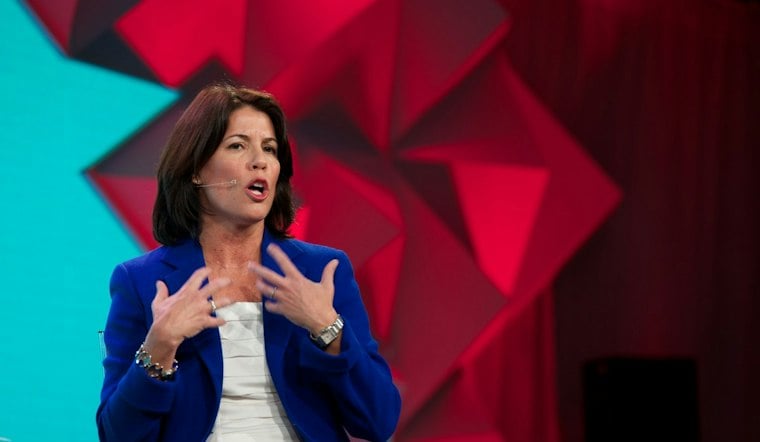
Rhode Island's three candidates for governor squared off at Rhode Island College Tuesday night in their second and final televised debate, trading pointed attacks over housing targets, a proposed $1.5 billion budget cut and Democrat Helena Foulkes's years running CVS's pharmacy business during the height of the opioid crisis. With early voting already underway and just two weeks left before the Nov. 3 election, it was likely the last big stage for Foulkes, Republican Aaron Guckian and independent Ken Block to make their case to Rhode Island voters.
The hourlong event, hosted by WPRI-TV 12, opened with an unscripted flare-up before the candidates even got to policy. According to The Providence Journal, Guckian called out Block’s notes, and Block ultimately put them away.
Housing Targets Split Sharply
Housing dominated much of the debate, and the three candidates offered starkly different numbers. Foulkes repeated her pledge to build 20,000 new housing units, a figure she says would be funded by revenue from the state's new millionaire's tax, according to WJAR. The Providence Journal reports she plans to replace existing borrowing and subsidy programs with a revolving fund financed by that same millionaire's tax.
Guckian, for his part, described a modular-home plan that would start with a veterans' housing village and a larger development near Quonset Business Park using federal assistance, per the Providence Journal, with the target potentially growing from 5,000 to 10,000 and then 15,000 homes over time. He also called for a “permitting czar” to cut through regulatory delays, the station's report notes. Block declined to commit to a specific target, saying estimates of the state's housing need range from 10,000 to 30,000 homes and that “we will build the units we need to have” if resources and community agreements allow, while proposing that the state acquire land jointly with municipalities and then bid it out for development.
WPRI's own debate recap frames the split differently, noting that Guckian described new construction increasing in “crescendo” increments of 5,000 units at a time, while Block again declined to offer a specific number, according to WPRI.
A $1.5 Billion Budget Fight
Guckian renewed his pledge to cut Rhode Island's state budget by 10%, a figure he and other outlets put at roughly $1.5 billion, and said per the Providence Journal that he would not seek reelection if he failed to hit that mark. He has also said he would work with frontline and union workers on budget savings.
Block pushed back hard on that number, calling $1.5 billion in unspecified savings unrealistic. He pointed instead to a possible statewide audit from the auditor general that could identify between $150 million and $250 million in misspending, according to WPRI. Block also recounted a conversation before he entered the race in which, according to Block, Guckian asked for his support; Guckian disputed that account. Foulkes and Block said they support giving the governor a line-item veto.
Tax Returns Remain a Sore Point
Block has still not released his personal tax returns, saying the filings would expose financial details about the multiple S-corporations he owns to competitors. Foulkes and her husband disclosed that they earned a combined adjusted gross income of $2,971,925 in 2025 and paid $176,305 in state taxes and $712,988 in federal taxes, according to the Providence Journal. Guckian has said he filed his returns by the Oct. 15 extension deadline and promised to release them publicly, though the newspaper's report noted the filings had not yet been made public as of its publication.
Foulkes Pressed on Her CVS Years
Foulkes, who led CVS's pharmacy business from 2014 to 2018, was questioned about the company's opioid sales and its federal settlement. CVS Health agreed on Oct. 13 to pay $315 million to resolve a federal lawsuit over its painkiller dispensing practices; the U.S. Department of Justice says the settlement required CVS to adopt additional safeguards so that prescriptions for opioids and other controlled substances would be dispensed only when medically appropriate, according to the U.S. Department of Justice.
Foulkes called the opioid situation complicated, per the Providence Journal. During the debate she also said that CVS cut opioid prescriptions by 40% and stopped filling prescriptions from 600 pill-mill doctors during her tenure, according to WJAR. Block used the moment to argue that Foulkes represents the same political machine that has produced decades of Rhode Island governors, the Providence Journal reports.
Polls Show Foulkes Ahead, Margins Vary
Foulkes entered the debate leading in the polls, though surveys cited in coverage differ on the size of her advantage. A Salve Regina University Pell Center poll released the morning of the debate showed Foulkes leading Block by 11 points and Guckian by 22 points, with Foulkes at 39%, Block at 28%, Guckian at 17% and 13% undecided, according to Salve Regina University. A separate WPRI-TV/Emerson College poll conducted earlier in October put Foulkes ahead of Block 44% to 35%, with Guckian at 10% and 9% undecided, per Emerson College Polling. A WPRI political analyst said after the debate that none of the candidates appeared to have moved public opinion.
Where They Agreed
Despite the sparring, the candidates found common ground on Flock automated license-plate readers: all three expressed concerns, but none called for shutting the cameras off. Foulkes said she supports Gov. McKee's proposed model guidelines for the technology.
On health care, Block proposed a regional insurance marketplace to lower costs, Guckian floated a loan-repayment program for medical providers, and Foulkes proposed sending trained experts into communities to help residents navigate health-care paperwork.



