

























































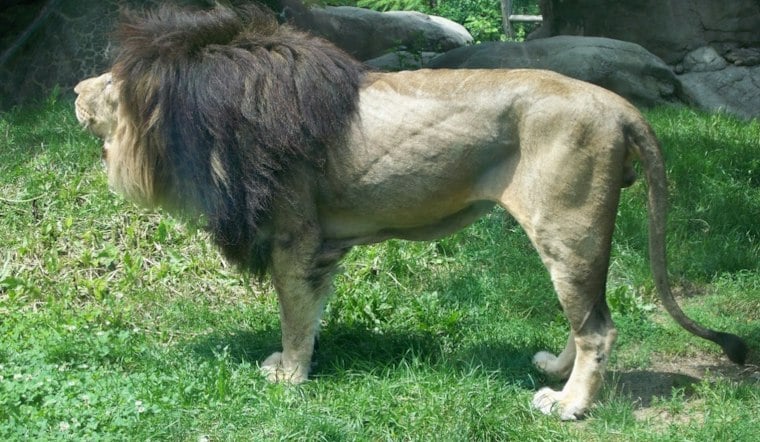
Dinari, the last living lion at Boston's Franklin Park Zoo, was euthanized this week following a steep decline in his health, zoo officials announced Thursday. The 17-year-old male had outlived the typical lion lifespan, but caregivers noticed him growing lethargic and losing his appetite in his final days, and blood work revealed signs of chronic renal failure.
Given his rapid decline and poor prognosis, zoo officials said a decision was made to humanely euthanize Dinari, according to Boston.com. Dinari's death leaves Franklin Park Zoo without a single lion for the first time in over a decade, and officials say the exhibit will sit empty, at least for now.
Sarah Patterson, an area curator at the zoo, said she and Dinari's care team were heartbroken over the loss. “Dinari's long life is a testament to the dedication and commitment” of those who looked after him, Patterson said, as reported by The Boston Globe. The Globe's account notes that caretakers found Dinari lethargic and lacking an appetite before the diagnosis emerged.
A Decade at Franklin Park, Cut Short by Age
Dinari moved to Franklin Park Zoo in 2015 alongside his brother and littermate, Kamaia, the Globe's reporting shows. The pair had become familiar fixtures of the zoo's lion habitat for more than ten years, outlasting what the National Zoo's aging-lion research describes as a geriatric threshold of 15 years, a mark at which kidney problems become a more serious concern for lions in captivity.
Kamaia did not get the chance to grow old alongside his brother. He was euthanized in 2023 at age 14 following a string of health problems, the same report notes. Kamaia had undergone surgery to remove an enlarged spleen after a bout of severe pneumonia and received a life-saving blood transfusion from Dinari himself before later needing hernia surgery, according to the Globe's earlier coverage of his decline.
Zoo officials have said the median life expectancy for lions is 16 years, per Boston.com's report, meaning Dinari's 17 years put him a notch past the typical mark. The Smithsonian's National Zoo, which treats lions over 15 as geriatric, says captive lions typically live between 16 and 22 years, a range that reflects how individual health can vary widely even among animals of similar age.
An Empty Exhibit, For Now
With Dinari gone, the lion habitat at Franklin Park Zoo will sit vacant, though officials say they hope to welcome new lions to the park in the future, per the Globe's reporting. No timeline, source zoo, or species detail for any future arrivals has been shared.
Franklin Park isn't the only New England habitat to go quiet this year. The last lion at Capron Park Zoo in Attleboro, a 20-year-old named Ramses, also died in 2026 after entering hospice care in August, the Globe noted in its coverage of Dinari's death. Farther south, Zoo Miami was left without any lions for the first time in nearly 20 years after its own last lion, 17-year-old Kwame, died following a long battle with chronic arthritis — a loss that came after his brother Jabari succumbed to the same condition, according to the Miami Herald. That zoo has since made initial plans through the Association of Zoos and Aquariums' Lion Species Survival Plan to bring lions back.
Dinari and Kamaia arrived in Boston together in 2015. For now, Franklin Park's own exhibit stands as a reminder of just how fragile that balance can be — even as zoo officials say wild lions have lost roughly 90 percent of their roaming territory and seen their population drop by nearly 75 percent over the past 50 years, underscoring why captive breeding programs matter to the species' future.



