

























































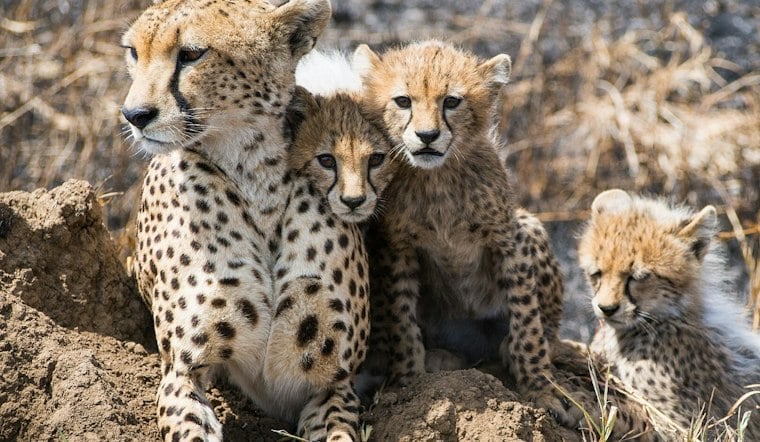
Five cheetah cubs are nursing and active at the Smithsonian's Conservation Biology Institute in Front Royal, Virginia, after first-time mother Zura gave birth on October 5. The 5-year-old cheetah delivered the litter at the institute's conservation campus, and zoo officials say the cubs are healthy and bonding with their mother.
The birth is the 21st cheetah litter born at the Smithsonian Conservation Biology Institute since its dedicated breeding program began in 2007, according to WUSA-TV. Cheetahs are notoriously difficult to breed in human care, which makes the program's nearly two-decade track record notable among conservation facilities. As reported by WTOP News, the Smithsonian's National Zoo and Conservation Biology Institute announced the births, and the cubs can now be viewed on the zoo's live cub cam feed.
Zura's cubs represent four living generations of the same cheetah lineage currently housed together at the Front Royal facility, according to Smithsonian Magazine. The newborns' great-grandmother, 16-year-old Sanurra, gave birth to grandmother Rosalie at the institute in 2015, and Rosalie in turn gave birth to Zura in 2021, the outlet notes. That kind of multi-generational continuity under one roof underscores just how long-term the institute's breeding success has been.
A Genetically Valuable Father With a Track Record
The cubs' father is 9-year-old Flash, whose lineage is considered genetically valuable to the North American managed cheetah population because it is underrepresented across accredited facilities, per Smithsonian Magazine. Flash has now fathered seven previous litters, and per WTOP, male cheetahs generally have little involvement in raising their young once cubs are born. His most recent litter before this one arrived in October 2025, when he fathered four cubs at Front Royal with another first-time mother, Amabala, who was herself born at the facility, according to Blizzard Watch. Amabala had also been part of the facility's first cheetah litter featured on the live cub cam back in 2020.
Pairing Flash with Zura reflects the scientific strategy behind the Association of Zoos and Aquariums' Cheetah Species Survival Plan, which uses genetic tracking across participating facilities to maximize diversity and prevent inbreeding. Adrienne Crosier, quoted by WTOP, said cheetahs are notoriously difficult to breed, and our team pours countless hours into each and every surviving cub. The National Zoo is part of a Cheetah Breeding Center Coalition that includes 10 centers across the United States working to sustain a healthy North American cheetah population, per the same account.
Why Front Royal Exists for Breeding Like This
The Smithsonian Conservation Biology Institute's campus spans 3,200 acres in Front Royal, roughly 60 miles from the main zoo in Washington, D.C., with off-exhibit, low-noise breeding grounds designed for species that need quiet conditions, according to the Smithsonian's National Zoo and Conservation Biology Institute. The sprawling property houses more than 20 endangered or threatened species away from public zoo crowds. Biologists there also regulate breeding schedules so litters arrive only between spring and early autumn, shielding vulnerable newborns from freezing winter conditions, a protocol Smithsonian Magazine has detailed in its coverage of the program; wild cheetahs in sub-Saharan Africa, by contrast, can breed year-round in warmer climates.
Newborn cheetah cubs are born blind and deaf with flattened ears, typically taking four to seven days to open their eyes and several more days before their ears stand up, per Smithsonian Magazine's reporting on the livestream. Zoo officials say they will keep a close watch on Zura and her cubs from afar for the next few weeks, mostly leaving them alone so they can bond without interference.
Why Every Surviving Litter Matters
Cheetahs are indigenous to sub-Saharan Africa, where the wild population has fallen to fewer than 7,000 animals, a decline that pushed the International Union for Conservation of Nature to classify the species as vulnerable to extinction, per WTOP. Human pressures, poaching, habitat loss and loss of prey all contribute to that vulnerability. Hoodline previously reported that up to 90% of wild cheetah cubs die before reaching maturity, largely due to predation from lions and hyenas, making successful captive births like Zura's litter a crucial buffer against further losses.
Wild cheetahs also face compressed lifespans of just 8 to 12 years due to habitat loss and poaching, while managed, captive cheetahs frequently live much longer, as shown by Zura's own 16-year-old great-grandmother, Sanurra. Biologists plan to keep the new cubs at Front Royal until at least their second birthday before deciding whether they will move to the public zoo in Washington, D.C., or to other partner breeding facilities, according to Washingtonian. Those placement decisions are governed by the Association of Zoos and Aquariums as part of the broader effort to keep the managed cheetah population genetically diverse for generations to come.





