

























































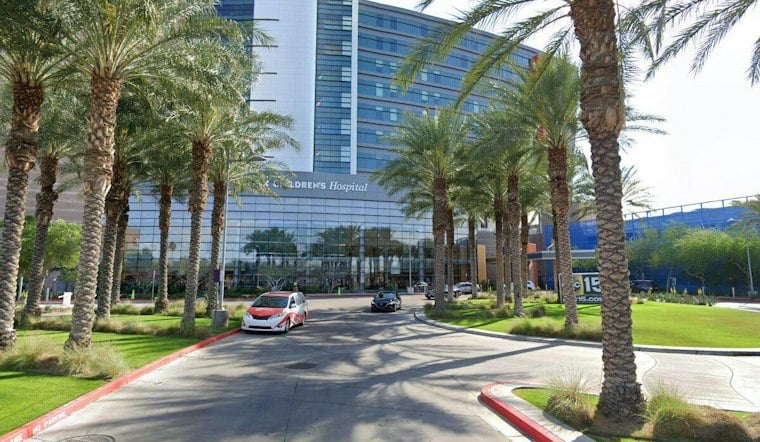
Arizona prosecutors say a man used a forged bank letter to redirect $12.8 million in state Medicaid payments intended for Phoenix Children's Hospital into a bank account he controlled, and as of publication he has not been arrested. A second, smaller scheme allegedly siphoned off more than $458,000 meant for Mayo Clinic Hospital in Phoenix, with that suspect now apprehended in Florida and awaiting return to Arizona.
The Arizona Attorney General's Office filed a direct complaint in Maricopa County Superior Court against Juan Carlos Da Cunha Tcachman, 56, who is charged with fraudulent schemes and artifices and theft of control of property, both Class 2 felonies, according to ABC15 Arizona. Prosecutors allege the scheme began in July 2026, when the Arizona Health Care Cost Containment System — the state's Medicaid program, known as AHCCCS — received a fax appearing to be a legitimate Wells Fargo letter claiming Phoenix Children's Hospital's bank account number had changed effective July 1, 2026.
How the Fraudulent Transfer Slipped Through
An AHCCCS employee approved the electronic funds transfer change after speaking by phone with a person identified only as Michelle, per the station's report. That single verification call opened the door for three payments of $4.29 million each to flow into the fraudulent account, and in total AHCCCS paid out $12,891,725.10 before the scheme was caught, though some funds were later recovered.
A financial review identified Tcachman as the account holder and signer, and investigators say he created the account using a District of Columbia passport. The fraudulent account saw multiple high-value withdrawals in both August and September 2026, the outlet reports.
Undercover Contact and Surveillance Images
Prosecutors made undercover contact with Tcachman on October 3, and he reportedly told them he handled one hundred percent of the account activity without any assistance. He said he expected payments from clients but claimed he did not know the money would come from a government source, and insisted he had no knowledge the deposits originated in Arizona — telling investigators the large incoming payments were tied to an investor he met online, per the same account.
Investigators reviewed Wells Fargo surveillance images showing cash withdrawals in Miami that followed the AHCCCS deposits, and they believe the person captured in those images matches Tcachman's passport photograph. The Arizona Attorney General's Office declined further comment, citing pending cases and ongoing investigations, while AHCCCS likewise declined to comment on pending or ongoing investigations, the article notes.
A Second Scheme Targeting Mayo Clinic
In a related but separate case, prosecutors charged 66-year-old Joao Luiz Malago with fraudulent schemes and artifices and theft of control of property. They allege Malago used forged bank letters and impersonated executive communications to redirect $458,407.08 in AHCCCS payments intended for Mayo Clinic. Mayo Clinic's Phoenix campus is a 368-bed acute care facility that announced a $1.9 billion “Bold. Forward. Unbound.” expansion in March 2025 to expand its clinical capacity, according to Mayo Clinic.
Arizona Attorney General's Office agents apprehended Malago in Florida, and he will be returned to Arizona to face charges. Federal court records reviewed by Monolithik show Malago was previously named in a 2012 Southern District of Florida federal indictment alleging money laundering and drug-trafficking conspiracy tied to a 2007 aircraft crash in Mexico. Prosecutors are seeking warrants in both cases, and both men are charged under Arizona statutes governing fraudulent schemes and theft.
Why the Charges Carry Mandatory Prison Time
Under Arizona Revised Statutes § 13-2310, fraudulent schemes and artifices is a Class 2 felony carrying a presumptive five-year prison sentence and up to 12.5 years for first-time offenders, according to the Arizona State Legislature. Crucially, when the value of the benefit obtained reaches $100,000 or more, state law mandates prison time and removes eligibility for probation or early release — a threshold both the $12.8 million and $458,000 figures in these cases clear many times over.
Separately, Arizona Revised Statutes § 13-1802 classifies theft of property valued at $25,000 or more as a Class 2 felony, while § 13-1801(B) allows prosecutors to aggregate amounts taken in thefts committed under one scheme or course of conduct, per the Tamou Law Group. The Tcachman case involved three separate payments of $4.29 million each.
Part of a Broader Medicaid Fraud Crackdown
The cases land amid a years-long statewide crackdown into an estimated $2.5 billion in alleged AHCCCS Medicaid fraud, which has produced more than 70 indictments and payment suspensions for roughly 100 healthcare providers, as Hoodline previously reported. AHCCCS covers nearly 1.8 million residents — about one in four Arizonans — with state general fund spending increases exceeding $113 million for the current fiscal year.
But this case marks a notable shift from recent high-profile prosecutions, which largely targeted behavioral health clinics billing for services never rendered. Instead, the Tcachman and Malago cases involve direct vendor banking redirection, compromising the payment accounts of two of Arizona's largest hospital systems rather than falsified treatment claims. Phoenix Children's Hospital, based at its 533-bed Thomas Campus, generated $1.73 billion in revenue in 2024, underscoring the stakes of a scheme that intercepted funds meant for its operations.
Just weeks before this case surfaced, state and federal prosecutors had filed other major AHCCCS billing fraud cases, including a September indictment of a Peoria man accused of billing AHCCCS $33 million for fake care. As of publication, Tcachman remains at large, leaving extradition and asset recovery as ongoing focal points in the investigation.




