

























































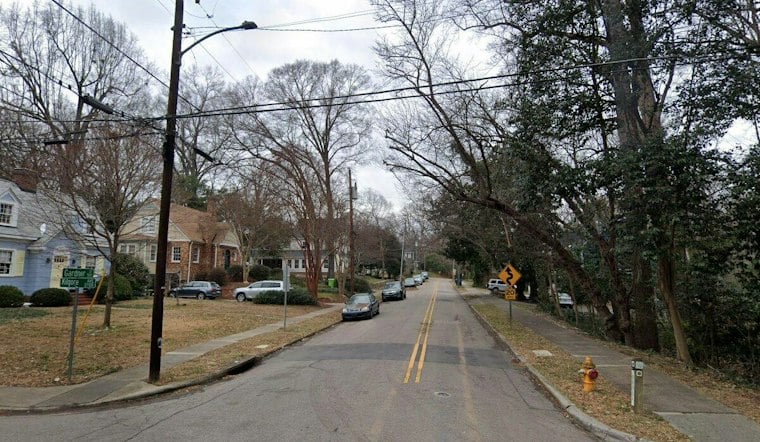
Christina Jepson says Gardner Street can feel like a racetrack on some days, with no speed bumps and no roundabouts to slow drivers weaving along the curved road between Hillsborough Street and Wade Avenue. She wants the city to install speed bumps, roundabouts, or additional stop signs before someone gets hurt, but a recent city traffic assessment found the street doesn't yet meet the numbers needed to qualify.
Jepson reached out about the lack of traffic controls on her street, a concern that prompted CBS 17 to raise residents' worries with the City of Raleigh in 2025. The city says Gardner Street makes it easy for drivers to speed, in Jepson's telling, but the station's report notes the city's own assessment found that 85 percent of vehicles traveled at or below 27 mph in a posted 25 mph zone — just 2 mph over the limit. Raleigh requires that 85th-percentile speed to exceed the posted limit by more than 7 mph before a street becomes eligible for traffic-calming devices like speed humps.
Why the Numbers Didn't Add Up
That 7 mph threshold isn't new policy invented for Gardner Street. According to Citizen Portal, the Raleigh City Council voted in March 2025 to raise the qualifying speed threshold for traffic-calming projects, a change that passed despite two dissenting votes. City staff also identified just one speed-related crash on Gardner Street over the preceding three years, short of the two crashes within three years the city requires for eligibility, per the same CBS 17 report.
Raleigh's Neighborhood Traffic Management Program also requires a residential street to hold a lowered speed limit of 25 or 30 mph for at least six months before it can even be formally evaluated for physical traffic-calming treatments, according to the city's NTMP policy document. That speed-limit reduction is framed as the most accessible first step in the city's broader safety framework — one it has applied widely, having lowered posted speed limits on 862 neighborhood streets covering more than 287 miles between 2015 and 2025, per city transportation data.
A Stop Sign, But Not for Speed
Jepson and a Gardner Street resident did get one win: an all-way stop at Gardner Street and Kilgore Avenue, installed after a traffic assessment found it was needed there, the CBS 17 report states. But that sign exists for intersection safety, not to slow traffic along the street itself. The Federal Highway Administration's Manual on Uniform Traffic Control Devices, which Raleigh follows, strictly prohibits using stop signs or yield signs for speed control, mandating that such signs be installed only based on traffic engineering warrants tied to intersection safety.
That federal rule explains the split outcome on Gardner Street: an all-way stop where engineers found a genuine intersection safety need, but no speed humps where the speed data fell short of the threshold.
Raleigh's Traffic-Calming Projects
As of September 2026, Raleigh had completed 100 traffic-calming projects spanning 60.97 miles of neighborhood streets, according to city transportation data.
When the work does happen, it appears to work. City data from September 2026 shows completed traffic-calming projects reduced average driver speeds by 8.4 mph, bringing post-project speeds within 1 mph of the posted limit. The city also notes that traffic patterns change over time, which is why Raleigh residents can request a new traffic assessment every 12 months — meaning Gardner Street's case isn't necessarily closed for good, even though its last evaluation came up short.
The city's Neighborhood Traffic Management Program policy was revised June 2, 2026. For now, Jepson says she simply doesn't want anyone hurt before real safety improvements arrive on Gardner Street — and under current policy, her next shot at making that case comes when the one-year waiting period for re-evaluation runs out.




