

























































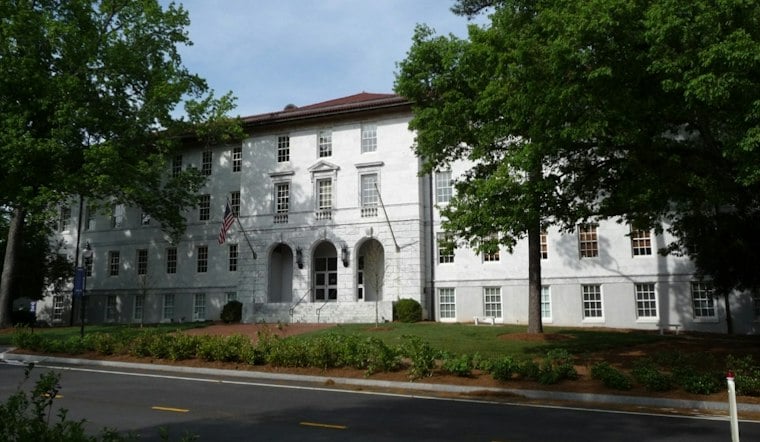
Georgia Tech and Emory University are together committing more than approximately $1.175 billion to artificial intelligence, with Georgia Tech investing more than $575 million overall across advanced computing, AI discovery, and workforce development, and Emory investing approximately $600 million overall, nearly half of which has gone toward recruiting and retaining talent. The investment includes a new supercomputer and efforts to push real-world AI applications into health care, business, and law.
According to CBS News Atlanta, the two universities say the funding will prepare students for the workforce, attract companies to the region, and accelerate research. Georgia Tech's portion includes a new Nexus supercomputer and additional Tech Square computing infrastructure, according to the Georgia Tech News Center, bringing the combined commitment to roughly $1.175 billion.
Nexus Supercomputer Goes National
Georgia Tech officially unveiled Nexus on Monday, a 400-petaflop AI supercomputer built with a $20 million National Science Foundation grant in partnership with the University of Illinois Urbana-Champaign. The machine is housed in Georgia Tech's Coda data center in Tech Square and marks the first national academic supercomputer hosted by the university, the school's news center reports.
At least 90 percent of Nexus's computing capacity will be allocated to researchers across the country through the NSF-supported ACCESS program and the National AI Research Resource, according to CBS News. That means scientists far outside Atlanta can apply through a peer-reviewed process to run data-intensive medical, robotics, and energy models remotely, turning the Tech Square machine into something closer to a national utility than a campus-only asset. Georgia Tech previously switched on a separate automated cloud lab in August, backed by an $18 million NSF grant, as Hoodline reported this past August.
Emory Bets on People, Not Just Processors
While Georgia Tech builds hardware, Emory is spending on people. Nearly half of the university's roughly $600 million investment has gone toward recruiting and retaining faculty for its AI.Humanity initiative, which brings together more than 250 faculty members across eight schools and colleges, according to a report on the investment. The initiative applies AI research to medicine, law, business, humanities, and ethics.
Emory's track record in at least one of those areas is already measurable. The university's AI.Health institute had generated three spinoff companies and 40 licensed technologies applying artificial intelligence to cancer and kidney disease treatment before this latest announcement, per the same report.
Business School and Corporate Dollars Join In
Emory's AI push extended into finance this week too. Emory's Goizueta Business School expanded its Center for AI in Finance by launching student fellowships and advisory partnerships with executives from JPMorganChase, BlackRock, and U.S. Bank, FOX 5 Atlanta reports. The center was originally established in fall 2025 under a former J.P. Morgan managing director to study portfolio allocation and AI auditing.
Spilling Into Statewide Workforce and Industry
The university investments align with the Georgia AIM initiative, which combines nearly $100 million in federal, state, and private funding to train workers and deploy AI technologies across regional manufacturing supply chains.
Georgia Tech's campus AI Makerspace already provides hands-on AI computing access and training to more than 6,000 students annually, giving students across disciplines practical experience with advanced GPU hardware. The two universities are also moving seven joint biomedical and medical research labs into Science Square, whose research tower is roughly 364,000 square feet and whose planned district build-out is about 1.8 million square feet, next to corporate facilities like Duracell's 83,000-square-foot global R&D center, Hoodline previously reported.
Taken together, the roughly $1.175 billion commitment reflects a division of labor: Georgia Tech supplying physical and cloud infrastructure anchored by Nexus and its AI Makerspace, Emory deploying human capital through faculty hiring across medicine, law, and business. That split feeds directly into Atlanta's broader ambition to become a top-five technology and entrepreneurship hub, a goal Hoodline detailed in its coverage of the recent Avant South summit. Whether outside startup founders can easily tap into Nexus through the ACCESS program, how many commercial spinouts eventually match Emory's 40-license benchmark, and whether regional employers actually hire the thousands of students trained through these programs remain open questions as the investment rolls out.





