

























































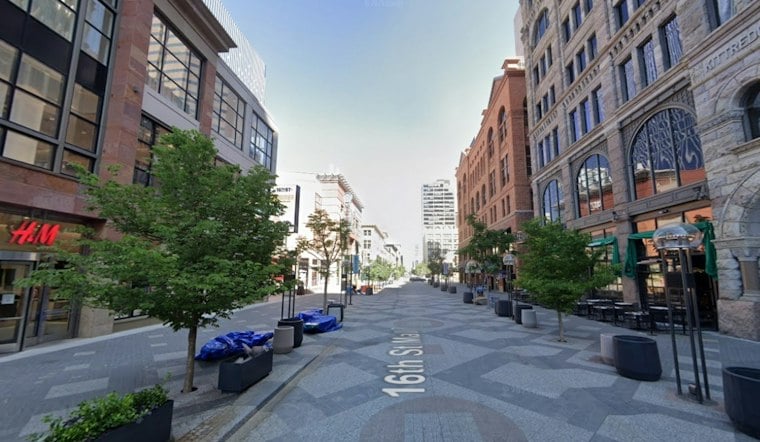
A 13-foot-tall inflatable structure built from overstock sail fabric is set to take over Glenarm Plaza at Denver Pavilions this weekend, offering free, senses-guided walkthroughs as part of its first-ever appearance in the United States. The installation, called “Oxímoron,” runs October 23 through 25 from 10 a.m. to 10 p.m. daily at 500 16th Street, admitting small groups of visitors into a billowing, air-pumped environment designed to surprise rather than explain itself.
The piece comes from Mexico City-based artists Pablo Kobayashi and Lucía Aumann, who have collaborated on art and design projects for seven years, according to The Denver Post. Both are architects by training who teach at the architecture school at Iberoamericana University, one of Mexico's leading private colleges, per the same report. Visitors enter in groups of up to 10, accompanied by on-site monitors who offer only limited instructions, and the experience inside can last anywhere from a few minutes to half an hour. Admission is free, though the Post notes organizers are asking people to register online in advance.
Its arrival is backed by more than just artistic ambition. The U.S. debut is presented by Southwest Airlines, with the Biennial of the Americas as sponsor. Biennial Culture Club members get first access with a members-only preview Friday from 5 to 6 p.m., according to the Biennial of the Americas, before the installation opens to the public with a street party on Glenarm Plaza featuring drinks from local venue Qué Rico.
An Opening Night With Food, Music and Kids' Activities
Kobayashi and Aumann will attend the opening event themselves on Friday from 6 to 10 p.m., per the Post's reporting, with food, drinks, live music and art activities for children rounding out the evening at Denver Pavilions. The Biennial of the Americas, a Denver-based nonprofit that encourages interaction and understanding across the Western Hemisphere, is sponsoring the installation as part of a broader slate of October programming. That lineup includes the Americas Leadership Luncheon at the Seawell Ballroom for more than 600 guests and public roundtables on downtown revitalization, according to the organization's event listings.
“Oxímoron” also lands alongside the “16 LIVE” event series, which features dance battles, silent discos and music events on the 16th Street Mall corridor.
From Sail Fabric to a Mexico City Boba Shop
The inflatable itself measures roughly 13 feet tall, 26 feet long and 13 feet wide, built from overstock sail fabrics in blue, red, orange, yellow and green that the artists acquired during a 2025 residency at Platform art center in Vaasa, Finland, where earlier versions of “Oxímoron” were installed at various sites, per the Post. Kobayashi, who holds a master's degree in Emerging Technologies and Design from the Architectural Association School of Architecture in London, leads Unidad de Protocolos, a Mexico City studio specializing in structural and geometric consulting whose work explores what it calls “analog programming” and pneumatic structures that blend digital modeling with physical material behavior.```
Other projects by the pair include Yoozoo, a sculptural light piece that used modulated light to evoke boba pearls in a boba tea shop, and Espectros, an installation in an optical boutique that used optometry tools to explore space and vision. In an interview with the Post, Kobayashi described their process as starting with materials that interest them and exploring the possibilities those materials offer. Aumann, who has also studied philosophy, and Kobayashi say they do not have one specific interpretation in mind for “Oxímoron.”
Before “Oxímoron,” Geoscope 2, a RUR Architecture/Reiser+Umemoto project, included inflatable design by Kobayashi/Unidad de Protocolos and Aumann among the fabrication team, according to the Sam Fox School of Design & Visual Arts. The first iteration was created for an exhibition at Princeton in 2020, and the second was shown at the 2021 Venice Architecture Biennale. The Biennale iteration was a pneumatic spherical multimedia environment, with the sphere split open and content projected over 42 individual faces.
Why Denver Pavilions Needs the Foot Traffic
The installation arrives as the Denver Downtown Development Authority undertakes a major investment in the Denver Pavilions. The authority bought the shopping center for $37 million in late 2025, paid an additional $8 million for operations and maintenance, and acquired two adjacent parking lots for $23 million, according to Denverite. The $45 million Pavilions investment was separate from the $23 million parking-lot purchase.
The investment follows the completion in late 2025 of a three-and-a-half-year, more than $175 million overhaul of the 13-block 16th Street Mall. The project sought to address storefront vacancies and declining pedestrian activity that affected the corridor during and after the pandemic. City and county officials have described the rebuilt mall as a foundation for bringing people back downtown; new tenants, including fast-casual Benihana Express, have also signed on as part of the recovery effort, as Hoodline previously reported.
Longer term, the Pavilions' future looks very different from its current footprint. In April, a 10-person Urban Land Institute advisory panel recommended demolishing parts of Denver Pavilions, turning the parking lots behind the mall into a public plaza and building residential towers, per the Colorado Sun. The panel proposed retaining the cinema building for retail, restaurants and performance space, and cited Bryant Park as an example of plaza-centered redevelopment. For now, though, the block's immediate future is a free, air-filled sculpture asking visitors to let their senses lead the way.





