

























































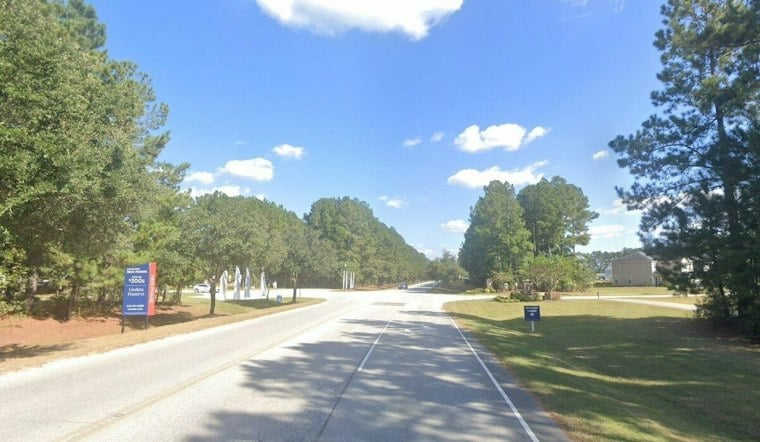
An 8-year-old boy was riding his bike home from Cane Bay Elementary School along the Cane Bay Trail in Summerville on Oct. 14 when a golf cart slammed into him and the driver kept going. Leo VanOsdol was left with scrapes and bruises, and the front tire of his bicycle was bent completely out of shape. His mother, Meaghan VanOsdol, says she is now determined to find the woman behind the wheel and to force a reckoning over golf-cart safety in the fast-growing community.
According to Live 5 News, the driver did not stop after hitting Leo, and several other people driving by reportedly swerved around the injured boy rather than stopping to help. It was not until another woman pulled over, helped Leo and called 911 that he got assistance. VanOsdol says she is now on a mission to track down the driver who hit her son and left him on the trail.
VanOsdol says leaving a child injured on the pavement is simply unacceptable, and she has been publicly asking the community for help identifying the woman. She posted about the crash in a local community group, and the response was immediate: neighbors rallied to help buy Leo a new bicycle while also throwing their support behind her broader push for change on the trail.
Why No Charges Were Filed
VanOsdol says first responders and law enforcement officials told her they could not file charges in the case because the Cane Bay Trail is considered private property and a golf cart is not classified as an automobile. That explanation has only deepened her concern about what she calls a lack of protection for kids traveling to and from school on the trail, and it has fueled her push for more signage and greater community awareness of golf-cart dangers in the area.
South Carolina law does treat golf carts operated on public roads as motor vehicles that can trigger criminal charges and civil liability, but that framework applies specifically to public roadways rather than private trails. State rules, outlined by the South Carolina Department of Public Safety, require golf carts on public roads to be insured, permitted and registered with the Department of Motor Vehicles, with drivers carrying proof of registration and liability insurance. Those carts are generally restricted to roads with speed limits of 35 mph or less, a four-mile radius of the registered address, and daylight hours unless properly equipped with headlights and taillights.
Separately, under the South Carolina Code of Laws, children under 12 must wear a fastened seat belt when a golf cart is driven on public streets and highways. The code also spells out that any driver involved in a crash causing injury or death must immediately stop at the scene or as close to it as possible — though VanOsdol says that duty was explained to her as not applying on the private Cane Bay Trail.
A Neighbor's Years-Long Warning
Melissa Hunt, who stopped to help Leo after spotting him injured while out following her kindergartener on a bicycle, has been sounding the alarm on golf-cart safety for years. She described the current conditions as the “wild, wild west” of golf carts, telling Live 5 News that with so many carts now functioning as a viable mode of transportation in the area, there needs to be real regulations and laws. Hunt says carts routinely take the right-of-way at crosswalks, which forces children to cross outside the marked zones to avoid them.
Hunt has suggested widening the trail to physically separate walkers and runners from golf-cart traffic, noting that newer sections of Nexton and Cane Bay have already added wider paths. She acknowledges golf carts cut down on local car traffic and can carry environmental benefits, but argues the growth of the area demands stronger rules to match. Cane Bay is marketed by developers as a golf-cart-friendly community, and VanOsdol says that branding comes with a responsibility to make the area safe for children, walkers, joggers, bikers and cart drivers alike.
VanOsdol has proposed treating the stretch of trail near the elementary school like an actual school zone, floating ideas such as speed bumps, added signage or active monitoring. Growth across Berkeley County communities including Cane Bay and Nexton has brought more residents, more traffic and more low-speed vehicles onto shared roads and paths, according to the Golf Car News. Under Berkeley County rules, carts must be registered and permitted through the DMV, carry liability insurance, and be driven only by someone at least 16 years old with a valid license.
A Regional Pattern of Rising Injuries
Leo's case lands amid what medical researchers describe as a broader rise in golf-cart injuries among children in the Charleston region. Golf-cart-related pediatric injury cases at the Medical University of South Carolina climbed from four in 2019 to a high of 19 in 2023, before dipping slightly to 17 in 2024, according to the Post and Courier. Mary Beth Vassy, a pediatric trauma injury prevention coordinator at MUSC, said the community has seen a pretty large increase in such injuries.
MUSC officials also identify head trauma as one of the more consistent golf-cart-related injuries seen among children, and a 2025 study cited in the same report found that about half of all child and adolescent golf-cart injuries involved kids under 12, with roughly 90 percent involving boys. South Carolina does not track pediatric golf-cart injuries statewide, so the true scope of the problem remains unclear. Charleston Moves executive director Katie Zimmerman has argued that golf carts simply do not belong on mixed-use pedestrian paths, since pedestrians, cyclists and runners already have limited safe space to share.
The pattern isn't confined to Berkeley County. Fire officials in Bluffton say they have been responding to more golf-cart crashes and related injuries as cart use climbs, per WTOC. That city passed a golf-cart safety ordinance in January requiring seat belts and working lights while limiting carts to roads with speed limits of 35 mph or less, though officials say it's still too early to know whether the rules have actually cut down on crashes.
For now, VanOsdol's focus remains close to home: finding the driver who hit her son and pushing Cane Bay to treat the trail outside its elementary school with the urgency of a school zone. Her campaign has already pulled in neighbors eager to replace Leo's mangled bicycle and back her call for signage, slower speeds and real oversight along a path thousands of families use every day.





