

























































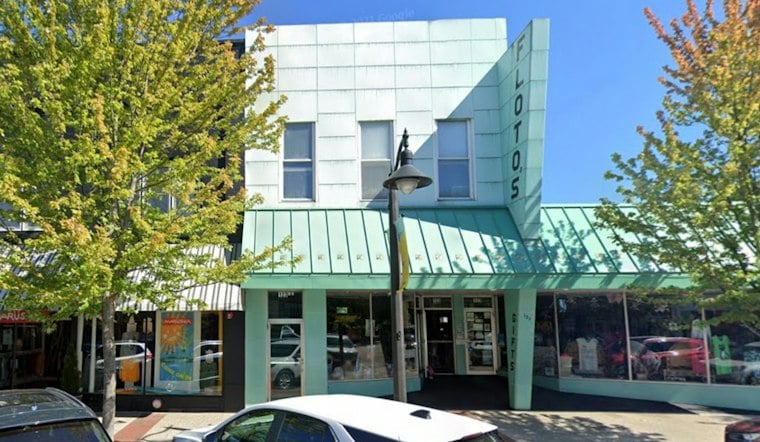
The long-vacant Floto's Gifts building in downtown Grand Haven is getting a new life, with plans for a ground-floor seafood restaurant, three two-bedroom apartments on the second level and a shared rooftop patio for tenants. The project at 123 Washington Ave. just picked up a $390,000 state grant to help make it happen.
The performance-based grant comes from the Michigan Community Revitalization Program, according to michiganbusiness.org, which also reports the redevelopment carries a total anticipated capital investment of $2,287,144. Property owner and developer Andrew Todtz is leading the project, per the same release. Separately, WOOD TV8 reports the commercial space would be a casual, beach-themed seafood restaurant, and describes the overall project cost as just under $2.3 million.
Project cost figures have varied across coverage of the redevelopment. WGHN has referred to it as a long-debated $1.99 million redevelopment plan, while Crain's Grand Rapids Business put the developers' planned investment at $2 million. The state's own release lists the highest and most detailed figure, at $2,287,144.
Financing Fight Over Brownfield Incentives
Beyond the state grant, Todtz is pursuing $589,800 in Housing Brownfield Tax Increment Financing through the Michigan State Housing Development Authority, with $305,293 of that anticipated to come from local tax increment revenues, according to michiganbusiness.org. That financing followed a contentious vote at the local level: the Grand Haven City Council approved a revised Brownfield TIF package in a 3-2 vote, WGHN reported.
The revised plan removed an Obsolete Property Rehabilitation Act tax abatement that had been part of earlier discussions and shortened the TIF reimbursement window from 25 years to 19 years or less, per WGHN's reporting. Reimbursement under the approved package is scheduled to begin in 2027. The building's contamination issues have also factored into the project's scope, with WOOD TV8 reporting that developer Marci De Vries told the City Council, “Floto's has a lot of contamination issues.”
A Downtown Storefront's Second Act
Records cited by WOOD TV8 show an LLC registered to Todtz purchased the Floto's Gifts property in 2025 for $687,000. As originally reported by the Grand Haven Tribune, the state grant is intended to help rehabilitate the building and offset significant rehabilitation costs tied to converting the structure into mixed-use space.
The vision for the finished building includes new commercial space on the first floor alongside three two-bedroom apartments on the second floor, plus a shared rooftop patio for tenant use — details confirmed by michiganbusiness.org. Ottawa News Network frames the project similarly, describing a new restaurant on the first floor, three two-bedroom apartments on the second level, and a shared rooftop patio for tenants.
Part of a Statewide Pattern
The Grand Haven award is one piece of a broader state push pairing downtown housing with commercial revitalization. Michigan's Revitalization and Placemaking program, which provides gap financing for place-based infrastructure and real estate rehabilitation, has backed similar conversions elsewhere, according to MLive. In Port Huron, a $2 million RAP grant is supporting conversion of the vacant Fead Building into 26 apartments and commercial space, a project expected to generate more than $7 million in total capital investment, per MLive's reporting.
MLive also reported that a $680,000 RAP grant is helping fund a similar first-floor-commercial, three-apartment conversion in Owosso, expected to generate about $1.4 million in capital investment. And in the Upper Peninsula, a $3.67 million redevelopment anchored by a $1.1 million RAP grant will restore two long-vacant historic buildings in Calumet into commercial space and workforce housing for households earning 50% to 100% of area median income, according to Ottawa News Network.





