

























































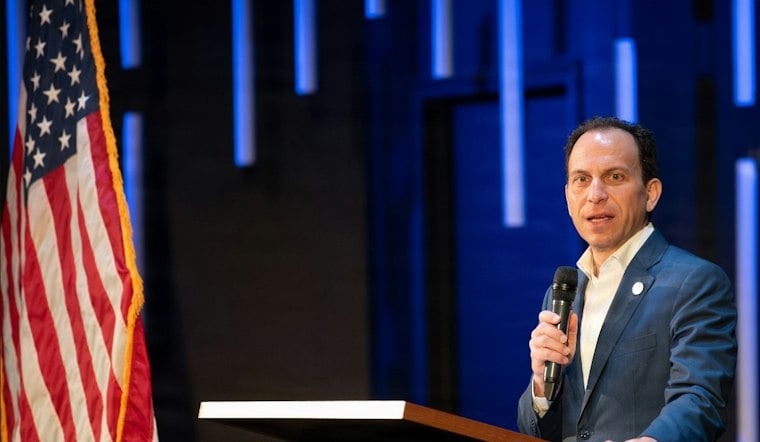
Louisville Mayor Craig Greenberg and Metro Councilmember Shameka Parrish-Wright faced off Saturday night in a debate covering crime, housing, data centers and artificial intelligence, giving voters a side-by-side look at the two candidates just over a week before the Nov. 3 general election. The two are the only candidates on the ballot for mayor, and because Louisville is holding its first nonpartisan elections under the merged government, neither will appear with a party label when residents vote.
Crime, Policing and a Budget Boost Take Center Stage
According to WLKY, the station's question-by-question breakdown of the debate asked each candidate to detail a public-safety strategy for addressing both violent and property crime in Louisville. Candidates were also pressed on what level of funding the Louisville Metro Police Department actually needs and what results they would expect to see after the recently passed budget increased LMPD's funding, the station reported. That increase follows a pattern from the city's FY25 budget, which allocated $242 million to LMPD — a $20 million jump from the prior year — at a time when the department was short 260 officers, per WLKY's earlier reporting on that budget.
The debate also dug into youth violence, asking what prevention programs or services each candidate would expand and whether reopening the youth detention center would help curb it, per the station's breakdown. The question arrives against a backdrop of recent improvement: fatal and non-fatal shootings involving children and teens 17 and younger are down 46% year to date in 2026 compared with the same period last year, WLKY has reported separately, with 16 children shot or killed so far this year compared with 29 in 2025 and 43 in 2024. The city's Community Violence Intervention program has reported a 36% year-to-date reduction in violence across six targeted neighborhoods, versus an 11% reduction citywide, according to that same WLKY report.
Data Centers and AI Oversight Emerge as Flashpoints
Beyond crime, the debate turned to one of the more contentious local issues of the year: data centers. WLKY's breakdown noted that candidates were asked whether Louisville should impose additional restrictions on where data centers can be built, and whether tax incentives or public assistance for such projects should come with guaranteed public benefits. The topic has already produced sharper daylight between the two candidates in other recent coverage. Per kentucky.com, Greenberg said he proposed regulations to ban hyperscale data centers, protect utility customers from subsidizing data center electricity and water usage, and strengthen neighborhood and environmental protections. Parrish-Wright, in the same voter guide, said she does not support hyperscale data centers of any size in Louisville or Kentucky and would not prioritize revenue over residents, neighborhoods, water, the energy grid or the environment.
Both candidates have backed the temporary moratorium currently blocking new data-center development, the outlet reported, a policy Louisville Metro Council put in place by approving a halt on rezoning, conditional-use permits, and certain development-plan applications tied to telecommunication hotels and data centers, according to Louisville Metro Government. Separately, the WLKY debate also asked about the broader role of artificial intelligence inside metro government, specifically whether residents should be told when AI is being used to make or inform a decision about them.
Housing Deficit and Transit Funding Also on the Table
Housing dominated another stretch of the hour-long forum, which Spectrum News 1 reported was held at Vincenzo's in downtown Louisville. WLKY's breakdown noted that Louisville continues to face an affordable housing deficit, and candidates were asked what steps they would take to increase housing supply across income ranges and neighborhoods, as well as how to reduce housing barriers for homeless residents. Greenberg, who was elected on a promise to build 15,000 affordable homes under his My Louisville Home strategy, pointed to that pledge during a related forum, according to Spectrum News 1's account; the debate moderator in that setting characterized his administration as having built roughly half of that total so far. Greenberg also said at the time that the city had reduced homelessness by 20% in just one year.
Parrish-Wright, in that same Spectrum News 1 coverage, emphasized equitable development. Existing initiatives have housed more than 400 people in less time. The FY25 city budget had set aside $25 million total for affordable housing, including $15 million for the Louisville Affordable Housing Trust, the station reported previously. WLKY's debate breakdown noted that transit riders are feeling their own squeeze, too: TARC faces ongoing funding pressures, and candidates were asked how they would ensure service keeps reaching transit-dependent residents, including those in underserved neighborhoods.
NuLu Growth, Downtown and a Full Slate of 19 Topics
The debate used Louisville's NuLu neighborhood, which has seen substantial recent growth, as a reference point for a question about replicating that momentum in south and west Louisville, per WLKY. Candidates were also asked how to improve downtown Louisville's business core and how the mayor's office can better support Jefferson County Public Schools graduates staying in the metro area after graduation. In all, the debate spanned 20 sections, from opening statements to closing statements, according to the station's breakdown, touching on topics ranging from a city-government issue each candidate felt received too much or too little attention to their single highest-priority infrastructure project for the next four years and how they would pay for it.
Other questions asked candidates to identify changes they would make to increase metro government transparency and accountability, to name their greatest accomplishment as public servants, and to explain in their closing remarks what makes them the better choice for Louisville mayor. WLKY framed the full breakdown as a resource to help voters find answers before heading to the polls for the Nov. 3 election, when Greenberg and Parrish-Wright will face off without party labels on the ballot.





