

























































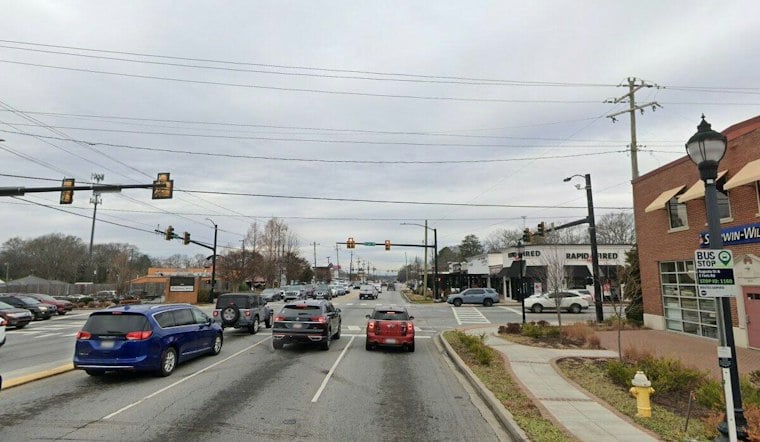
Overnight construction crews roll onto Augusta Street Monday, kicking off what city leaders call the largest and most complex utility undergrounding project in Greenville's history. Power and communication lines along more than six blocks of the busy commercial corridor will be moved underground, with utility poles and overhead wires removed in the process. City leaders expect the work to take about a year, wrapping up in fall 2027.
The $8.33 million project is funded through a combination of Duke Energy contributions, money from the state of South Carolina, and Greenville's own city utility underground fund, according to WSPA 7News. Augusta Street has been the city's designated top-priority corridor for overhead utility burial since Greenville first established its municipal undergrounding program back in 2009, according to the Greenville Journal. The city council formally authorized the funding package during its September 14 meeting, according to a city announcement shared on Facebook.
Clint Link, director of engineering services for the City of Greenville, said most of the construction will happen in the middle of Augusta Street, where crews will excavate the roadway and install a duct bank system to support the new underground lines. That work will also extend into sidewalks and side streets, and contractors will install transformers and switchgear components as part of the buildout. Duke Energy is partnering with the city on the project, and the utility says it will follow normal processes to keep existing power lines functional and operational throughout construction, so residents should not expect service interruptions.
Two Phases, One Busy Corridor
The project is split into two construction phases. Phase 1 runs from Lupo Street south to Melville Avenue, while Phase 2 covers commercial areas near Faris Road and residential stretches near Mauldin Road. Road access will remain open to businesses along the impacted streets throughout construction, and Augusta Street will be resurfaced once the burial work wraps up, with contractors also installing 36 new pedestrian and street lights.
The corridor carries roughly 20,000 vehicles a day, according to the City of Greenville, which is why engineers scheduled all Phase 1 road excavation overnight between 7 p.m. and 7 a.m., with nightly detours marked by signs. Project leaders are asking commuters to be patient and give crews room to work as the nightly closures roll through the neighborhood.
Poles Inches From Traffic Have Long Worried Residents
The push to bury the lines isn't just about storm resilience — it's also a response to a corridor where utility poles sit inches away from travel lanes, creating visibility issues for pedestrians on sidewalks and while crossing the street. Vehicles have clipped those poles with their side mirrors for years, and a local road safety audit found 11 vehicle collisions with utility poles along Augusta Street between 2016 and 2020, per the Greenville Journal's reporting. Statewide, South Carolina recorded 1,410 vehicle collisions involving utility poles in 2023 alone, resulting in 23 deaths and 32 serious injuries, according to Hoodline's prior reporting.
City councilmember Wil Brasington has pointed to the project as a way to improve both power reliability and safety at once, since underground lines reduce hazards to the power grid and delivery system while also improving sightlines and aesthetics along the street. Greenville has already buried lines along Haywood Road and the streets surrounding Unity Park, and city leaders say community feedback after those earlier projects was positive.
A Costly Fix With Deep Roots in Storm History
Burying lines is expensive work. Utility industry estimates show that undergrounding electrical distribution lines costs three to four times more than installing them overhead, while burying high-voltage transmission lines can run up to 10 times as much, according to the Post and Courier. That cost calculus has taken on new urgency since Hurricane Helene knocked out power to more than 1 million utility customers across South Carolina in late September 2024, reigniting statewide debate over grid resilience.
Greenville's own Utility Undergrounding Fund dates back to 2010, created in the aftermath of a severe 2005 ice storm. It allocates roughly $1.2 million annually from Duke Energy franchise fees, split 80 percent toward commercial corridors and 20 percent toward residential areas. In February 2025, the city council tapped that fund for $345,000 to bury aerial utility line crossings along Augusta Street's residential stretch, laying groundwork for the larger commercial-corridor project now underway.
Civil contractor Carolina Conduit Systems has been selected to install the concrete-encased underground duct bank along the road right-of-way, with that work scheduled to run through mid-summer 2027 before Duke Energy and telecom providers begin relocating lines and removing the physical poles. Until then, drivers along Augusta Street should expect nightly detours and gradual changes to the corridor as Greenville works to finally clear its poles from the roadside for good.



