

























































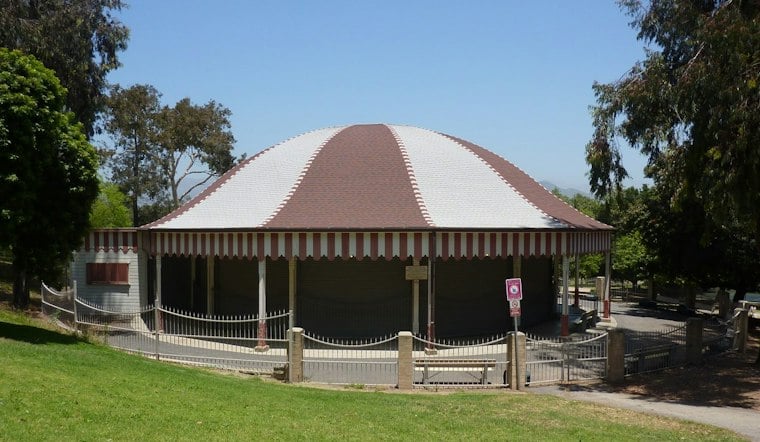
Griffith Park's beloved merry-go-round turned 100 years old in 2026, but the hand-carved horses have sat frozen in place since the pandemic shuttered the ride, save for a brief limited reopening in 2022. Now, with the City of Los Angeles owning the carousel outright, a small team of volunteers — including engineers from Walt Disney Imagineering — is trying to figure out exactly what it will take to make it spin again.
Leading the effort for the city is Tracy James of the Department of Recreation and Parks, who focuses on Griffith Park and is helping guide the refurbishment plans, according to the Los Angeles Times. The newspaper reports the restoration is expected to take at least two years and cost millions of dollars, a price tag James herself estimates at more than $3 million or $4 million. A full restoration assessment is expected in the coming weeks, the Times reports.
The scale of the challenge comes down to age and neglect in equal measure. The ride's 1920s-era paint contains lead that must be stripped away, and the wooden horses have developed small fractures in their joints over the decades, per the Times. The restoration plan calls for repairing worn wood, restoring faded carving lines, making the carousel ADA accessible, and installing modern controls to smooth out a ride that currently travels at 14 mph but can reach 25 mph.
Disney Veterans Donate Their Expertise
Some of the volunteers working on the project are veterans of the theme park industry, the Times reports, including Kurt Sawitskas of Walt Disney Imagineering, who analyzed the carousel's mechanisms and overall condition and recruited ride engineers Troy Leverton and Pim Renting to join the effort. None of the volunteers are being paid for their time, according to the newspaper.
Once the assessment is complete, fundraising will fall to Friends of Griffith Park, the nonprofit tasked with raising the private dollars needed to supplement the city's investment, the Times reports. James told the newspaper she plans to host open houses on as many Saturdays as possible while the work moves forward, giving Angelenos a chance to see the carousel up close even while it remains out of commission.
The city's ownership of the ride itself only became possible after a long and painful chapter in the carousel's history. Co-owner Julio Gosdinski, a Peruvian immigrant who began working at the carousel at age 16 and was gifted a 50 percent ownership stake in 2011, died unexpectedly in August 2020 at age 49, according to LAist. His death left his half-share tied up in probate court for years, stalling any path toward reopening or sale.
A $1 Million Deal Ends Years of Limbo
That limbo ended on August 21, 2025, when the Los Angeles Board of Recreation and Parks Commissioners formally approved a $1 million acquisition of the carousel from Gosdinski's estate, according to the Los Angeles Department of Recreation and Parks.
The carousel's story stretches back a full century before that sale. Built in 1926 by Spillman Engineering Co., the ride began its life in San Diego before being relocated to Los Angeles in 1937, per the Times. It includes horses carved by Charles Looff and Charles Carmel, decorated with jewels and real horsehair tails — originally 68 of them, though 66 wooden horses remain on the ride today. One original horse now resides at Disneyland, and another is reportedly held by a former owner, according to the Times.
Three of those horses carry an even more unlikely history: they originally belonged to a sister 1924 Spillman carousel at Lincoln Park in Los Angeles, and survived a fire that destroyed that ride in August 1976 before being salvaged and worked into the Griffith Park carousel, according to Atlas Obscura.
The Ride That Inspired Walt Disney
Walt Disney visited the Griffith Park carousel with his daughters, and the ride is often credited with sparking his idea for a family amusement park, according to the Times. Disneyland's own King Arthur Carousel dates to the 1920s, and Disney reportedly requested modifications to it, including making all of its animals jumpers, unlike the stationary rows typical of older carousels.
The Disney connection even extends to the furniture. When the city replaced Griffith Park's original wooden benches with concrete seating, carousel management salvaged three original benches from the Walt Disney era — sending one to the Walt Disney Family Museum in San Francisco, another to the lobby of the Great Moments with Mr. Lincoln attraction at Disneyland, and keeping the third at the ride itself, according to Attractions Magazine.
The carousel grounds have also served as a stage for Los Angeles social history well beyond Disney nostalgia. The Los Angeles Times has recounted civil-rights actions at the carousel. The surrounding lawns hosted hippie love-ins throughout the 1960s and, according to the Los Angeles Conservancy
, were the site of Los Angeles's first Gay-In rally on Memorial Day in 1968 — a year before the Stonewall riots in New York.
Personal Memories Tied to the Ride
For longtime visitors, the carousel carries memories far more personal than its civic history. Wendy Osmundson rode the merry-go-round with her three sisters after her mother's kitchen burned, she told the Times, a small act of normalcy amid a household crisis. It's the kind of story James and the restoration volunteers hope to preserve as they plot a path back to operation.
The carousel has also been immortalized in film and television, according to Nice News.
For now, the carousel remains closed, its fate resting on an assessment still weeks away and a fundraising campaign that hasn't yet begun in earnest. But with the city's ownership secured and a volunteer brain trust of ride engineers already at work, supporters say the hundred-year-old ride finally has a real shot at spinning again.





