

























































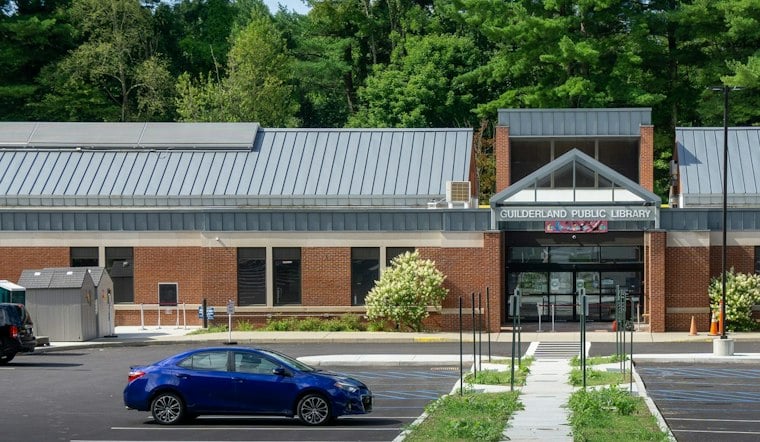
Guilderland's town board has adopted a local law rezoning two parcels on Mercy Care Lane to make way for a 72-unit affordable and workforce housing complex near the town's public library. The Oct. 20 vote changes the zoning on 6 and 10 Mercy Care Lane, about 10.71 acres, from single-family residential R15 to a Planned Unit Development district, clearing a key hurdle for developer Rockabill after more than a year of local review.
The rezoning covers land described in the new law as sitting within a designated hamlet mixed-use area, close to infrastructure, commercial nodes and civic uses, according to The Altamont Enterprise. The project already has preliminary site-plan approval from the planning board, and the newly adopted zoning caps building height at 36 feet. Town officials say the law is consistent with Guilderland's 2025 comprehensive plan and its pro-housing community pledge.
Under the plan, Rockabill's project would mix 80 percent affordable units, targeting households earning 30 to 60 percent of area median income, with 20 percent workforce units aimed at households earning 80 percent of area median income. The building layout calls for two three-story buildings with 20 units each, one three-story building with 24 units, and two two-story townhouse buildings with four units each.
Fees, Sidewalks and a Three-Year Clock
Before building permits can be issued, Rockabill must pay a parkland assessment of $2,200 per townhome unit and $1,200 per multifamily unit, along with applicable water and sewer connection fees. The zoning law also requires a sidewalk along Mercy Care Lane running from the project site to Winding Brook Drive.
The law carries a built-in expiration: if an active building permit is not issued within three years of its effective date, the parcels revert to single-family zoning. The town board may grant a one-year extension to that deadline. Separately, the board previously granted Rockabill an exception to its moratorium on certain residential development so the company could pursue state funding.
A Funding Deadline That Shaped the Timeline
Much of the urgency behind this fall's votes traces back to Rockabill's financing needs. Principal P. Christopher Dirr told the town board the project depended on securing financing through New York State Homes and Community Renewal's annual 9-percent tax-credit round, and that the earliest construction could begin, if funding came through, was July 2026, as reporting from the same outlet detailed. By August, Dirr told the board the project was aimed at the 2026 HCR funding round, with applications due in early September, and he later specified his funding deadline with the state agency as Sept. 10.
That same reporting noted the board in July chose to proceed with traditional environmental review rather than use the town's newer streamlined process, and unanimously voted to defer the SEQR Type II determination while scheduling a site-plan hearing for Aug. 18. Dirr said a number of state agencies had already been consulted on endangered species, cultural sensitivity and wetlands. By August, the board voted 5 to 0 to issue a negative declaration under the State Environmental Quality Review Act, finding an environmental impact statement was not required. The board had adopted the proposed density of 72 units in August 2025, less than seven units per acre.
Board Chair Stresses Votes Were Procedural, Not Final
Town Supervisor Peter Barber cautioned that the density action was not final approval and that the board was not giving permission for anything at that stage. Barber also said affordable and workforce housing were distinct residential uses, a distinction raised amid board discussion of the project's zoning classification.
Not everyone on hand was satisfied with how the project fit the zoning framework. Laurel Bohl, a former councilwoman and adjoining property owner, argued the project did not meet the PUD public-use standard because the planned clubhouse would serve residents rather than the public. Kevin McDonald also raised concerns about the PUD designation during the same discussion. Jacob Crawford urged the developer to explore opening the co-working space to the public, and Rockabill subsequently reported, through a town planner's memo, that it had expanded the clubhouse to include co-working space open to both residents and the general public. The zoning law lists a community-center building among the project's features, though it does not require that building to be open to the public, and it remains unclear from the October packet whether the co-working proposal will remain in the final plan.
How This Project Differs From an Earlier Attempt
The Mercy Care Lane site has seen housing proposals before. Beacon Meadows, a 2000-era plan for 65 cottage-style units, ultimately failed to secure state funding because age restrictions had been placed on it, the development team told the Enterprise. By December 2024, a new proposal for the site had no formal application before the town and no secured funding, a contrast to where Rockabill's project now stands with adopted zoning and preliminary site-plan approval in hand.
The current development team pairs Rockabill with engineering firm LaBella and site owner First Columbia. Dirr is a principal with Rockabill.
Income Limits Behind the Workforce-Housing Rents
The project's workforce-housing component follows guidelines the town finalized earlier this year. Those rules require rent plus required tenant-paid utilities to stay at or below $1,706 per month, a figure tied to Albany County income data rather than Guilderland's own. The Enterprise's reporting on the policy noted that Guilderland's median household income runs about $112,000 a year, well above the Census Bureau's QuickFacts figure of $85,333 for Albany County as of 2024. Eighty percent of that county figure works out to roughly $68,250 a year, and the Enterprise reported that using Guilderland's own town-level median would have produced rents somewhere between $2,500 and $2,700 a month instead. The Guilderland Industrial Development Agency's policy requires at least 25 percent of units in assisted housing projects to be set aside for people earning 80 percent of the Albany County area median income.
State-level funding dynamics also loom over the project's fate. New York State Homes and Community Renewal issues its Multifamily Finance 9% LIHTC Request for Proposals once a year, accepting applications for only a limited window after release, according to New York State Homes and Community Renewal. A separate agency announcement described up to $58 million in federal 9% Low-Income Housing Tax Credits, $10 million in state tax credits and more than $200 million in state capital subsidy loans available through the 2026 round, with proposals accepted through Sept. 10, 2026, per a statement from the agency. Town meeting minutes indicate the Guilderland Town Board accepted Rockabill's application at its March 3, 2026 meeting, according to Town of Guilderland records.


