

























































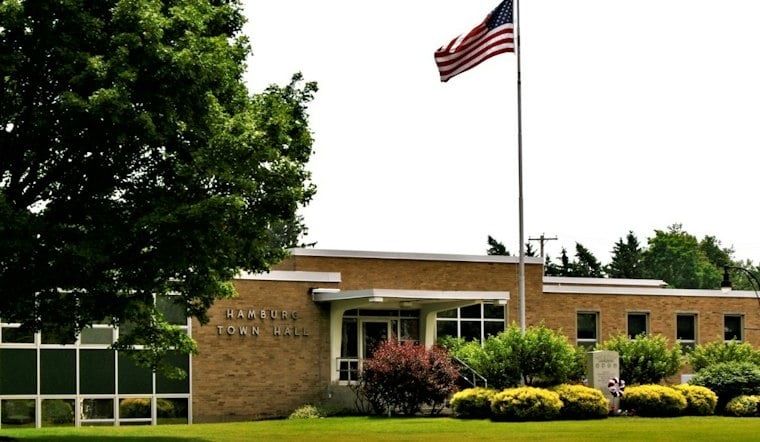
Hamburg town leaders scheduled a public hearing for Monday, October 19, on a proposed one-year moratorium that would freeze new large-scale data center development across the town, joining a wave of Western New York municipalities moving to slam the brakes on the energy-hungry facilities. The Hamburg Town Board set the hearing for 6 p.m., giving residents an opportunity to speak on the proposed measure before the board votes on whether to enact it.
As reported by the Buffalo News, the Hamburg Town Board is considering a resolution that would impose a one-year moratorium on large-scale data centers, and councilmember Frank Bogulski said the residents he's spoken with are firmly opposed to the facilities coming to town.
Residents Cite Overdevelopment, Health Worries
Bogulski told the Buffalo News that the biggest complaint he's heard from constituents is overdevelopment, and that the town needs to weigh what's best for the environment and its citizens before any data center breaks ground. Data centers — large facilities that house computer systems for storing, managing and distributing data, and which can also run and train artificial intelligence — can require significant amounts of electricity and water, per Bogulski's account to the paper. He added that their development raises land-use questions involving infrastructure, noise, backup power generation, environmental impacts and compatibility with surrounding properties, and said health implications are also on residents' minds.
Bogulski said he believes one year is enough time for town departments to study the effects on utility costs, electrical capacity, water resources, the environment, neighboring areas and quality of life, and report their findings back to the town board, according to the Buffalo News. He also floated a more drastic option: banning data centers from Hamburg entirely. The town would first need to consult its attorneys on whether an outright ban could survive a legal challenge, the paper reported, but Bogulski said he personally prefers a total prohibition. If data centers do end up somewhere in Western New York, he said he'd rather see them placed on former heavy-industrial land, such as the old Bethlehem Steel site or industrial parcels in the Tonawanda area.
A Regional Pattern Takes Shape
Hamburg wouldn't be breaking new ground — it would be catching up. The Town of West Seneca Board unanimously passed its own one-year moratorium, Local Law 2026-11, on October 5, 2026, following a public hearing held in late September, according to WGRZ. The Buffalo Common Council went further, approving a resolution on September 29, 2026, for a two-year pause on new data center developments while a nine-member task force drafts updated zoning codes, WGRZ reported separately.
Tonawanda moved earlier and more specifically. Its town board unanimously passed a one-year moratorium on August 3, 2026, banning applications for data centers requiring 20 megawatts or more of peak power. A proposed data center at the former Tonawanda Coke site had already been put on hold in June, partly because of grid-review delays, per the same outlet's reporting.
State Action Sets the Backdrop
These local pauses are unfolding against a statewide moratorium Governor Kathy Hochul put in place in July 2026 through Executive Order #62, which freezes new hyperscale data centers drawing 50 megawatts or more for one year while state agencies craft environmental and grid protection standards, according to Third Act. Because that order targets only the largest hyperscale facilities, towns like Hamburg and Tonawanda have set lower power thresholds or blanket bans to catch smaller commercial projects that might otherwise slip through.
State lawmakers are pushing further still. Senator Liz Krueger and Assemblymember Anna Kelles introduced Senate Bill S.9144 and Assembly Bill A.10141A in February 2026, seeking a statewide moratorium of at least three years on permits for data centers requiring 20 megawatts or more until environmental and ratepayer impact studies are finished, according to the New York State Senate. Environmental group Buffalo Niagara Waterkeeper advocates for freshwater protection.
Where Could Data Centers Go Instead?
Bogulski's suggestion that data centers belong on old industrial land echoes a broader argument taking hold across Erie County: that residential and agricultural areas simply aren't built for this kind of infrastructure. One site repeatedly floated as an alternative is the former Bethlehem Steel site, roughly 240 acres now being redeveloped as Renaissance Commerce Park by the Erie County Industrial Development Agency.
Hamburg's path forward hinges on whether the town board ultimately follows West Seneca, Tonawanda and Buffalo in pressing pause, or whether Bogulski's preference for an outright ban gains traction once town attorneys weigh in on its legal footing.




