

























































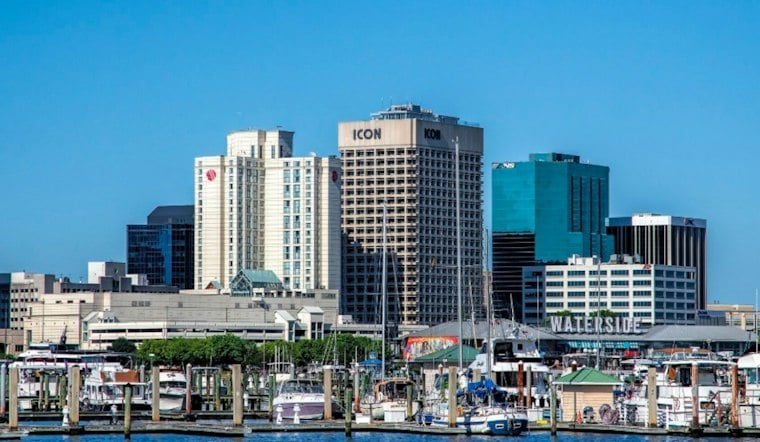
Hampton Roads could approach $150 billion in nominal gross domestic product this year, but that scale does not mean the region’s growth is reaching more workers. At the Oct. 6 State of the Region address in Norfolk, Old Dominion University’s Dragas Center for Economic Analysis and Policy projected growth of about 1.6% in 2026. The outlook pairs that expansion with a shrinking workforce, federal job losses and a shortage of housing, according to WHRO’s account of the presentation.
The current estimate should not be treated as a direct revision of an earlier Dragas Center forecast. In January, economist Vinod Agarwal projected 0.5% real GDP growth for 2026, as reported by The Virginian-Pilot. The forecasts were made at different times and use different measures; the center has not reconciled them into one figure. The October estimate is part of the broader outlook presented at the event, not proof that job losses have eased.
The workforce decline is a separate measure of strain
The region’s civilian workforce fell from about 880,000 at the start of 2025 to 863,000 in August 2026, a decline of roughly 17,000, The Virginian-Pilot reported in its coverage of the regional outlook. Earlier Pilot reporting put federal civilian employment at about 54,500 in November 2025, down from roughly 60,800 a year earlier. These are not interchangeable counts: the U.S. Office of Personnel Management describes its federal employment series as a snapshot of active federal civilian employees, a measure distinct from active-duty military jobs.
The distinction matters in a region with a large federal presence. The October outlook identified federal civilian job losses as a drag even as it expected defense spending to grow. The Pilot also reported an unemployment rate of 3.5% in September 2025, below the 4.4% national rate at that time. That earlier unemployment comparison and the more recent workforce figures describe different points in time and different aspects of the labor market; neither cancels out the reported decline in workers.
Trade and investment offer counterpoints, not a full offset
The Port of Virginia shows how performance can diverge across sectors. After loaded container volumes fell in 2025 amid tariff effects, the port handled 1.13 million loaded twenty-foot equivalent units from January through May 2026, up 2.5% from the same period a year earlier. It was the only one of four East Coast ports in the comparison to post growth, according to the American Journal of Transportation. That five-month result is a sign of resilience at the port, not evidence that the wider regional effects of tariffs or federal cuts have disappeared.
Tourism is another substantial part of the local economy, with 2025 direct spending estimated at $7.2 billion and total economic impact put between $12 billion and $15 billion in the event reporting. But the Dragas Center said revenue growth has slowed and inflation-adjusted revenues have been flat for several years, as reported by WHRO. Strong activity in particular sectors therefore sits alongside broader limits on growth.
Housing is a local constraint; data-center demand is a regional planning issue
Housing supply stands out as a problem local governments have more ability to address than federal staffing, trade policy or national defense spending. The outlook called for more single-family and multifamily construction. The reported figures point to especially tight options for lower-income households: a 2026 National Low Income Housing Coalition study cited by Virginia Business found 42 available homes for every 100 Hampton Roads households at or below 50% of area median income, and 26 for every 100 households at or below 30%. Virginia Business has also reported annual rent growth above 5% in Hampton Roads, compared with about 1% nationally.
Data-center investment adds another planning pressure, particularly around electricity and water, but statewide forecasts should not be mistaken for estimates of a specific local project’s effects. The PJM 2026 load forecast lists data-center load growth among adjustments for its DOM zone without identifying impacts from any particular Hampton Roads facility. Separately, a forecast commissioned by Virginia’s Joint Legislative Audit and Review Commission projects that unconstrained statewide power demand could double within 10 years, with data centers the main driver; it is a Virginia-wide projection, not a Hampton Roads forecast, according to JLARC.
The central question raised by the regional outlook is not simply whether Hampton Roads’ economy grows, but how much of that growth can translate into employment and a place to live. Housing construction is one lever local leaders can influence, while federal workforce decisions and national economic policy largely sit beyond their control. The presentation identified that imbalance as a reason housing supply matters to the region’s broader economic prospects.



