

























































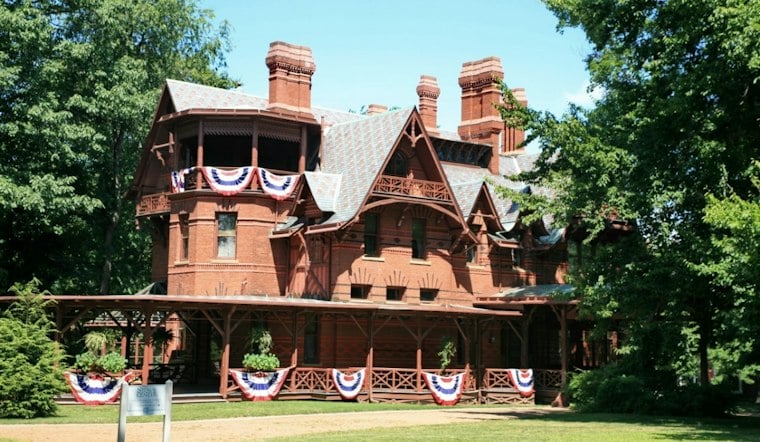
Lydia Millet is $25,000 richer this fall, and the reason traces straight back to a restored Hartford mansion where Mark Twain once lived. The Mark Twain House & Museum has named her 2025 collection Atavists the winner of its American Voice in Literature Award, setting up a celebration weekend that pairs a tribute to a working novelist with a blunt public reckoning over whether machines can do what she does at all.
The museum announced the win on October 1, saying it was pleased to award the honor to Millet for Atavists, an interconnected short-story collection published by W. W. Norton & Company, according to The Mark Twain House & Museum. Millet was a finalist for both the Pulitzer Prize and the National Book Award, and she joins a list of past recipients that includes Ocean Vuong, Jesmyn Ward, Alice McDermott and Ben Shattuck. As CT Mirror detailed in a branded feature on the award weekend, the prize recognizes fiction that speaks to American experiences in a distinctive voice, and this year marks its tenth anniversary, according to CT Mirror.
The award itself carries real financial weight. It comes with a $25,000 cash prize and was established in 2016 with support from David and Michelle Baldacci, celebrating its 10th anniversary this year, per the museum's own account. The formal celebration honoring Millet is set for Friday, November 6, at the Mark Twain House & Museum in Hartford, the same organization has confirmed.
A Symposium Built Around an Uncomfortable Question
The festivities don't stop at the awards ceremony. The next morning, the museum turns its attention to a much thornier subject: what generative AI is doing to the craft Millet just got paid to practice. The Creative Writing in the Age of AI symposium runs Saturday, November 7, from 9:30 a.m. to 3 p.m., with both in-person and livestream registration available, the museum said in announcing the program.
The gathering will happen at 351 Farmington Avenue in Hartford, the museum's own address, and will be moderated by writer and editor John Warner, with participants including Millet herself alongside Ron Charles, Jane Rosenzweig and David Baldacci, according to the same announcement. Organizers say the program will unfold through conversations addressing the philosophical, ethical, legal, labor, educational and literary effects of generative AI, touching on legal and ethical frameworks, author and publisher experiences, and shifts in classrooms, libraries and reading habits, per CT Mirror's branded account of the weekend.
Writers Are Split on What AI Actually Does for Them
The symposium arrives as the publishing world remains deeply divided over what AI means for working writers. A study of 1,481 working writers found 61% reported using AI tools, which they say increase their productivity by an average of 31%, according to Publishers Weekly. Yet only 7% of those surveyed said they had actually published AI-generated text, suggesting most writers treat the tools as assistants rather than authors. Among fiction writers specifically, just 42% said they use AI at least sometimes, though those who do reported strong gains: 60% said it improved writing quality and 87% said it boosted their productivity, the outlet reported.
The publishing industry itself is moving faster than individual writers are. A separate survey of 771 North American book-industry professionals found organizational AI use at publishers jumped to 63% this year, up from 48% in 2025, while individual use among employees actually dropped, from 46% to 38%, the same publication found. Respondents' biggest worries centered on the lack of controls governing copyrighted material, the inaccuracy of AI-generated content, and a proliferation of fraudulent or low-quality AI-generated books, Publishers Weekly reported.
Overseas, Novelists Fear for Their Paychecks
Concern runs even deeper among published novelists in the United Kingdom. A University of Cambridge report found 51% of published UK novelists believe artificial intelligence is likely to end up entirely replacing their work, according to EurekAlert. About a third of novelists, 33%, said they use AI in their writing process, but mainly for non-creative tasks such as information searches rather than composing prose. The same report found 39% of novelists say their income has already taken a hit from generative AI, with 85% expecting further losses ahead.
That anxiety has spilled into the awards world the Hartford symposium is built to examine. AI writing scandals, especially those linked to literary prizes, have exploded over the last year, per CNN. The network points to the Caine Prize for African Writing, which comes with a £10,000 award, where Zimbabwean author Simbarashe Kundizeza faced questions over his winning story, “The Blue Fighter,” and insisted, “I did not use generative AI to write it. It is entirely my own work.” CNN also notes that detection tools meant to settle such disputes can produce contradictory, biased or erratic results, with one 2025 University of Maryland study finding the detector Pangram erroneously labeled 2% of documents as AI-generated even as the company claims a far lower false-positive rate.
The House Where Twain Wrote His Classics
The setting for all this adds its own layer of irony. The Mark Twain House & Museum is the restored Hartford home where Samuel Clemens, better known as Mark Twain, lived with his family from 1874 to 1891, the museum notes, and it was there that he wrote Adventures of Huckleberry Finn, The Adventures of Tom Sawyer and A Connecticut Yankee in King Arthur's Court, according to CT Mirror's account. The museum, now a National Historic Landmark, offers tours, activities and educational programs about Twain's literary legacy throughout the year.
For those attending the symposium in person, registration includes lunch and refreshments, and admission is discounted for students and educators, per CT Mirror. CT Mirror's editorial staff had no role in creating or producing that particular story, which ran as a paid post sponsored by the museum. Whatever conclusions the panelists reach on November 7, the debate over whether a machine could ever tell America's stories the way Twain once did will be happening inside the very walls where he told them himself.





