

























































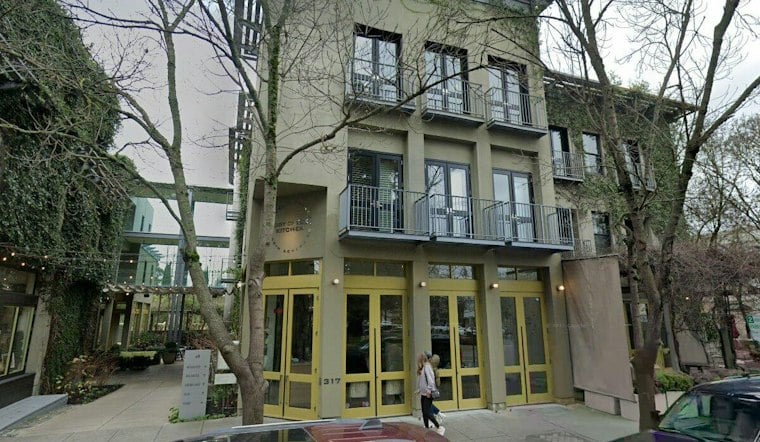
Hotel Healdsburg and Dry Creek Kitchen are marking 25 years in Healdsburg with a month of anniversary events in November 2026. The program includes a free community party, a $275-a-person reunion dinner with Charlie Palmer and seven other chefs, and throwback tasting menus. The hotel opened in November 2001 on land that had served as a dog park and rose garden.
From Rose Garden to Wine Country Anchor
The Sher family’s project began with a community debate over what should occupy the site. According to sonomamag.com, Merritt and Pam Sher took an interest in the dog park and rose garden in the 1990s. Merritt Sher, a shopping center developer, envisioned a hotel beside Healdsburg Plaza. His daughter, Circe Sher, who co-founded Hotel Healdsburg and Piazza Hospitality with her late father, has described pushback over building on the site and said the family financed much of the project after banks proved reluctant to participate.
The site’s history predates the hotel and the town’s commercial era: the same account notes that it was once home to a prehistoric village, or Kalè, inhabited by Southern Pomo and Western Wappo people. Harmon Heald established his first store nearby in the early 1850s, and the 300 block of what is now Healdsburg Avenue became a commercial center within a decade. After the block fell into disrepair, the city bought and demolished the buildings in 1980, clearing the way for the hotel site.
A Restaurant Built on Local Vineyards
Dry Creek Kitchen opened alongside the hotel in October 2001, and it was chef Charlie Palmer, known for his New York restaurant Aureole, who agreed to put his name on it after meeting Merritt Sher. Palmer has said Healdsburg already had the vineyards, farmers and growers that a true wine country restaurant would need. Mark Purdy served as the restaurant's first executive chef, and from day one, Dry Creek Kitchen devoted its wine list exclusively to Sonoma County wine — a commitment that, per Wine Industry Advisor, has grown into a list of more than 600 selections today.
That dedication to local wine paid off quickly. The restaurant earned its first Wine Spectator Best of Award of Excellence in 2002 and has kept it every year since, according to sonomamag.com's account of the hotel's history. Dry Creek Kitchen also picked up a Michelin star in 2007, becoming one of the first upscale restaurants to open on Healdsburg Plaza. Today, there are six Michelin-recognized restaurants within walking distance of the hotel.
New Leadership, Same Address
Dry Creek Kitchen still sits at 317 Healdsburg Ave. near Matheson Street, according to the San Francisco Chronicle. Executive Chef Shane McAnelly returned to Healdsburg in 2023 to take the helm of the kitchen.
Two Nights of 25th Anniversary Celebrations
As first detailed by The Mercury News, Hotel Healdsburg will host a free community celebration on November 6 from 7 to 9 p.m., with live jazz from the Lorca Hart Quintet, birthday cake, sparkling wine and a toast to 25 years. The following night, November 7 at 6:30 p.m., Charlie Palmer returns to Dry Creek Kitchen for a reunion dinner limited to 100 guests at $275 per person. Joining him are chefs Shane McAnelly, Dustin Valette, Kyle Connaughton, Carlos Mujica, Reed Palmer, Scott Romano and Ryan Fancher, as well as winemakers Kara and Daryl Groom, Bob Cabral, Tom Rochioli, Ben Papapietro, Derek Baljeu and Clay Mauritson.
For diners who can't make the big-ticket dinner, Dry Creek Kitchen will offer three-course throwback menus on November 5, 12 and 19, with McAnelly revisiting memorable dishes from the restaurant's 25-year history; those throwback Sonoma Neighbor menus are priced at $55 per person. Separately, the Hand Fan Museum of Healdsburg will present a Hotel Fans From Around the World exhibition running the entire month of November.
A Town Reshaped by Tourism
The hotel and restaurant’s anniversary arrives amid a broader debate about what tourism growth has meant for Healdsburg. The Healdsburg Tribune reports that the town’s population has stayed fairly stable over the past decade while the number of local businesses has grown, with tourist spending fueling that growth. The outlet also reported that Healdsburg’s Tourism Improvement District model generated $11 million for the town in 2022. Residents continue to debate how to regulate formula retail businesses and where they should be allowed to operate.
What the tourism figures do—and don’t—show
The reported $11 million figure is not, by itself, a measure of district spending or general city revenue. The City of Healdsburg’s HTID management plan set the annual assessment at 2% of gross short-term room-rental revenue and says those funds cannot be diverted to general government programs. Separately, the city’s transient occupancy tax comparison lists grand totals of $9,804,566 for FY 2022–23 and $9,367,407 for FY 2023–24. Those receipts provide a time-bounded lodging-tax measure, not a measure of total visitor spending; these figures alone do not show how lodging capacity has changed since 2001 or how district revenue was spent over time. Housing costs offer another piece of context, but not evidence of a tourism cause.
It's a far cry from the agricultural town Healdsburg once was. By the turn of the 20th century, according to Permit Sonoma, the area's main crops were hops, grapes and prunes — a working landscape that Hotel Healdsburg and Dry Creek Kitchen helped transform into the wine country destination the town is known as today.


