

























































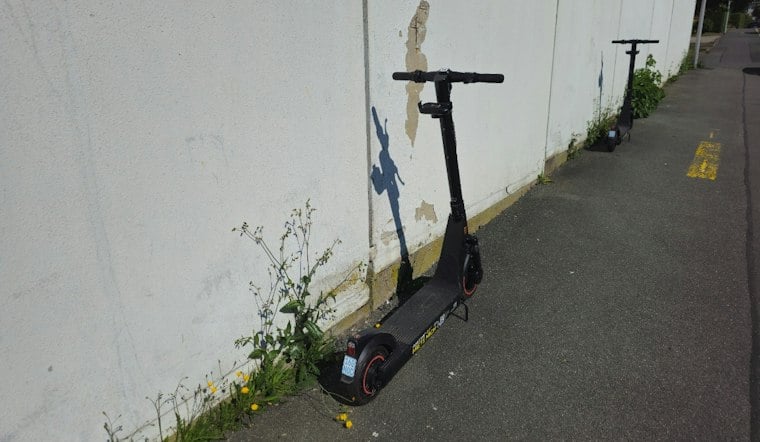
Hillsborough County commissioners are set to discuss a proposed ordinance that would overhaul the rules for e-bikes and e-scooters countywide, including speed caps as low as 10 miles per hour on sidewalks and mandatory helmets for riders. The push follows the February 2024 death of 19-year-old University of South Florida student Connor Lynch, who was struck by a car while riding his scooter near campus.
Lynch was a USF sophomore when he died after a car turned in front of him as he rode his scooter back to his apartment, according to his mother, Michelle Lynch, as reported by Tampa Bay 28. She described her son as vibrant, enthusiastic and full of ideas, with a wonderful life ahead of him. It was only after the crash, she said, that she learned how fast some e-bikes and scooters can actually travel.
Michelle Lynch has since urged riders to wear helmets, dress in bright colors and use scooter lights to stay visible. WUSF reports that Connor Lynch died when a car struck him while he rode down Fletcher Avenue in February 2024, a loss that has since become a rallying point for safety advocates across the Tampa Bay region.
What the Proposed Ordinance Would Require
Under the draft rules, e-bikes and scooters would be capped at 10 miles per hour on sidewalks, 15 miles per hour on shared paths and trails, and 28 miles per hour on roads and bike paths. Riders would be required to use working brakes, reflectors and lights, and to wear helmets. The ordinance would also prohibit tampering with devices to make them go faster than they were designed to travel.
Beyond speed and equipment, the proposal targets risky riding behavior directly. Riders would have to yield to pedestrians and give a verbal warning before passing, and the ordinance would restrict towing another rider, more than two people riding side by side outside of a bike path, stunt riding and wheelies, and street takeovers involving e-bikes or e-scooters. Penalties on the table range from warnings and citations to notices of violation, fines or jail time.
Commissioners must still adopt the ordinance before it can move forward, and the City of Tampa is separately considering the issue at a workshop this week. If the county ordinance advances, the public could weigh in at a meeting on November 10.
Doctors Describe Worsening Injuries
Medical providers in the region say the crashes they are treating are getting more severe. Dr. Ebony Hunter said children are arriving with serious injuries including fractures that require surgery, while Dr. Hassan Mir said per the same account that the injury severity is just getting worse and worse, with some crashes proving fatal.
That pattern shows up in the numbers too. Tampa General Hospital, the region's only Level 1 trauma center, recently saw a 500% increase in pediatric e-bike injuries, according to WUSF. Dr. Jade Kumar noted that children riding e-bikes experience twice the rate of traumatic brain injuries compared with those on traditional bicycles, prompting AAA to launch its E-Ride Ready campaign urging young riders to wear helmets and stick to safe speeds.
A Regional Surge in Crashes
USF police on the Tampa campus have responded to at least 23 incidents involving electric rides since 2023, the station's report found, with 40 e-scooter incidents recorded on campus between 2021 and 2025 — just three in 2023, but 14 in 2024 and 15 in 2025. By contrast, only one e-bike incident was recorded at USF over that same span.
Nationally, annual e-rider deaths rose 2,000% between 2017 and 2024, a trend WUSF reports was mirrored in Hillsborough, Pinellas and Pasco counties. The Tampa Bay Times has separately counted almost 30 e-bike deaths locally over the preceding five years, per the same WUSF account, though the two figures reflect different measures and time frames. The Miami Herald reports that the National Highway Traffic Safety Administration cautions that micromobility crash data may be underreported, since such crashes can be misclassified as other types of incidents.
The surge is not unique to Tampa Bay. The Miami Herald reports that Memorial Healthcare System in South Broward saw a 178% increase in micromobility-device injuries from 2024 to 2025, a trend continuing into this year, while Nicklaus Children's Hospital logged 37 severe e-bike and e-scooter injuries in 2025, up from just six in 2021. In Central Florida, Orlando Health Arnold Palmer Hospital admitted about 50 patients with serious e-bike and e-scooter injuries in 2023, a number that climbed to 125 in 2024, according to Fox 35 Orlando.
How Other Communities Are Responding
Some institutions have gone further than proposed speed limits. The University of Miami banned all micromobility devices starting in August, citing pedestrian safety, accessibility, emergency access and the risks posed by lithium-ion batteries. Closer to home, the Hillsborough County Sheriff's Office announced increased e-bike enforcement in Fish Hawk after receiving numerous calls for service, according to Bay News 9, with deputies emphasizing education for children and parents during traffic stops and coordinating with motor and bike units.
Florida law already gives local governments broad authority here. Under Florida Statutes, a local government may adopt an ordinance governing electric bicycles on its streets, sidewalks, paths and trails, set minimum age requirements, and require government-issued photo ID for operators. State law also bars tampering with an e-bike's motor to boost its speed unless the classification label is replaced, and requires electric bicycles to meet standard bicycle equipment rules along with labeling showing their classification, top assisted speed and motor wattage. That patchwork authority is why e-bike rules already vary from city to city, since different types of e-bikes can travel anywhere from 20 to 28 miles per hour depending on their classification.





