

























































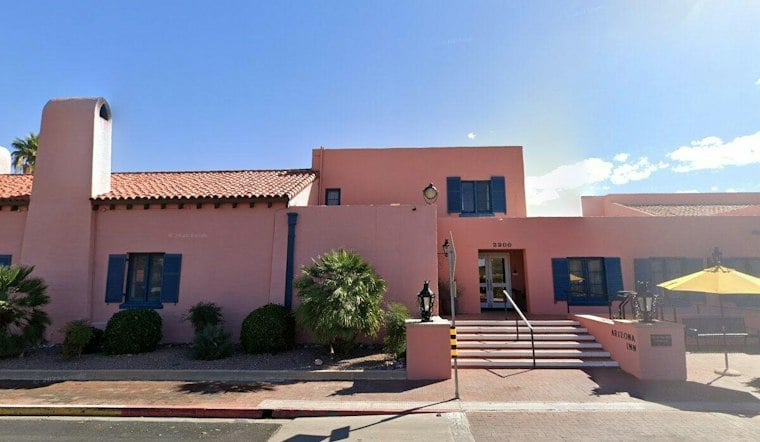
The Arizona Inn, Tucson's nearly century-old Midtown landmark, wants to add 25 casita-style rental homes to its 14-acre property, with the inn itself planning to own, manage and rent out every unit. The proposed town-home-style casitas would rise one and two stories, topping out at 25 feet, while three additional single-family casitas with one or two bedrooms would round out the project. Completion is targeted for early 2028, and rental prices will be set by market conditions once the homes are finished.
The plan, first detailed by the Arizona Daily Star, would place the three single-family casitas on the east side of the inn's Elm Street parking lot, while the larger group of town-home casitas would go on the property's southwest corner along Olsen Street. The inn sits at 2200 E. Elm St. in Tucson, between North Campbell Avenue and North Tucson Boulevard, on roughly 14 acres it has occupied since opening in 1930. No project renderings were available because site design work had only just gotten underway, according to the same report.
An Inn Built on Preservation Promises
Brian Underwood, writing on behalf of the project, said the ownership team is deeply committed to preserving the quality, character and historic hospitality that have made the Arizona Inn such a beloved Tucson landmark for generations. He added that the added income would support the inn's long-term viability and financial strength, per the same reporting. The Planning Center CEO Linda Morales said the new residences are intended to reflect the inn's style and character and blend seamlessly with the existing property.
Tucson City Council member Miranda Schubert, who represents Ward 6, said the inn's ownership has committed to respecting the property's historic character and ensuring new housing complements it. The property is eligible for the city's community corridors tool, a zoning option that eases the path for developers to add density and height to vacant city parcels or parking lots, according to the inn's project team. Ownership plans to meet with neighbors next month to explain the plans, a courtesy the team says isn't legally required since newer state and city laws no longer mandate public hearings for this kind of project. The Blenman Elm Neighborhood Association did not reply to the Star's request for comment by deadline.
A Landmark With a New Ownership Chapter
The Arizona Inn was designed by architect Merritt H. Starkweather and earned a spot on the National Register of Historic Places in 1988. The property was owned by the family of founder Isabella Greenway until the sale was announced in spring 2025 and the property was purchased in fall 2025 by a group of Tucson investors, as tucson.com has reported. That ownership group includes Steve and Margot Kerr, Greg and Marla Amado, Phil and Mimi Amos, Kirk Saunders and Ann Peterson, Brian and Shamra Strange, and Jim and Kerrin Berwick. Accounts of the inn's size vary: tucson.com describes it as 89 rooms with about 5,000 square feet of event and amenity space, while JLL refers to it as a 93-room resort.
Since the purchase, the inn has renovated the majority of its rooms, upgraded its lobby and Audubon Bar, and added a jacuzzi and private cabanas to the pool area. A spa has also been added, and the former Greenway House is slated to become a larger spa space down the line. The inn has created a tennis membership allowing non-guests to play on its clay courts, and owners plan to offer membership plans granting access to all hotel facilities.
Casitas Fit a Citywide Housing Push
The casita proposal arrives as Tucson has steadily widened the door for small-scale housing. The city's Unified Development Code was amended on Nov. 21, 2024, to comply with state requirements for casitas and accessory dwelling units, permitting them on parcels in zones that already allow residential uses, according to the City of Tucson's casita information. A city worksheet outlines the process for property owners, identifying designing the casita and applying for a building permit as the basic steps.
Tucson has approved or is processing more than 300 accessory dwelling unit permits since adopting pro-casita policies in 2021, with a record 80 applications filed in a single recent year, according to AZ Housing For All. The city has also expanded its casita program to allow duplexes, triplexes and fourplexes on most residential lots. Even so, construction costs averaging more than $100,000 per unit remain the biggest barrier for many smaller property owners looking to build.
Housing pressure in Tucson has been building for years. Renters made up 37.6% of households in the Tucson metropolitan area as of 2018, and median rent in the region climbed nearly 11% between 2013 and 2018, according to the MAP AZ Dashboard. The same data shows Tucson had the third-lowest rents among 12 western metro areas as of April 2020, even as it posted the third-highest rent growth rate among those same peers in 2019, at 5.1%.
The Arizona Inn proposal is separate from other land moves tied to the property: the ownership is also selling land on Wilson Avenue and Elm Street as three parcels for single-family home development, with proceeds earmarked for hotel improvements and upgrades. Phil Amos said buyers of those parcels are expected to build attractive homes that enhance the inn's image and aesthetic, and that the ownership team sought income sources to provide financial stability when it took over the property. He added that he expects potential renters of the planned casitas to include University of Arizona professors, doctors and parents of UA students, and that tenants will likely be close enough to frequent the inn's bar, library and restaurant.
The inn was also named one of three local hotels added to Historic Hotels of America this year, with the organization recognizing it for maintaining its historic integrity.


