

























































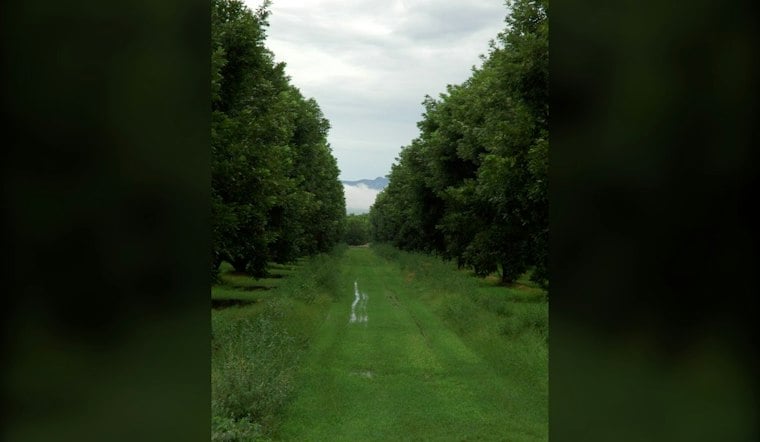
Farmers Investment Co., the company behind one of Southern Arizona's largest pecan operations, has agreed to sell its land and all other holdings, bringing an end to 78 years of the Walden family farming along the Santa Cruz River near Sahuarita. The sale covers more than 7,000 acres of orchards spread across Sahuarita, Continental and San Simon, and FICO expects the deal to close sometime during November 2026.
According to Arizona Daily Star, FICO has farmed in the region for 78 years and grown pecans there for 61 of those years, and the company is owned by the Walden family alongside Chicago-based Henry Crown and Co. But the identity of the buyer is murky: the Star reported FICO officials describing the purchaser as an out-of-state partnership, while KVOA's headline described the orchards as being sold to growers. Neither version has been resolved, and FICO spokesperson Brian Driscoll said the new owners' names will not be revealed until closing.
Groves Expected to Keep Producing Pecans
FICO's Sahuarita and Continental groves occupy 4,483 acres, with another 3,652 acres of pecan acreage in San Simon, bringing the company's total holdings to 8,135 acres. The Sahuarita and Continental farms stretch along the river for about 10 miles. Per KVOA's report, FICO said the sale will ensure the orchards remain in pecan production for the foreseeable future, and the station noted that further details about the purchaser would be shared at closing.
The workforce picture also diverges between accounts. The Star reported that, per Driscoll, employees are not expected to be laid off as a result of the sale, though some may leave voluntarily.
A Family Legacy Along the Santa Cruz
The Walden family's connection to this land dates to 1948, when Keith Walden bought the Sahuarita and Continental farms, converting them to pecan production in 1965. Keith Walden died in 2002 at age 88. Today, Richard Walden is 84 and Nan Walden is 72, according to the Star's reporting. FICO also won a landmark Arizona Supreme Court ruling in 1976, years before the state's Groundwater Management Act passed in 1980, a legal backdrop that shaped how the company could draw water for its orchards.
Water Use and Irrigation Efficiency
Water has long been central to FICO's operation. The company jointly funded a $17 million Central Arizona Project water pipeline with Freeport-McMoRan in 2020, built from CAP's terminal just south of Tucson, and FICO's groves have received CAP water via that pipeline ever since. FICO has also gradually converted its irrigation, moving up to 250 acres per year from flood irrigation to sprinklers, a switch that typically reduces water use by about 10 percent.
FICO has shifted much of its water use to CAP water, which its groves receive through the pipeline.
Pecan farming's water footprint has been studied closely in the region. A University of Arizona Cooperative Extension bulletin from July 2023 found more than 30,000 acres of pecans now established statewide, nearly double the acreage reported in 2013. Measurements taken at a mature Wichita pecan stand in Sahuarita, planted in 1994, found growing-season consumptive water use averaging 52.5 inches across the 2014 through 2016 seasons, which researchers defined as running from March 1 through November 30.
Development Plans and an Earlier Retreat From Processing
The sale is not FICO's first pivot. In 2021, the company closed its Sahuarita pecan-processing plant while continuing to grow pecans in the region, according to AZPM. FICO attributed that closure to tariffs, low-cost competition from Mexican processors and the financial impacts of COVID-19, and said another U.S. processor would take over shelling the pecans previously handled at the Sahuarita plant.
FICO had also floated development plans for parts of its land well before this sale. Tucson.com reported that the company first submitted its Sahuarita Farms plan to the town in 2011; planning materials described a possible transition of the farmland to other uses over the next 40 to 50 years.
Earlier proposals for FICO land contemplated a possible transition of farmland to other uses over the next 40 to 50 years. Whether any such plans carry forward under new ownership remains unknown, as FICO has said only that the orchards are intended to stay in pecan production, bringing to a close the Waldens' 78 years of farming this stretch of the Santa Cruz River.





