

























































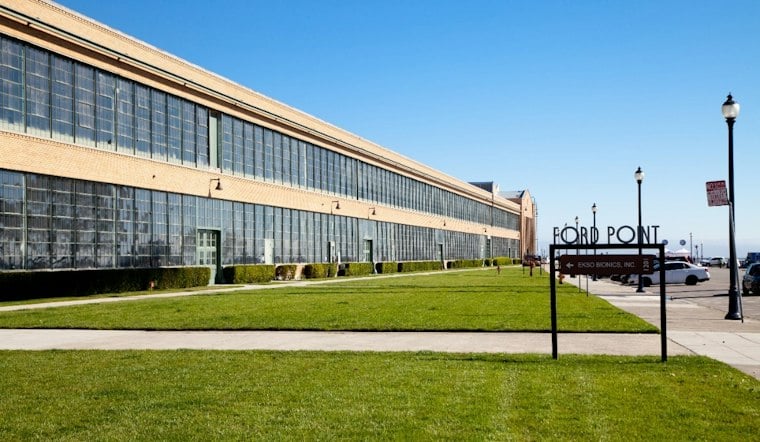
Ford Point, the former Ford Motor Company assembly plant on Richmond’s waterfront, has changed hands through foreclosure after its owners defaulted on a $106.3 million loan. The debt was reported at $92.6 million by the time the property transferred to an affiliate of Blackstone’s real estate financing arm, putting a landmark with commercial tenants and public-facing uses under new ownership.
Contra Costa County Recorder's Office documents show the foreclosure was filed on October 2, 2026, according to The Mercury News. Blackstone Mortgage Trust describes itself as a real estate finance company that originates senior loans collateralized by commercial real estate in North America and Europe, according to SEC filings.
Madison Capital and Meadow Partners bought Ford Point from Orton Development in 2022 for $103.7 million, according to REBusiness Online. The buyers financed the purchase with a $106.3 million loan from a Blackstone unit, according to The Mercury News. Published descriptions differ on the complex’s size and occupancy: REBusiness Online reported 478,761 square feet and 83 percent leased at the time of sale, as well as a 22.9-acre site; Orton Development describes 517,000 square feet; and the City of Richmond has cited 90 percent occupancy, or about 420,000 square feet.
A Tenant's Collapse Left a Hole in the Rent Roll
A major source of lost rent was Moxion Power, which once leased 181,000 square feet—roughly 35 percent of Ford Point—according to The Mercury News. The company reduced its workforce and ceased business in 2024, leaving a substantial vacancy. The loan tied to the ownership group’s purchase was already delinquent before foreclosure, the report said.
Other Bay Area commercial properties have faced similar pressure recently. An Oakland office tower was foreclosed amid what was described as widening Bay Area office-market weakness, according to a separate Mercury News report. A building in Oakland's historic warehouse district also tumbled into foreclosure due to a failed real estate loan, as reported by The Mercury News' sister paper.
From Wartime Tanks to Rosie the Riveter
Ford Point’s industrial past and historic status predate its current commercial uses. Architect Albert Kahn designed the factory, completed in 1930; it produced cars until closing in 1955, according to Richmond Confidential. During World War II, the plant was converted to assemble military jeeps and process tanks. The building was listed on the National Register of Historic Places in 1988 and was damaged in the 1989 Loma Prieta earthquake.
Orton Development bought the site from the City of Richmond in 2004 and redeveloped it, spending $51.3 million on upgrades that included a complete seismic retrofit, per the Mercury News report. The redevelopment also included an extensive seismic upgrade and a one-megawatt solar power plant installation, according to Orton Development, whose rooftop panels were said to supply half of the electricity needed by the building's occupants, per Richmond Confidential. Orton Development has described the property's transformation plainly: “Ford Point stands as a testament to the adaptive reuse of historic industrial architecture.”
More Than Offices — A Waterfront Landmark
The complex includes the Craneway Pavilion, a 45,000-square-foot restaurant and event space used as a concert and production hub, as well as the Rosie the Riveter museum. Tenants at the time of the 2022 sale included SunPower, Mountain Hardwear and California Closets, according to REBusiness Online. Richmond Confidential reported that the redevelopment helped shift perceptions of Richmond by showing businesses that the site was secure.
A Park Site With Planned Public Uses
Ford Point also has a public role tied to its historic status. The National Park Service's management plan says the Ford Assembly Building was designated as a site in the legislation establishing Rosie the Riveter/World War II Home Front National Historical Park.
What happens next for Ford Point's tenants and the Craneway Pavilion under its new ownership remains to be seen. For now, the foreclosure marks a sharp turn for a site that spent decades being rebuilt from a shuttered auto plant into one of Richmond's most recognizable commercial landmarks.





