

























































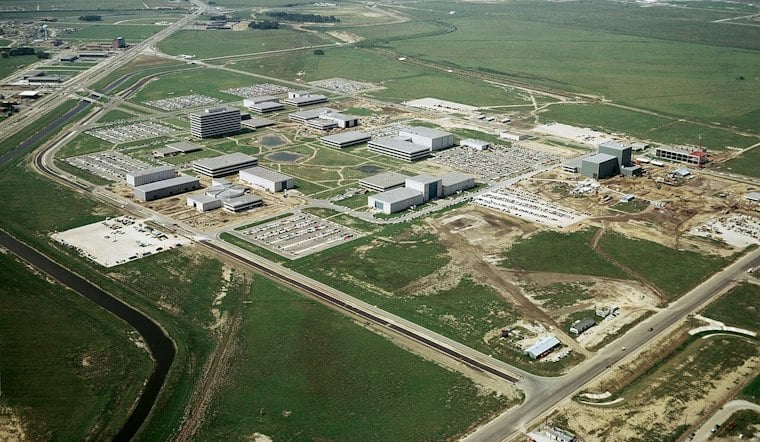
Four volunteers who spent more than a year locked inside a simulated Mars habitat at NASA's Johnson Space Center in Houston were scheduled to walk back out on Saturday, Oct. 31, closing out a 378-day mission designed to mimic what astronauts might face on a real trip to the Red Planet. The crew grew their own crops, rationed limited resources and practiced suited spacewalks without ever leaving Texas.
NASA said the four volunteers would exit their habitat after 378 days of isolation, according to a release from the agency, which organized the mission under its CHAPEA program. As reported by CW39 Houston, the crew's confinement ends with a streamed exit ceremony marking the close of the yearlong experiment. The four crew members have been identified as Ross Elder, Ellen Ellis, Matthew Montgomery and James Spicer, according to illawarramercury.com.au.
The crew lived inside a 1,700-square-foot, 3D-printed habitat at Johnson Space Center, according to a report from the University of Central Florida, which noted one of its alumni was among the participants. Over the course of the mission, the group grew crops, managed limited resources, dealt with simulated communication delays and conducted suited spacewalks, the same report notes. Their only contact with family came through email, delayed to mimic the lag of a real Mars transmission, per the outlet's account.
Months of Simulated Isolation and Blackouts
At the 200-day mark back in May, the crew entered a simulated two-week loss-of-signal period meant to replicate the communications blackout that occurs when Mars passes behind the sun, according to a NASA account of the milestone. That stretch of total radio silence from mission control is one of the scenarios NASA has been most interested in studying, since a real Mars crew would face the same blind spot for roughly two weeks during actual planetary alignment.
A NASA technical report has found that increased isolation and the challenges of delayed communication are linked to heightened stress, frustration, adverse behavioral symptoms and reduced individual performance, according to the agency's own research documentation. Once the Houston crew emerges, the group is expected to undergo two weeks of post-mission evaluations and assessments, per the report from illawarramercury.com.au.
What NASA Hopes To Learn
NASA scientists have been collating and processing health and performance data on the crew throughout the mission, data the agency says will feed directly into planning for future long-term missions to Mars and efforts to mitigate spaceflight risks, the same report states. NASA Human Research Program chief scientist Michael Stenger framed the stakes of the experiment in a statement cited by the outlet: “This mission has been incredibly valuable in starting to teach us how to understand requirements for year-long missions, including medical and psychological care, via communication delays.”
This is NASA's second CHAPEA simulation. The agency's first crew wrapped up its own yearlong Mars-simulated mission in July 2024, according to a NASA announcement at the time. Researchers have long turned to ground-based isolation experiments to study how humans cope with the psychological toll of deep-space travel before ever committing astronauts to the real thing.
Lessons From an Earlier 520-Day Experiment
A 2014 study that confined six healthy men to a 550-cubic-meter chamber for 520 days, developed and operated by the Institute for Biomedical Problems of the Russian Academy of Sciences, found substantial differences in how individual crew members behaviorally responded to prolonged confinement and isolation, according to the peer-reviewed findings published in PLOS One. That same study found conflicts with mission control were reported five times more often than conflicts among crew members themselves.





