

























































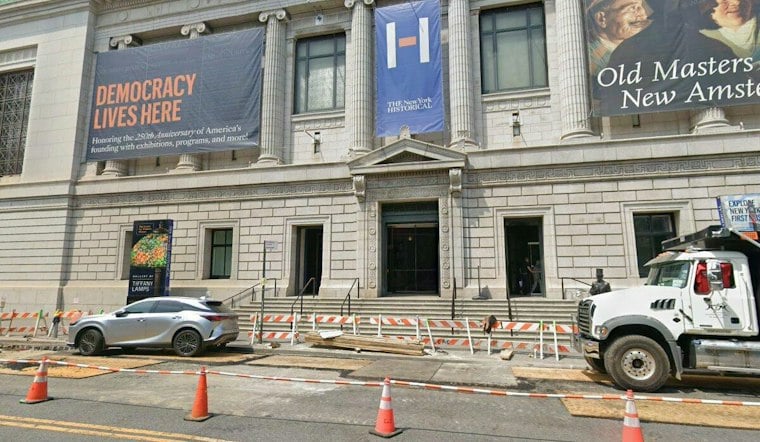
A network of loans and archival materials underpins “You Should Be Dancing: New York, 1976 and Beyond,” now on view at The New York Historical. The exhibition opened October 2 and runs through April 4, according to Spectrum News NY1 and City Life Org.
The work behind the displays
Some loans require years of planning. John Holmstrom wrote in Holmstrom’s Newsletter that Yale University’s Beinecke Library requires at least two years’ notice for institutional loans. The exhibition includes material from Yale’s Punk Archive, including early PUNK Magazine items, he reported.
The museum also coordinated with a wide range of lenders. Allison Robinson contacted more than 30, and they supported the exhibition, NY1 reported. That collaboration brings together material connected to performers, venues and audiences across the city rather than drawing on a single collection.
Objects tied to places and communities
The material points to the different spaces where New York music scenes developed. For the downtown punk scene, the exhibition includes a CBGB awning and objects associated with the Ramones and other performers, NY1 reported. A Fender signed by Dee Dee Ramone, handwritten lyrics to “The Blank Generation” by Richard Hell, and a shirt once worn by Patti Smith are among the items described by the New York Almanack.
Photographs and club ephemera offer another way into the city’s nightlife. NY1 describes the exhibition’s account of disco’s early roots in LGBTQ+, Black and Latino underground clubs and its later presence at venues including Paradise Garage and Studio 54. City Life Org reports that the displays include an opening-night invitation to Studio 54 and photographs by Village Voice nightlife photographer Bill Bernstein. VICE’s reporting on Bernstein describes his late-1970s photographs as a record of New York club life.
The exhibition’s hip-hop materials include Grandmaster Flash’s turntables and beat box, alongside vinyl he selected for display, NY1 reported. Visitors can try mixing music on an interactive turntable, according to the New York Almanack.
Archival collections beyond the exhibition
The exhibition is one example of material from music scenes entering institutional collections. Cornell’s Hip Hop Collection says it was established in 2007, contains more than 250,000 items across dozens of archival collections documenting hip-hop’s origins and evolution, and is housed in Cornell University Library’s Division of Rare and Manuscript Collections, according to the Cornell Hip Hop Collection. Catalog records at the New York Public Library offer further examples of how cultural histories are documented. Its Patti Smith notebooks and manuscripts collection dates from the 1970s to 2014 and contains three notebooks and a small assemblage of her writings. A separate Michael Holman collection, dating from 1961 to 2015, includes photographs, writings, appointment books, contracts, correspondence, articles, fliers, posters, and audio and moving image recordings.
The economic backdrop
The exhibition places the music scenes against New York’s mid-1970s financial distress, while treating the relationship as context rather than a simple cause-and-effect account. NY1 reported that officials prepared bankruptcy paperwork before the city made it through an October weekend in 1975. Separately, Chosun reported that the federal government approved a short-term loan of more than $2 billion in December, after President Gerald Ford initially opposed aid. The city’s police force fell by about 6,000.
Low rents helped young artists settle near downtown venues such as CBGB and experiment. That is one part of the exhibition’s framing, not proof that the fiscal crisis alone produced the music. NY1 reported that Widmer and Robinson presented the show as an account of creativity and cultural influence during a difficult period.
The exhibition also reaches beyond music into popular culture. NY1 reported that objects on view include Robert De Niro’s Taxi Driver outfit and the taxi license he obtained for the role, as well as a Sesame Street Fever album. The selection reflects the show’s stated scope across music, film and television, as described in NY1’s coverage and the City Life Org announcement.



