

























































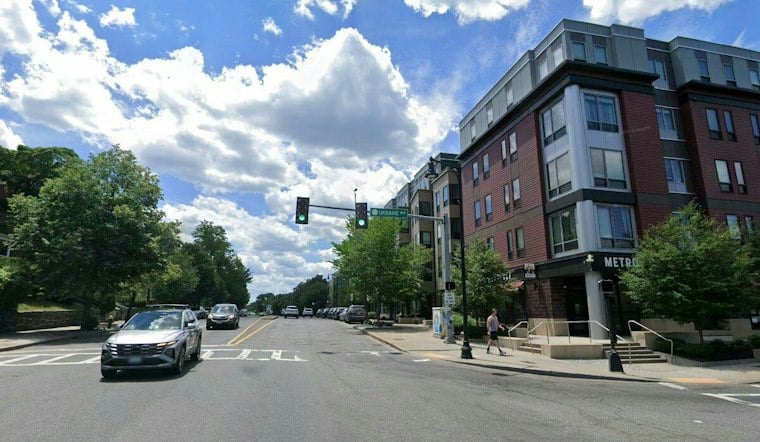
City Hall released a repaving plan for Hyde Park Avenue on Monday, October 5, including safety fixes residents had demanded since a fatal 2024 bus crash. By Thursday, October 8, workers had milled the street surface in preparation for new pavement, and neighbors who gathered at an October 5 meeting learned the city had quietly added wider crosswalk markings, concrete barriers against illegal parking, and a short lane removal near the Ukraine Way intersection outside Forest Hills Orange Line station.
The changes mark a reversal from the city's earlier approach. As reported by Streetsblog Massachusetts, the Wu administration had announced plans in 2025 to repave Hyde Park Avenue in its existing configuration, without the safety improvements residents had been pushing for. Hyde Park Avenue's four-lane cross-section has been acknowledged by Mayor Michelle Wu and other city officials as unsafe, particularly for pedestrians crossing at intersections.
Caterina Scaramelli, a neighbor involved in the advocacy effort, asked residents to thank Wu, City Councillors Enrique Pepén and Ben Weber, State Representative Montaño, and senior Streets Cabinet staff for the shift. She said the city significantly improved its repaving plans in response to residents' organizing, and urged neighbors to acknowledge officials when they listen and improve on earlier proposals.
A Years-Long Fight Rooted in Tragedy
The push for safer design traces back to October 2024, when an MBTA bus driver struck and killed Forest Hills resident Glenn Inghram in a crosswalk outside the station. The 63-year-old gardener was crossing during a shared green pedestrian signal phase at Tower Street, according to CBS News. His family planned to file a wrongful-death lawsuit against the MBTA, and more than 600 area residents had signed a petition calling for pedestrian safety improvements. Forest Hills residents went on to form the Boston Better Streets Coalition that same year.
That group continued pressing for safer street design. In early 2025, the Wu administration announced plans to repave Hyde Park Avenue in its existing configuration, without the safety improvements residents had been pushing for.
Nathan Eckstrom, one of the neighbors who learned of the updated plans at the October meeting, said the changes begin rebuilding trust between residents and City Hall, while cautioning they represent only the bare minimum needed to address safety on the corridor. He and other neighbors have asked city officials to address bus priority for the corridor in collaboration with the MBTA.
Bus Riders and School Buses Share a Congested Corridor
The stakes are high for transit users. Hyde Park Avenue is one of Boston's highest-ridership bus routes, and the segment south of Forest Hills Station is frequently clogged with stopped traffic. The MBTA's Route 32 bus along the avenue has over 10,000 average daily boardings and ranks among the MBTA's ten busiest lines, according to a Streetsblog guest column.
City officials separately cited Vision Zero data at an October 2025 City Council hearing showing more than 30 car crashes and nearly 10 pedestrian-involved incidents along the avenue in 2025 alone, as reported by the Jamaica Plain Gazette.
Plans for dedicated bus and bike lanes across much of the three-mile stretch between Forest Hills and Cleary Square had been drawn up years ago, but stalled during the COVID-19 pandemic and the transition to Mayor Wu's administration. The city has promised additional safety measures within the next two years, including upgrades to other Hyde Park Avenue segments closer to Cleary Square, signal adjustments to deter late-night speeding, and improved ADA ramps required under a 2021 federal consent decree.
Part of a Broader Citywide Push
The Hyde Park Avenue project fits into a larger infrastructure campaign touted by Mayor Wu's administration, which reported resurfacing 50 miles of city streets, upgrading 1,723 ADA-compliant sidewalk ramps, and dedicating 73 percent of its three-year capital transportation budget to street and sidewalk care, according to prior Hoodline reporting. Still, the corridor's dangers reflect a pattern seen across Massachusetts: 76 pedestrians were killed by drivers statewide in 2025, and more than 70 percent of fatal pedestrian crashes occurred in environmental justice neighborhoods, according to a WalkBoston finding reported by Streetsblog Massachusetts.
Broader Boston crash data underscores the stakes for pedestrians specifically. Municipal dispatch analysis covering 2015 through 2025 found the city recorded 42,683 crash records, and 92 of 156 fatal crashes involved a pedestrian, according to Larson Law Boston.
Hyde Park Avenue is not the only southwest Boston corridor facing scrutiny. Advocates raised concerns in May 2026 over city capital budget freezes affecting traffic-calming initiatives in nearby Jamaica Plain, including a $1 million reduction for the Centre/South corridor plan, according to Hoodline's recent coverage of a car crash into a medical building near Faulkner Hospital. For now, the improved Hyde Park Avenue repaving plan appears poised to become reality — a milestone Streetsblog Massachusetts notes has eluded prior proposals over the last seven years.





