

























































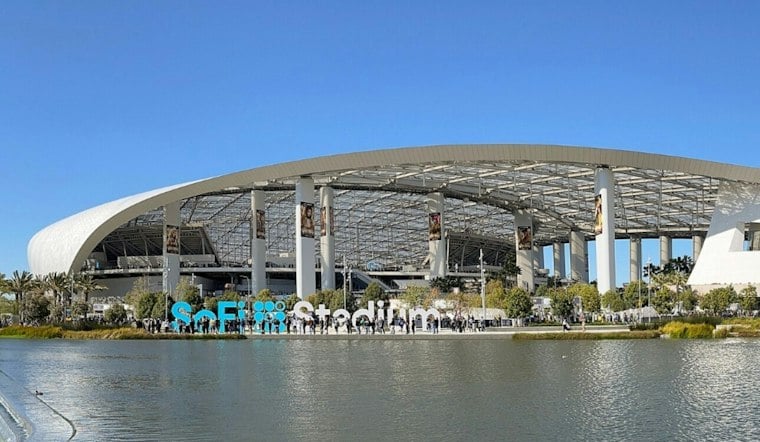
Inglewood city officials have launched a formal audit of their financial relationship with SoFi Stadium, arguing the venue could owe years of unpaid ticket taxes now that a judge has thrown out the 2015 contract that originally brought the stadium to town. The Inglewood City Council voted unanimously on October 13 to commission the review, setting aside $325,000 from the general fund to pay an outside accounting firm to dig through the numbers.
The audit traces back to a September ruling from a Los Angeles Superior Court judge who voided the decade-old development agreement between Inglewood and Hollywood Park, the master developer behind SoFi Stadium. As reported by LAist, the court decision threw into question the financial terms governing the relationship between the city and the stadium development, and city officials now say it means a cap on admissions-tax revenue no longer applies. Mayor James Butts called the audit a necessary next step after the ruling.
The legal reasoning behind the court's decision traces to a specific and consequential precedent. According to the Daily Journal, Judge David K. Reinert relied on the 2018 appellate ruling in Center for Community Action & Environmental Justice v. City of Moreno Valley, which established that statutory development agreements cannot be adopted through voter initiative because state law requires a negotiated legislative process with public hearings. That matters because Inglewood's 2015 deal was never negotiated by the council at all — developers gathered more than 22,000 resident signatures in early 2015 for a ballot initiative, which the council then adopted outright to bypass environmental review and referendum delays, per eyeoninglewood.
What the Audit Will Actually Examine
Under the council's motion, the retained accounting firm must publicly report its findings within 30 days and will examine the financial relationship between the stadium and the city dating back to 2015, including what was owed and received from taxes on tickets and parking. City officials say the review will also seek to clarify how ticket-sale taxes are assessed and whether that revenue actually reaches the city, and officials plan to continue auditing those taxes quarterly going forward. The stakes are significant on both sides of the ledger: Inglewood collects a 10% admissions tax on SoFi Stadium tickets, a levy that a 2015 initiative capped starting at $15 million annually with inflation adjustments, even though the tax has generated an average of $20 million a year since the stadium opened.
Hollywood Park, for its part, maintains that the stadium development has met its financial obligations, including paying all required taxes, according to a spokesperson cited in the same LAist report. A Hollywood Park spokesperson went further, characterizing the audit as an attempt to distract from scrutiny of the city's own fiscal mismanagement and the mayor's conduct. Councilmember Diane Sambrano took the opposite view, saying Inglewood needed an audit from day one.
A $376 Million Claim and a Widening Deficit
The financial fight runs in both directions. Hollywood Park's separate claim is that Inglewood owes it about $376 million in infrastructure reimbursement, a figure tied to a contractual trigger in the now-voided agreement. Under that 2015 deal, the city was only required to begin reimbursing Hollywood Park's upfront infrastructure costs once total annual tax collections from the site passed $25 million — a threshold Hollywood Park claims was reached back in 2022, according to 2UrbanGirls.
Inglewood, meanwhile, is working against a $30.8 million deficit, which the city's own financial reports describe as its largest budget shortfall in at least two decades. The LA Local reports that the city nonetheless holds more than $150 million in reserve funds that can offset short-term gaps. General fund spending roughly doubled after SoFi Stadium opened in 2020. Those original infrastructure cost projections looked very different a few years ago: HR&A Advisors' 25-year planning estimates, cited in earlier Hoodline reporting on the billboard fight, had projected $1.3 billion in gross tax revenue for Inglewood starting in 2021.
Ballot Measures and a Political War Chest
Voters will weigh in directly next month. Inglewood's Measure AT, on the November 3 ballot, would remove the annual cap on SoFi Stadium's 10% admissions tax entirely while also introducing a new 2.5% tax rate on venues seating 10,000 to 22,000 people — a tier that happens to include the Intuit Dome, home of the Los Angeles Clippers since 2024, according to LAist's election coverage. A city analysis of the measure estimated that removing the cap could generate up to $50 million in additional revenue in future years, though Inglewood has not estimated how much admissions-tax revenue it missed while the now-voided agreement was in effect. WOW Media, the city's billboard contractor, is funding a campaign supporting Measure AT.
The ballot fight has turned into a proxy war over city leadership. Campaign finance disclosures reviewed by the LA Local show Hollywood Park spent $750,000 funding Take Back Inglewood, a political action committee working to defeat Mayor Butts' bid for a fifth term, while the stadium-aligned Neighbors for Beautiful Inglewood spent $3.1 million backing Measure BB, an anti-billboard initiative. Butts had previously maintained a close working relationship with Rams owner Stan Kroenke during the stadium's construction, a relationship the current fight has visibly strained.
Billboards, a Separate Lawsuit and a Proposal That Stalled
The ticket-tax audit arrived alongside an unsuccessful push to widen its scope. Councilmember Gloria Gray proposed adding an audit of city revenue from billboard fees at the same meeting, arguing that the same financial-transparency standard should apply to every city agreement, but her motion did not receive a second. Councilmember Eloy Morales said he would support placing a billboard-revenue audit on a future council agenda. Inglewood currently receives as much as $8 million a year from billboards under deals that let WOW Media operate digital displays on public medians and sidewalks in exchange for a share of advertising revenue and other concessions.
Billboards have already been the subject of their own courtroom battle. In June, a Los Angeles Superior Court judge ruled in Inglewood's favor in a separate suit filed by Hollywood Park, which had alleged that the city's long-term commercial billboard contract with WOW Media violated state or municipal law, per The Real Deal. That case is part of a broader litigation campaign that has run between the city and stadium-linked entities since the summer of 2025.
City leaders have also pointed to state legislative history to justify their audit powers. The city council's October audit initiative specifically cited 2023 Assembly Bill 8, a Sacramento bill by Assemblymember Laura Friedman that sought statewide itemization of primary event ticket fees, which the Los Angeles Rams opposed and which ultimately failed to pass, according to 2UrbanGirls' separate report on the council vote.
Looming Deadlines Before the Super Bowl and Olympics
Mayor Butts said the audit was prompted both by the development agreement's collapse and by the approach of major events the city is set to host, including the 2027 Super Bowl and the 2028 Olympics. Hollywood Park could still appeal the ruling that voided its contract, and Butts has said the city wants to negotiate a replacement agreement rather than remain in legal limbo. The LAist report, which originally appeared on the LA Local, notes that the November 3 election will also include ballot measures touching commercial advertising rules alongside the ticket-tax questions — leaving voters to help decide the financial terms the city and stadium will operate under heading into those global events.





