

























































Roger Herman has spent four decades living and working inside a wedge-shaped plywood house wedged against Elysian Park, a structure that architect Frederick Fisher built for him in Solano Canyon in 1985 for just $150,000. At 5,000 square feet and roughly $30 per square foot, the home still functions as a residence and painting studio; a ceramics studio was added in a second building in 2003 for the 78-year-old artist.
According to the Los Angeles Times, Herman and Fisher built the home on a tight budget on a triangular lot abutting the park, cladding it in plywood sheeting with plywood floors and ceilings, salvaged steel casement windows, and oversized doors. Fisher has said Herman originally asked him for something like “a castle in the woods,” and described the project to the paper as a true collaboration between architect and client. A 1989 Los Angeles Times article discussed Fisher’s assemblage approach and use of salvaged and raw materials.
A Studio That Grew With the Artist
The original studio space has 16-foot-high ceilings, clerestory windows, and an overhead skylight, per the Los Angeles Times account. Herman later added a dividing wall and custom shelving for his library and ceramics, while the second floor holds a communal living, dining, and kitchen area and the third floor contains the master bedroom and three decks. In 2003, Herman and Fisher expanded the complex with a second building housing a ceramics studio, an office, and a studio for photographer Eika Aoshima.
That second building sits near a cactus garden bordered by Elysian Park, according to the same report. The whole compound functions as a working laboratory for Herman, who still fires his ceramics in his own kiln and builds oversize vessels by starting them on a wheel and hand-building the rest.
From European Law Studies to L.A.'s Neo-Expressionist Wave
Herman's path to Solano Canyon began far from Los Angeles. Born in Saarbrücken, Germany, in 1947, he studied law and politics for about three years, later studied law for four years, and attended the Academy of Fine Arts in Karlsruhe under Georg Baselitz and Markus Lüpertz, relocating to California in 1977 on a DAAD grant, according to Hyperallergic. By the 1980s, he had become a leading figure of the West Coast's Neo-Expressionist movement, and dealer Larry Gagosian represented him during that decade, positioning him commercially as a West Coast counterpart to East Coast stars David Salle and Jean-Michel Basquiat, per the Anderson Ranch Arts Center.
Herman's work now sits in the permanent collections of the Los Angeles County Museum of Art, the Museum of Contemporary Art, and the Hammer Museum, the Los Angeles Times reports. Anderson Ranch Arts Center says Herman had been a UCLA art professor since 1984; the Los Angeles Times describes him as a former UCLA professor.
Clay, a Graduate Student, and 500 Pots
Herman didn't pick up ceramics until 1998, and when he did, he learned from one of his own graduate students. Lisa Yu taught him to throw on the wheel, and he has said she made him produce 500 pots and bowls before he felt he understood the medium, initially working up to 10 hours a day on clay to balance his painting practice, per the Anderson Ranch Arts Center. Herman has said the discipline taught him something painting hadn't: to relinquish control and accept unpredictability.
That same restless curiosity shaped his role in Los Angeles's art world beyond the studio. Herman co-founded Chinatown's Black Dragon Society gallery in 1998 with Austrian painter Hubert Schmalix and filmmaker Chris Sievernich; it operated until 2008. The gallery exhibited artists including Jonas Wood and Ry Rocklen.
Poppies, Mezcal Cups, and a Dog Named Willy
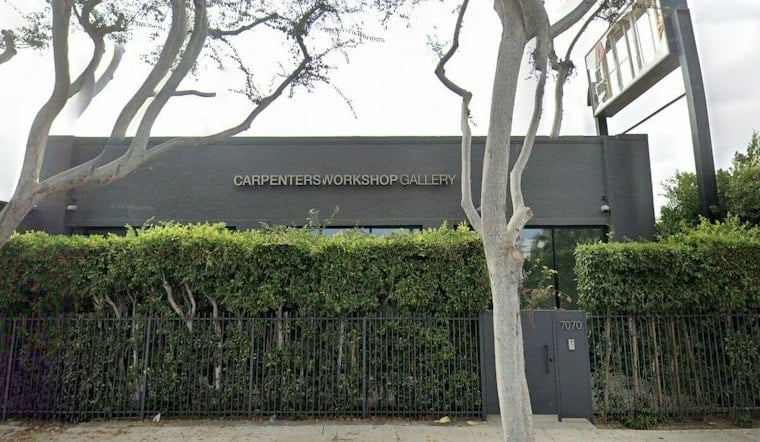
Herman's current body of work is on view through Saturday in his solo exhibition California Poppies at Carpenters Workshop Gallery in Hollywood, which opened in June and presents paintings, ceramic vessels, and modular tile-topped tables. Damien Anger, a senior sales associate at the gallery, has said collectors can create their own composition with the tiles. Herman has recently branched into smaller objects too, including small mezcal cups.
Away from the kiln, Herman now lives with his wife amid artwork by friends and former students. His house sits in Solano Canyon, a neighborhood established in 1866 when Costa Rican butcher Francisco Solano purchased 87 acres in the Stone Quarry Hills from the city, later subdivided into 100 residential lots by his son Alfredo in 1888, according to the Solano Canyon Historical Society.



