

























































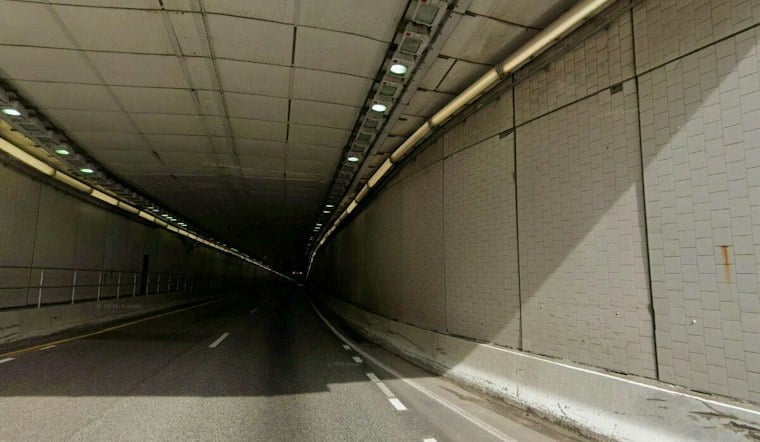
Nearly two miles beneath the Continental Divide, a crew of 22 trained firefighters stands ready around the clock, not for a typical highway stretch but for what amounts to a small underground city carved into granite at 11,112 feet. The Eisenhower-Johnson Memorial Tunnel carries Interstate 70 traffic through the Rockies, and keeping it open involves far more than plowing snow.
According to the Colorado Department of Transportation
, running the tunnel at that elevation means managing what the agency describes as a city-sized power grid, fighting what crews call the “Ice Monster,” and responding to emergencies in seconds inside bores that have no shoulders. That framing lines up with the scale of infrastructure CDOT actually operates there. The tunnel's dedicated fire brigade, staffed by 22 trained firefighters working with specialized fire engines and tow vehicles built for high-altitude emergencies, according to
5280Fire
, exists because outside help is too far away. Fire departments based in Georgetown or Silverthorne would need 10 to 12 minutes just to reach the portals.
A Mountain Facility That Runs Like a Utility
Keeping breathable air moving through the tunnel's 1.7-mile bores requires 27 massive ventilation fans strong enough to produce hurricane-force winds and clear out carbon monoxide, according to the mountain shuttle service Mountain Shuttle. Those fans run alongside roughly 4,400 interior light fixtures, all powered by dedicated electrical substations in Lake Dillon and Georgetown, with the twin bores drawing from dual regional power lines to keep electricity flowing without interruption.
Then there's the water problem. CDOT's own operational reporting shows internal collection systems and wastewater treatment plants inside the facility must process roughly 200 gallons of water per minute to stop the structure from degrading and the roadway from icing over, the agency notes in materials published on CDOT's tunnel operations page. Maintenance crews also sweep out about 16 tons of dirt from tunnel gutters every year as part of the same upkeep. That water seepage, which travels through the surrounding granite, is what creates the unpredictable ice hazards crews sometimes refer to as the Ice Monster — a problem serious enough that CDOT launched a $71 million infrastructure repair project in June 2023 to address water infiltration, ceiling leaks, and recurring ice mounds along the tunnel's walls and travel lanes, as reported by KUNC.
A Control Center Built for Faster Response
The tunnel's nerve center got its own overhaul recently. In February 2025, CDOT finished a $5 million, two-year upgrade to the facility's 24/7 control center, relocating operations to the west portal and swapping 1970s-era copper communications for fiber optics tied to 162 video camera feeds, according to CBS News Colorado. The old control center had relied on analog copper systems and routinely dropped to 45 degrees Fahrenheit inside, a detail that underscores just how dated the previous setup had become before the switch to modern fiber infrastructure.
Those upgrades matter because the tunnel sits in one of the harshest stretches of highway in the country. Located within the Arapaho National Forest along the Continental Divide, the site averages 315 inches — about 26 feet — of snowfall annually between November and April, per CDOT's travel information page. The facility itself straddles the county line, with Clear Creek County to the east and Summit County to the west.
Traffic Rules Built Around the Bores Themselves
Because the tunnel has no shoulders, traffic management is treated as a safety system in its own right. CDOT implements metering at the approaches whenever eastbound volume exceeds 2,800 to 3,100 vehicles per hour or when congestion threatens to block emergency vehicle access inside the bores, according to the Vail-based transportation company Blue Sky Limo. Those holds pause inbound traffic for 15 to 20 minutes at a stretch to prevent gridlock inside the tubes.
Hazardous materials add another layer. Under state regulation, trucks hauling hazmat are normally barred from the tunnel and must detour over Loveland Pass on US 6 — but whenever winter weather shuts that pass down, CDOT runs hourly escorted convoys through the bores instead, briefly holding general traffic at the portals to clear the way. Hoodline has previously covered how winter weather triggers these escort protocols near Georgetown, and in July reported on a tanker fire that forced a separate shutdown of the westbound bore near Silverthorne.
The Descent That Comes Next
Even after clearing the tunnel, the danger isn't over. Drivers exiting the westbound bore immediately face a seven-mile downhill descent at a seven-percent grade into Summit County, where the Lower Straight Creek emergency runaway ramp was used 75 times over a five-year span by vehicles that lost control, according to CBS News Colorado. That ramp is recognized as the most frequently used runaway truck ramp in the state.
The tunnel's place in highway history adds further context to why so much engineering effort goes into keeping it open. At 11,158 feet above sea level and running beneath 1,497 feet of bedrock, the Eisenhower-Johnson Memorial Tunnel is the highest point on the entire U.S. Interstate Highway System and the longest mountain tunnel ever funded by the federal Interstate program, per the Federal Highway Administration. The westbound bore opened in 1973, with the eastbound bore following in 1979, at a combined original construction cost of $262 million. Hoodline readers who followed this spring's 75-car pileup near the tunnel have already seen how quickly conditions here can turn dangerous, a risk that CDOT's expanding infrastructure investments are meant to help contain as mountain traffic keeps climbing through one of the most unforgiving stretches of road in the country.


