

























































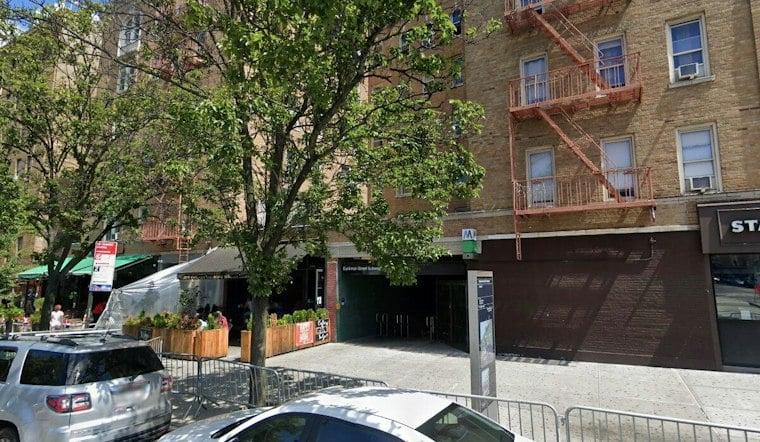
Quisqueya Plaza's future remains unsettled as New York City prepares a capital plan for the space. Merchants and several elected officials want to replace its year-round car-free status with a seasonal, summertime-only open street. The roughly 250-foot stretch of Dyckman Street between Broadway and Seaman Avenue became a gathering place for New York City's Dominican community.
The plaza grew out of Mayor Bill de Blasio's pandemic-era Open Streets program and joined the Open Dining program in June 2020. It became fully car-free in 2021, and the city's Department of Transportation has been preparing to make that status permanent. Streetsblog New York City reported that restaurant owners along the corridor want motor traffic and parking restored.
Council Member Carmen De La Rosa has proposed a compromise allowing limited car access and angled parking at certain times, such as winter. She told Streetsblog the plan would include vehicular access, traffic-calming measures, and bumpouts. According to the outlet, De La Rosa, Robert Jackson, Al Taylor, Manny De Los Santos, Brad Hoylman-Sigal, and Representative Adriano Espaillat also sent DOT a letter last month asking it to explore a redesigned approach with some traffic and parking restored, and for an update on removing the protected bike lane through part of the plaza.
A Plaza Built for Safety, Now Facing Pushback
Before the open street, the Dyckman Street block between Seaman Avenue and Broadway had 314 reported crashes that injured 65 people over nine years, according to the Streetsblog report. The report also said fewer than 25 percent of area households have access to a car. The plaza connects to a two-way bike lane, the Dyckman Street A train station, the Bx7 bus, and the M100 bus.
In an interview with Streetsblog, Christianne Greiert described the plaza as a safe corridor along Dyckman. The plaza has also served as an official host site for DOT's car-free “Trick-or-Streets” Halloween programming and hosted a community block party during the New York Latino Film Festival, as Hoodline previously reported. It was also the northern terminus for this summer's car-free Summer Streets Saturdays.
Residents Split Over Noise, Safety, and Who the Space Serves
Some residents have opposed changing the plaza before DOT releases its renovation plan. Manhattan Community Board 12 passed a resolution supporting a part-time open street, with 23 votes in favor, 15 against, and four abstentions. Streetsblog's meeting coverage reported that Sandra Jaquez associated the plaza with loitering, drug use, and homelessness, while Tanya Bonner argued that seasonal operation would maintain the status quo because the noise and disruption residents complain about mostly occur in summer.
Streetsblog's report also described friction between nearby residents and large events celebrating the Dominican diaspora. The debate comes amid a broader regulatory shift: in April 2025, DOT finalized citywide rules allowing pedestrian plaza and open street operating partners to run private subconcessions and dedicated outdoor dining seating. The change drew formal complaints from Inwood residents alleging nearby restaurants had mismanaged public space with loud outdoor music and private dining extensions, according to NYC Rules.
City Money Already Committed, Plans Still Pending
DOT allocated $7 million in 2023 for capital reconstruction, pedestrian safety, and bike-lane enhancements at the plaza, a commitment confirmed by CityLand, which also noted Quisqueya Plaza was the first Open Streets location designated for permanent conversion back in 2021. The city's Fiscal Years 2026–2035 Ten-Year Capital Strategy still lists the plaza as a priority site for permanent reconstruction and open space expansion, according to city budget documents. DOT has not yet released public renovation designs, though the agency plans to conduct community outreach on the capital project this fall.
What comparisons can—and can't—show
A separate open-street case offers limited historical context: in 2020, Streetsblog New York City reported that DOT said the 34th Avenue Open Street in Jackson Heights and Corona would continue past Oct. 31 while the agency worked with local stakeholders on a long-term plan. That was a different corridor and process; the account does not establish what operational disputes arose there or predict the outcome for Quisqueya Plaza. The estimate cited above that fewer than a quarter of area households have access to a car is not, by itself, a comparison of local travel patterns or residents' views on the plaza. The U.S. Census Bureau explains that American Community Survey travel questions cover commuting to work, not nonwork trips. Commute-mode figures therefore would not capture all local travel or establish residents' preferences about the plaza.
The New York City Council has also directed discretionary funding through De La Rosa's office to Dyckman Gardens Corp, a local organization established during the pandemic by neighborhood stakeholders and restaurateurs, for plaza cleanup — $20,000 in each of fiscal years 2025 and 2026, and $28,000 budgeted for fiscal year 2027. Nearby, DOT completed a protected bike lane on Riverside Drive this past August that forces greenway-bound cyclists to carry their bikes up and down stairs, after Community Board 12 rejected a direct Dyckman Street route in late 2024 to preserve 40 parking spaces, as Streetsblog reported separately.
Political Shakeup Looms Over the Debate
The debate is also unfolding amid a local political shift. Espaillat, who had previously supported removing cars from the plaza, now backs an open street requested by local businesses, according to a spokesperson cited by Streetsblog. Espaillat lost the June 23 Democratic primary for New York's 13th Congressional District to challenger Darializa Avila Chevalier. In the election district encompassing the plaza, Avila Chevalier won 75 percent of the vote to Espaillat's 22 percent, while Espaillat carried the district overall by a narrower 49 to 45 percent margin, according to the Norwood News.
Espaillat, first elected to the House in 2016 as the first formerly undocumented immigrant to serve in Congress, previously chaired the Congressional Hispanic Caucus, per WNYC. Meanwhile, Mayor Zohran Mamdani's administration has yet to release a decision on Quisqueya Plaza's future, despite promising to transform the city's streets into the envy of the world. For now, the plaza's fate sits in limbo between a $7 million capital plan still awaiting public designs and a local political coalition pushing to let the cars back in.


