

























































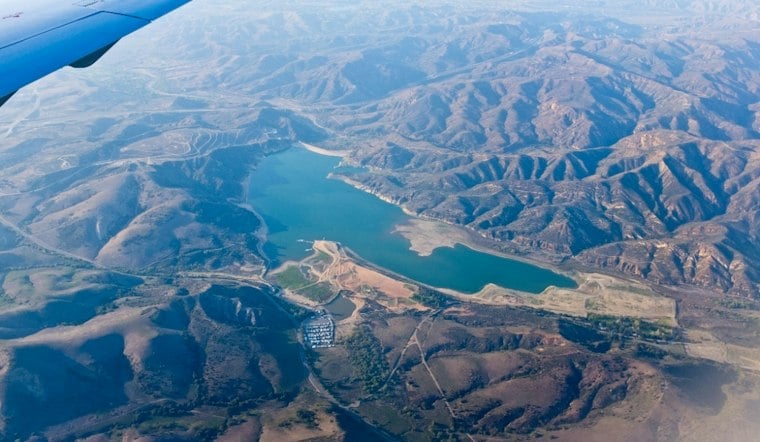
Irvine Lake started draining this morning, kicking off a years-long overhaul of the 93-year-old dam that holds it back. Water levels at the reservoir were set to drop from roughly 738 feet to 720 feet starting Monday, Oct. 26, the first visible step in a project that will eventually leave the lake completely empty for construction.
The Santiago Creek Dam, which forms Irvine Lake, was built in 1933, according to the Irvine Ranch Water District. IRWD launched a comprehensive assessment of the then-84-year-old dam back in 2017 and found it was still operational but could be made safer. That review set the stage for the Santiago Creek Dam Improvement Project, which will rebuild the spillway and outlet tower, strengthen the structure to modern standards, and restore 3,700 acre-feet of storage capacity that had been lost over time.
About 300 acre-feet of water is expected to remain in the lake until next summer, when the reservoir will be fully drained for construction, according to the Orange County Register. From there, the newspaper reports construction is expected to take five years, with the lake sitting empty the entire time. CBS News reported the draining got underway this morning, part of what the station described as an upgrade to the 93-year-old reservoir.
Why Orange County Needs This Water Back
Irvine Lake isn't just scenery off Santiago Canyon Road — it's a working piece of the region's water supply. IRWD states that Irvine Lake water, used for both drinking and irrigation, makes up about 5% of its overall supply.
The scale of who exactly depends on that water isn't entirely settled across sources. IRWD says more than 1.5 million residents live in areas directly or indirectly impacted by the Santiago Creek Dam, while the Orange County Register reports the reservoir's main purpose is capturing and storing drinking water for about 900,000 residents. Either way, officials say the goal is the same: a sturdier dam that can capture more rainwater and reduce the region's reliance on imported water, according to City News Service, which reports the project is scheduled for completion by 2030.
Anglers Push Back Over Fish Left Behind
Not everyone is cheering the drawdown. The region's fishing community has raised concerns about protected fish species in the lake and has pushed for a salvage and mitigation plan before the water disappears, the Register reports. IRWD's response has been that the species in question, including white sturgeon and blue catfish, were stocked into the lake and are sterile, and that no native fish actually live there.
District officials have also tried to reassure anglers that the closure isn't permanent. After the project wraps, IRWD fully anticipates that fishing will resume at Irvine Lake, according to the same Register report. Until then, the lake's popular fishing grounds will be off-limits as crews work through a construction window stretching toward the end of the decade.
A Statewide Reckoning With Aging Dams
Irvine Lake's drawdown lands amid broader scrutiny of California's dam infrastructure. A state audit released this month found 57 dams statewide in poor or unsatisfactory condition as of May, according to CalMatters. The outlet reports that the 40 dams rated high or extremely high hazard tend to cluster near densely populated coastal cities, and that repairing the state's less-than-satisfactory dams could cost around $28 billion.
For Orange County residents watching Irvine Lake's water line recede this week, the dam work is a years-long trade-off: a dry lakebed now in exchange for a stronger, bigger reservoir once construction wraps up by 2030.





