

























































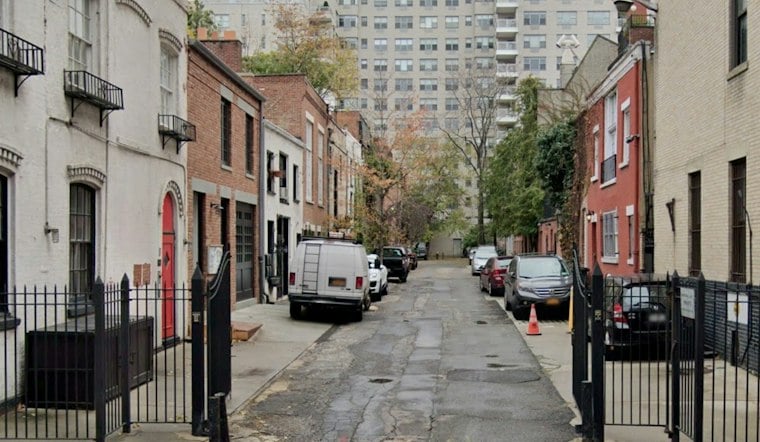
A three-story carriage house tucked behind a locked gate in Greenwich Village has hit the market for $7,995,000, and its pitch isn't just the skylight or the private garden — it's the fact that Jackson Pollock and Lee Krasner once used the place as a studio. The 25-foot-wide townhouse at 9 MacDougal Alley measures roughly 1,500 square feet, with two bedrooms, two full bathrooms and two kitchens spread across its three floors.
The listing is held by Sotheby's International Realty, according to StreetEasy. As the New York Post first reported, the home is being marketed as either a single-family residence or a live-work space, playing up the wall of windows that floods the interior with natural light. Jackson Pollock lived at number 9 from 1949 to 1950, a home he borrowed from his friend and benefactor, painter Alfonso Ossorio, according to Brick Underground.
A Studio Pollock and Krasner Shared
Ossorio maintained his own studio at 9 MacDougal Alley from 1949 to 1952, and during one of his absences in early 1951, Pollock and Krasner stayed there and used the space to work, according to Francis York. The home's principal room is a loft-like studio set beneath a large artist's skylight, the same outlet notes, with a pair of French doors opening onto a south-facing balcony lined with lavender. The ground floor connects to a private garden with mature plantings, and the house still has its wood-burning fireplace and kitchens on both the ground and second floors.
The listing also raises the possibility of future rooftop development, including a landscaped terrace and, subject to the necessary approvals, an added penthouse, per the same Francis York account. Whether any such approvals have actually been pursued or granted isn't addressed in the available listing material.
Behind the Gates of a 19th-Century Mews
MacDougal Alley itself is part of the draw. The gated mews dates back to 1833 and sits just north of Washington Square Park, lined with buildings that traditionally served as carriage houses for the grand mansions along Washington Square North, according to StreetEasy. It's the kind of street where listings are rare — Brick Underground reports that a home on the alley comes up for sale only about once every seven or eight years.
That scarcity shows up in the numbers. Appraiser Jonathan Miller told Brick Underground that private-alley addresses can carry a value bump of a few percentage points, even though the homes themselves tend to run small relative to the rest of the neighborhood. Number 7 on the same block last sold for $5.5 million back in 2009, the outlet reported — a useful marker for just how far prices on the alley have climbed since.
An Art-World Address With Deep Roots
MacDougal Alley's connection to the art world runs deeper than Pollock. Sculptor Gertrude Vanderbilt Whitney, who went on to found the Whitney Museum of American Art, took a studio at 19 MacDougal Alley beginning in 1907, converting a former hayloft and stable into a workspace of her own, according to the Whitney Museum. That complex eventually grew into the first home of the Whitney Museum itself in 1931, as Hyperallergic has reported.
Pollock's work from his years in New York, including pieces made during his time connected to MacDougal Alley, has continued to command major prices at auction; his work Number 7, 1951, an ink-and-gouache drawing on Japanese paper, sold for $4,503,500 at Christie's New York in November 2016, according to Francis York. Whether 9 MacDougal Alley finds a buyer at its current asking price — or what that buyer ultimately pays — remains to be seen.





