

























































A Jacksonville elementary school sat for decades atop a former municipal dump laced with toxic ash before it closed in 2001 due to environmental contamination, and today the same stretch of the city counts among the worst places in Florida for children to get shot. At least 375 children under 18 in Jacksonville have been hospitalized for firearm injuries since 2018, and three of the city's ZIP codes rank among the state's 10 worst for child firearm-injury rates.
The site, known as Brown's Dump, operated as a landfill from the late 1940s until the mid-1950s and contained toxic ash from nearby municipal incinerators, according to KFF Health News, as reported by the Miami Herald. The Duval County School Board built a school on the former dump site in the 1950s, and the 250-acre property was first assessed as a potential Superfund site in 1985. By 1999, the federal government and the state of Florida determined that the soil at Brown's Dump “posed a potential public health hazard,” and Mary McLeod Bethune Elementary School closed two years later, in 2001.
A Landfill's Long Road to Cleanup
Officials began cleaning up lead, arsenic and other contaminants at Brown's Dump in 2009, per the U.S. Environmental Protection Agency. The broader ash site covers more than 1,100 acres across three parcels and includes a 250-acre park. By December 2024, the EPA reported that much of the site had been cleaned or covered with new soil, and that contamination in the cleaned areas no longer threatened nearby residents or workers.
Jacksonville's history of redlining runs parallel to that contamination story. In the 1930s, the U.S. government deemed parts of Jacksonville and nearly 240 other American cities undesirable for mortgage lending, a practice that shaped decades of disinvestment in Black neighborhoods. The Jacksonville City Council approved a resolution in 2024 acknowledging and seeking to redress the effects of that redlining.
A Bank Settlement Over Lending Patterns
That history has also drawn federal scrutiny of local lenders. The U.S. Department of Justice announced a $9 million settlement with Ameris Bank in 2023 over a redlining case, according to the U.S. Department of Justice. Ameris, which reported nearly $26 billion in assets under management at the time, agreed to establish a loan-subsidy fund, improve outreach and community partnerships, and open its first branch in a minority neighborhood, along with dedicating mortgage loan officers and a director of community lending to affected areas. Ameris Bank CEO Palmer Proctor said the bank strongly disagreed with suggestions of discriminatory conduct.
Researchers have been examining whether childhood lead exposure itself carries consequences well beyond health. A study led by University of Wisconsin-Milwaukee researchers, with lead author Lindsay Emer, found that lead exposure in the first six years of life was positively associated with an increased risk of firearm violence in early adulthood. The team studied more than 89,000 Milwaukee residents tested for lead exposure by age 6 and found that exposure increased the risk of becoming a perpetrator or victim of firearm violence even after adjusting for other factors, per KFF Health News. The federal government banned lead in house paint in 1978.
Where Jacksonville's Children Are Getting Shot
More than 4,000 Florida children age 17 or younger were hospitalized for firearm injuries from 2018 through 2024, averaging roughly 1.5 hospitalizations per day statewide, according to KFF Health News. Jacksonville kids were shot most often in racially segregated neighborhoods affected by pollution, dilapidated housing, poverty and other longstanding problems, the outlet reported, and research cited in that reporting shows kids in disadvantaged neighborhoods are up to 20 times more likely to suffer firearm injuries than children in the most advantaged areas.
The dossier's underlying data carries a notable discrepancy on which ZIP codes drive those numbers. KFF Health News reported that at least 150 of Jacksonville's hospitalized children came from ZIP codes 32206, 32208 and 32209, while Action News Jax identified 32208, 32209 and 32210 as the three standout ZIP codes. UF Health Jacksonville treated 255 patients for gunshot wounds in 2024, including 32 who were 17 or younger, per KFF Health News.
Public Health Funding Has Shrunk
Resources for tracking and addressing these problems have thinned over time. Jeffrey Goldhagen led Duval County's health department from 1993 to 2005, a period when the agency had the equivalent of 852 full-time employees and spent about $91 per person in 2008. By 2019, the department had just 422 workers and spent $34 per person, according to the same reporting.
Not every resident has stayed passive in the face of this history. Spencer Fletcher worked to save 26 bungalows in a historically Black Jacksonville neighborhood, according to KFF Health News, an effort tied to the broader push to preserve what remains of these communities amid decades of disinvestment and contamination.
A Morgue Project Draws Its Own Backlash
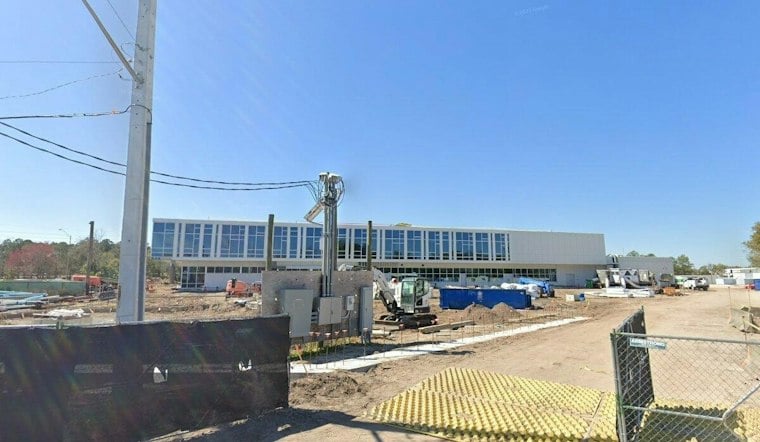
Separately, the city's handling of another facility has stirred local anger. Jacksonville officials allowed a new medical examiner's office and morgue project to move forward in 2024, with the roughly 51,000-square-foot, two-story building located at 4368 North Davis Street in Brentwood, a neighborhood where more than 80% of residents are Black. The Jacksonville City Council approved $62.8 million in borrowing for the facility on April 11, 2023, according to a complaint filed in Duval County Circuit Court and hosted by Jax Today.
That complaint alleges construction of the morgue began before the city secured proper rezoning and approvals, and that officials failed to provide required notice and meaningful community input under Jacksonville's Neighborhood Bill of Rights — allegations from plaintiffs that have not been adjudicated. Brentwood residents have requested an urgent care center or pharmacy at the site instead, and the complaint cites research reporting an average 17.3% decrease in property values when a mortuary is sited in an area.
The Florida Times-Union reported that in 2020, Jacksonville officials considered at least three industrial properties east of the Eastside neighborhood as possible alternative sites for the medical examiner's office. In one case, a consultant offered the owner of an East 7th Street property $900,000, but the owner countered at $1.25 million and the city balked at the price, per The Florida Times-Union. An environmental programs manager said some of those alternative sites would likely have carried their own contamination concerns.
The report tying Jacksonville's gun-violence data to its environmental and lending history was produced by KFF Health News, The Trace and Action News Jax, with data editing by KFF Health News data editor Holly K. Hacker. The Miami Herald version of the story was authored by Fred Clasen-Kelly, Daniel Chang, Olga Pierce and Yona Gavino.





