

























































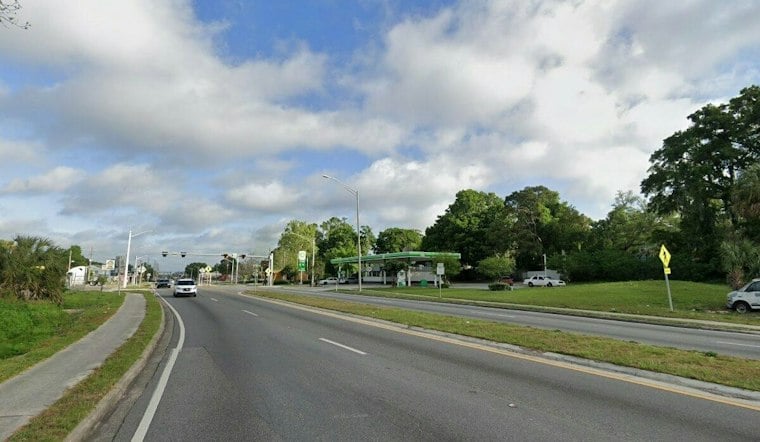
Jacksonville's proposed FY 2024/25 budget paperwork says the city met—on paper—the ordinance requiring a share of local gas-tax revenue to fund bicycle and pedestrian safety. That accounting does not resolve a dispute over whether the funded work has delivered dedicated safety infrastructure: city officials say they are identifying specific projects for next year's capital improvement plan after an advocate questioned how the money was used.
At an August mayoral budget town hall, Stephen Tocknell, president of Pedaling for Safety, questioned whether the designated funds were supporting the improvements he believes are needed, according to First Coast News. Tocknell told the outlet that some maintenance projects had been labeled as pedestrian-related to meet the funding obligation. He called for road designs that slow traffic and protect cyclists, as well as trails connecting parts of the city.
Jacksonville's Local Option Gas Tax is a six-cent-per-gallon tax on motor fuel and diesel sold in Duval County, with revenue divided between the city and the Jacksonville Transportation Authority. Under the proposed FY 2024/25 budget, the city retained one cent and JTA received the other five, according to a Council Auditor handout filed with the City Council. A 2014 City Council ordinance, now Municipal Code Section 799.107, requires 20% of the city's share to fund bicycle and pedestrian safety improvements. The city's share has amounted to roughly $1 million, per First Coast News.
A Process the City Admits Had Gone Dormant
Matt Fall, the city's transportation programs supervisor, acknowledged to First Coast News that the process for allocating that money to specific projects had become dormant for a long time. He said Jacksonville is now in the process of better directing gas-tax dollars toward concrete bicycle and pedestrian projects, and that the city will prioritize shared-use paths in areas with higher numbers of bike and pedestrian crashes.
The Council Auditor's FY 2024/25 proposed budget listed $5,081,586 in projects funded through the one-cent share, including $1,016,317 earmarked for ADA-compliant curb ramps and sidewalks, according to the City of Jacksonville Council Auditor. The document says the 20% bicycle and pedestrian spending requirement was met as proposed. That establishes how the budget counted the allocation; Tocknell's criticism is that such technical compliance may not have produced dedicated new bike and pedestrian infrastructure.
The Jacksonville mayor's office has said the city plans to add more bicycle and pedestrian safety projects in accordance with city code, and that outreach has increased through initiatives including the city's Vision Zero program. A draft 2026 List of Priority Projects points to where some of that could land: a Normandy Boulevard project stretching from I-295 to Cassat Avenue calls for a protected bike lane and pedestrian-safety improvements requiring resurfacing, while a separate project on Lem Turner Road and Norwood Avenue would add bike lanes, sidewalk improvements, buffer areas, transit improvements and other safety measures, according to the same council auditor filing.
Behind the Push: A Rising Pedestrian Death Toll
The urgency behind the funding fight traces back to Jacksonville's traffic-safety numbers. As of late June, the city had recorded 92 traffic fatalities in 2026, 25 of them involving pedestrians, according to the Jacksonville Sheriff's Office Traffic Homicide Unit, as reported by News4Jax. Fall told the station that more than 60% of the city's pedestrian fatalities happen in dark lighting conditions, and that the share of crashes involving vulnerable road users like cyclists is rising even as crashes decline nationally.
Jacksonville's Vision Zero Action Plan is meant to target those patterns directly, using crash data to identify roads and intersections where severe and fatal crashes cluster most often. The city has described the plan as aiming to reduce speeds, improve lighting and crossings, and implement traffic-calming measures along high-crash corridors, the same station reported last year. Fall has said the city's broader approach should combine improved infrastructure, educational outreach and reduced vehicle speeds in pedestrian-heavy areas, with the ultimate goal of reducing fatalities to zero.
Jacksonville's pedestrian-safety record has drawn outside scrutiny too, though the picture is not entirely consistent. One ranking places the city 16th nationally for pedestrian fatalities, while a separate Smart Growth America study has ranked Jacksonville among the top 10 U.S. cities for pedestrian deaths — different studies using different methodologies that were not detailed in city materials reviewed for this story.
Jacksonville's Safety Classification
The City of Jacksonville says Florida remains a Focus State for pedestrian and bicycle safety and Jacksonville is within a designated Focus MPO/Region—the North Florida Transportation Planning Organization region, according to the City of Jacksonville. The designation provides geographic context for the city's safety work; it does not itself show how crash counts have changed over time.
Regional Context and What the Law Allows
Florida law caps local-option fuel taxes at six cents per gallon and requires that revenue go toward transportation expenditures, including comprehensive-plan capital improvements and critical transportation-related projects, according to the Florida Legislature. Where local governments split that revenue through interlocal agreements without built-in adjustments, state law requires the terms to be reviewed and public hearings held at least every two years.
Jacksonville's situation echoes smaller efforts elsewhere in the region. Atlantic Beach received $200,000 for a plan to implement complete-streets projects aimed at improving safety for drivers, pedestrians and cyclists alike, while Palatka was slated for $960,000 toward a safe-streets plan, according to reporting from Jax Today. The North Florida Transportation Planning Organization has also mapped out so-called Bicycle and Pedestrian Level of Stress ratings across the region, scoring roads from one to four based on factors like pavement condition, heavy-vehicle traffic and intersection design, per the organization's own planning materials. The TPO has separately studied the feasibility of a Core to Coast Trail that would connect downtown Jacksonville to the city's beach communities, a longer-term vision for the kind of connected trail network Tocknell says he wants to see realized.





