

























































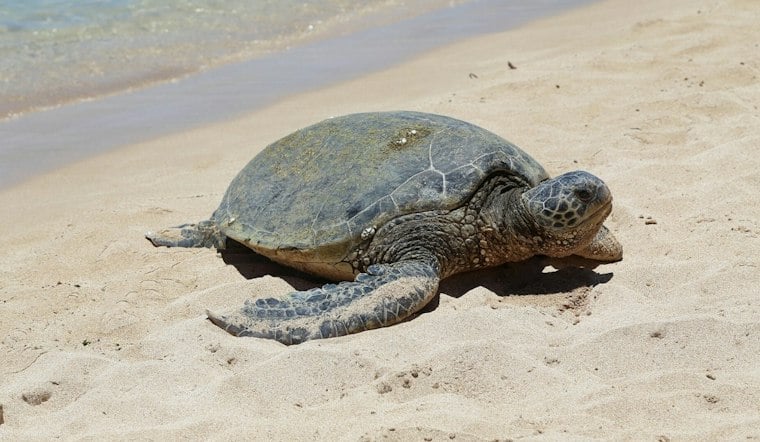
A green sea turtle nest on Jekyll Island hatched 66 eggs on Oct. 11 following a 56-day incubation period, an unusual event on a beach where loggerheads typically dominate the sand. The nest, laid Aug. 16, also left behind 84 eggs that did not hatch, according to a conservation team inventory.
The hatch marks only the third green sea turtle nest documented on Jekyll Island since monitoring began in the 1950s, and the second to have hatched successfully, according to savannahnow.com. The Brunswick News described it in its headline as Jekyll Island's first successful green sea turtle nest in 19 years, consistent with the 2026 hatch being the island's second successful nest after one in 2007.
A Painstaking Count on the Sand
The Jekyll Island conservation team completed its nest inventory on Oct. 14, several days after the hatch, carefully sorting through the sand to tally hatched and unhatched eggs, per actionnewsjax.com. During that same inventory, the team documented a leucistic green sea turtle hatchling displaying pale, almost white coloration, the station reported.
Jekyll Island's primary nesting species remains the loggerhead, with its first documented green turtle nest recorded in 2007, according to the Sea Turtle Nest Monitoring System at seaturtle.org. Conservation workers collect genetic samples from all sea turtle nests on Jekyll and send them to a University of Georgia laboratory for DNA analysis, savannahnow.com noted.
A Northward Shift Conservationists Are Watching
Green sea turtle numbers in Georgia are slowly starting to increase, a trend that Will Hicks, a conservation technician referenced in the same savannahnow.com report, attributed largely to decades of conservation work. Hicks also pointed to what he described as a northern expansion of the range of green sea turtles, which have historically nested primarily in warmer Caribbean and South Florida waters.
Population models cited in that report suggest sea turtle populations could recover over the next 30 years to pre-1940s numbers. Georgia's loggerhead population, meanwhile, has been increasing at approximately 4 percent annually since the early 1990s, according to the Georgia Department of Natural Resources.
Loggerhead Numbers Swing Year to Year
Georgia loggerhead nesting peaked at 4,071 nests in 2022, then dipped to 3,431 in 2023 before reaching just over 2,490 in 2024, the state wildlife agency reported. That volatility makes 2026 notable: Georgia's loggerhead nest count climbed to its highest level since 1989 this year, with totals topping 4,110 nests by early August after surpassing the prior record of 4,071 set in 2022, according to the Georgia Wildlife Blog.
Nearby Cumberland Island also set a nesting record this season, documenting 1,256 total nests and surpassing its previous mark of 1,255 set in 2022, per actionnewsjax.com's separate report. That count included 1,207 loggerhead nests, five green turtle nests and three rare Kemp's Ridley nests, with the island's 18-mile beach stretch often accounting for roughly a quarter of Georgia's total sea turtle nesting activity.
What Protections Exist for Green Turtles
Green sea turtles are among the species the U.S. Fish and Wildlife Service and NOAA Fisheries have looked to protect under the Endangered Species Act, including a 2023 proposal tied to critical habitat designation, according to the U.S. Fish and Wildlife Service. Separately, turtle excluder devices are designed to allow sea turtles to escape when accidentally caught in trawl fishing gear, according to NOAA Fisheries.
For the team on Jekyll Island, the rare nest and its pale hatchling are a reminder of what sustained conservation work can produce, even in small, singular moments on a stretch of Georgia coastline better known for its loggerheads.





