

























































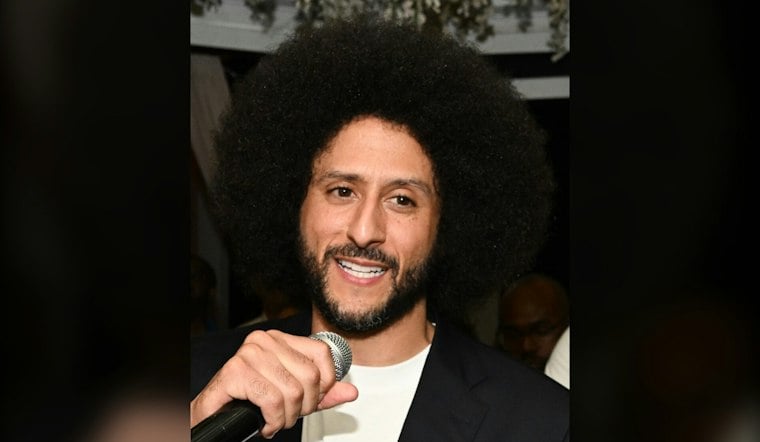
Colin Kaepernick stood before a sold-out crowd in Dallas on October 6 and did what he's been doing for a decade: asked NFL owners to explain themselves. The former San Francisco 49ers quarterback, promoting his new memoir, questioned why Dallas Cowboys owner Jerry Jones and other owners opposed demonstrations against police violence, reviving a confrontation that first erupted a decade ago and never really went away.
Kaepernick appeared at The Black Academy of Arts and Letters as part of a book tour for his memoir, The Perilous Fight, according to Yahoo Sports. The event, organized by The Dock Bookshop and moderated by four-time Olympic gold medalist Michael Johnson, sold out across both general-admission and VIP tiers, per The Shadow League. Kaepernick told the crowd his 2016 protest addressed police killings of Black Americans and broader racial injustice, the same framing he's maintained since he first sat during the national anthem before a 49ers preseason game on August 14, 2016, before switching to kneeling later that season.
A Decade-Old Standoff Revisited
The Dallas appearance gave Kaepernick a public platform to question why Jones and other owners opposed demonstrations against police violence in the first place. Jones criticized the anthem protests during the 2016 season, calling them disappointing and praising Cowboys players who chose not to kneel, the station's report notes. He argued that the demonstrations could hurt the league's standing with fans and distract from the games themselves, a stance he doubled down on in October 2017 when he said Cowboys players who disrespected the flag would not play.
Kaepernick hasn't appeared in an NFL game since January 1, 2017, and remained unsigned as of this October, even as he's stayed visible as an author and social-justice advocate. His protest split public opinion from the start, drawing praise from supporters who said he raised awareness of social issues and criticism from those who argued politics had no place in football. He filed a grievance against the league in October 2017 alleging collusion among owners to keep him off rosters, and the two sides reached a confidential settlement in February 2019 without any public finding, per the same Yahoo Sports account.
How Public Opinion Shifted Over Time
Polling suggests the country's view of the gesture moved considerably in the years after Kaepernick first knelt. Just 28% of Americans considered his actions appropriate in 2016, a number that climbed to 35% by 2018, according to Axios. By 2020, a Yahoo News/YouGov poll found a majority of Americans supported NFL players kneeling during the anthem to protest racial inequality, with only 36% disapproving.
That same 2020 survey found sharp divides by age, race and political affiliation. Respondents between 18 and 29 were the most supportive group, with 68% calling the protest appropriate, while support ran to 77% among Black respondents, 57% among Hispanic respondents and 47% among white respondents, Axios reported. The partisan gap was just as stark: 77% of self-described Democrats backed the protest, compared with 20% of Republicans and 20% of Trump voters, figures that closely track a separate Yahoo News/YouGov poll cited by NBC Sports, which found 52% of Americans found kneeling acceptable against 36% who did not.
Claims About the NFL's Response Behind the Scenes
Beyond the Dallas stage, Kaepernick has also described what he says happened inside the league's inner circle after players began kneeling alongside him. By the end of the 2016 season, dozens of other NFL players had joined the demonstrations, according to The Guardian. Kaepernick has said that during a 2017 meeting between players and owners, Patriots owner Robert Kraft called the kneeling and the protests “the elephant in the room,” and that Bills owner Terry Pegula followed by saying, “We need a Black face to help us end this,” claims reported by Yahoo Sports.
Kaepernick has said NFL owners were explicitly looking for a prominent Black figure to help steer the league away from the player-led protests he started, and that he was offered a role leading the league's social-justice initiatives, which he rejected. He has also compared the NFL's partnership with Jay-Z to what he described as the FBI's historical use of Black people to undermine the Civil Rights movement, a characterization reported by The Shadow League. None of these accounts have been corroborated by the NFL or other participants named in them.
Inspire Change and the League's Own Accounting
The NFL has pointed to its Inspire Change initiative as its answer to the unrest Kaepernick's protest set off. The league says it has provided more than $244 million to 37 national grant partners and hundreds of grassroots organizations since 2017, according to the NFL. The league recently announced renewals of 21 national grant partnerships totaling $6.5 million, with funding directed toward education, economic advancement, police-community relations and criminal-justice reform. As reported by Cleveland.com, Kaepernick's Dallas remarks land a decade after his first protest, a milestone that has renewed scrutiny of whether the league's response has settled the question he first raised or simply managed it.





