

























































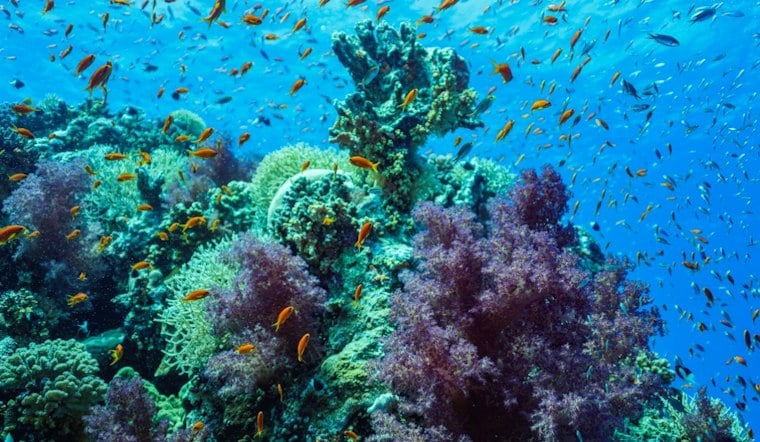
Storm-driven surf and surge damaged coral along Kauai's south and west shores after Hurricane Nolo brushed past the island on Sept. 7 and 8. A local restoration group and its partners assessed nearly 20 miles of reef, and Hoomalu Ke Kai is now working to reattach more than 2,000 damaged corals.
The restoration effort is operating through the Hawaii Emergency Reef Response Network, according to The Garden Island. Tim Leichliter of Hoomalu Ke Kai told the outlet that the group and its partners surveyed the reefs following Hurricane Lowell. Hanakaape Bay, accessed through the Koloa Landing boat ramp, was among the areas with the most significant damage.
“Hanakaape Bay, with its lead-in access at the Koloa Landing ramp, was one of the areas where we documented some of the most significant coral damage,” Leichliter said, per the outlet's report. The group's work is part of a broader hands-on restoration response operating under the Hawaii Emergency Reef Response Network, with emergency restoration authorized by NOAA and administered through the state's Division of Aquatic Resources, while the Division of Land and Natural Resources oversees the state authorization, as reported by The Garden Island.
A Narrow Window for Reattachment
Leichliter described a 45-day survival window for damaged coral, making timely reattachment a priority. Hoomalu Ke Kai received a HERR permit to work with more than 2,000 damaged corals over a 10-day period. He said securing the permit was difficult, according to The Garden Island.
What the Research Says About Coral Recovery
A U.S. Geological Survey study of storm-generated coral fragments in the U.S. Virgin Islands followed colonies for 12 years and found that survival differed by species and transplant status; 9% of the colonies studied were alive at follow-up. The project was separate from Kauai's restoration effort, and its findings do not establish a universal 45-day survival cutoff, according to the U.S. Geological Survey. For reference, NOAA's National Centers for Coastal Ocean Science produced maps of benthic habitats in Kauai's nearshore waters shallower than 30 meters. Those maps describe habitat types, not damage from the current storm or the storm's name and track, according to NOAA's National Centers for Coastal Ocean Science.
The response includes further documentation dives as well as recovering and reattaching broken coral to the reef. Leichliter has been joined underwater by Kaiulani, an emergency coral response specialist from Mexico. Hoomalu Ke Kai also postponed a planned Saturday water entry because of uncertain weather, water quality and visibility conditions, the outlet reported.
Koloa Landing Becomes a Makeshift Reef Hospital
Access and logistics have also been part of the response. Koloa Landing is serving as a base for restoration work, including coral education, mixing specialized concrete for reattachment and staging dive support. Community partners led by Marvin Otsuji worked through county permits to clear debris and smooth the landing entrance for safer crew access, according to The Garden Island.
Kauai's response fits into a larger pattern playing out across the state this storm season. The Hawaii Emergency Reef Response Network has developed statewide guidance and trained island-based teams, according to The Nature Conservancy, after network members conducted rapid assessments and hands-on restoration on Maui and Oahu following Kona Low storms that caused coral breakage and sedimentation. The conservancy notes that acting quickly, within weeks of impact, is essential to saving damaged corals and supporting reef recovery.
That urgency has played out elsewhere in the islands this season too. Hurricane Lala triggered a first-ever $200,000 payout from Hawaii's coral reef insurance policy on Aug. 21, and Hurricane Lowell triggered a second payout of $300,000 roughly two weeks later to fund reef-damage assessment and repair, per the same conservancy report. Hawaii News Now reported that the combined half-million-dollar payout funded crews who surveyed 30 miles of Hawaii Island coastline and recently reattached more than 200 corals in a single day.
Why the Reefs Were Already Vulnerable
The storm damage lands on reefs that were already under strain. Hawaii's corals are struggling to survive against warming seas from climate change, cesspools, overtourism and other human impacts, according to Civil Beat. That backdrop is part of why the insurance mechanism backing this work matters: the policy, first purchased in 2022 as the first of its kind in the U.S., provides a maximum payout of $2 million over its year-long period and up to $1 million per qualifying storm, per The Nature Conservancy.
The Hawaii Emergency Reef Response Network describes itself as a coordinated statewide coalition of government agencies, scientists, nonprofits and community groups, and it is now seeking new funding mechanisms, whether public, private, philanthropic or blended, to keep reef restoration going regardless of what causes the next round of damage. Immediate coral-damage assessment, collection and reattachment work typically starts at around $25,000 per acre, according to the Honolulu Star-Advertiser, which also reported that Kuleana Coral helped reattach more than 400 broken corals in Maunalua Bay during a previous Kona Low response.
Kauai residents can follow or support the effort through kauaicoralrestoration.com. Hoomalu Ke Kai and the Kauai Coral Restoration Nursery are also scheduled to host a community screening of Chasing Coral, filmmaker Jeff Orlowski's documentary, on Oct. 16 at the Kauai Community College Performing Arts Center. Doors open at 5:30 p.m. with a share-out, a panel discussion begins at 6:30 p.m., and the film screening starts at 7 p.m., according to The Garden Island.



