

























































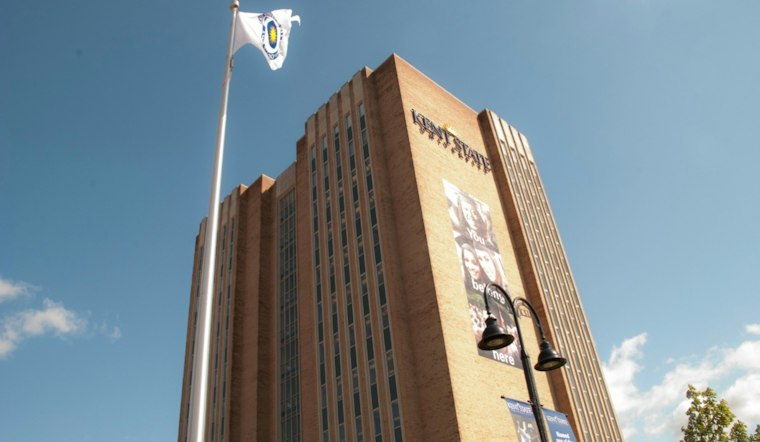
Forty-five college students spent a weekend designing clothes for humanoid robots at Kent State University, turning the campus Innovation Hub into an unlikely runway where puffy gowns, knitted sleeves and motorized garments competed for prizes. One team built a soft, bubbly dress meant to make a robot look comforting enough to sit with a nervous kid in a classroom. Another, led by a Carnegie Mellon robotics Ph.D. student, wrote original software just to make a knitted garment move.
The event, called the Humanoid Robot Fashion Challenge, took place at Kent State University's Innovation Hub in Kent, Ohio, according to WKYC. Teams had roughly a day and a half to design looks for different robot models before showing their work to the public and a panel of judges the following day, the station reports. Organizers believe it to be the first event of its kind on a college campus, per the same account.
A Dress Designed to Comfort, Not Just Decorate
Katie Kennedy, a freshman at Kent State whose team included an engineering major, helped design a puffy, bubbly dress for one of the competition's robots. The team wanted the robot to look appealing and comforting to children, with an eye toward therapy use in classrooms similar to how therapy dogs are used, the station notes. It's a reminder that the clothing wasn't just decoration — it was meant to shape how a person reacts the moment a robot walks into the room, since, as the report puts it, the clothing is intended for the people interacting with the robot as much as the machine itself.
That idea echoes broader research into why people dress robots at all. A 2024 study from the Association for Computing Machinery, which interviewed 11 people who create clothing and accessories for robots, found that experts tend to dress robots to express individual identity, appeal to different audiences and boost a machine's expressivity, according to ACM. The same research describes robots being dressed either to blend into their surroundings or to stand out during special events, suggesting Kent State's students were tapping into a real design tension rather than just playing dress-up.
Knitting, Code and a Winning Sleeve
Angelica Bonilla, a robotics Ph.D. student visiting from Carnegie Mellon University, took a more technical approach. She wrote her own software to control the movement of her garment and described working on a sleeve for a robot using a knitting machine, per WKYC's report. Bonilla called fashion an underrated technology and said personal accessories, and technology as a form of accessorizing, are worth taking seriously.
Her background backs that up. Bonilla describes herself as a Colombian artist, engineer and researcher focused on human-computer interaction, robotic creativity and immersive technologies, according to a Carnegie Mellon University School of Art profile, which notes her recent work uses computerized machine knitting, plotters and collaborative robot arms. At Kent State, that expertise paid off: Bonilla's team won the competition's top prize with its knitted design, while Kennedy's team took home one of five prizes awarded.
Clothing Robots Comes With Its Own Rules
Dressing a robot isn't the same as dressing a mannequin. The ACM study identified practical concerns designers have to navigate, including pinch points and environmental clearance, since fabric and moving mechanical parts don't always coexist peacefully. Those same researchers found the challenge spans far beyond humanoids, having examined clothing practices across six very different robot platforms — Robovie, Roomba, Pleo, ERICA, Dragonbot and Ohmni Robot.
Kent State's competition fits into a small but growing niche of robot fashion events. A 2025 Humanoids conference featured its own Robot Fashion Show competition, covering robot design, fashion for robots and safe human-robot interaction, according to the 2025 Humanoids conference. Separately, a GitHub project tied to the October 2026 Kent State challenge documents 3D-printable Dutch wooden clogs made for a Booster K1 humanoid robot, complete with simulation models showing the robot's barefoot dance moves still working once it was fitted with the wooden shoes.
Together, the projects point to designers treating robot clothing as functional engineering as much as creative expression — whether it's a dress meant to put a child at ease or a knitted sleeve rigged with custom code. For the 45 students who spent a weekend at Kent State's Innovation Hub stitching, coding and problem-solving, the challenge offered a glimpse of a field where fashion and robotics are increasingly inseparable.





