

























































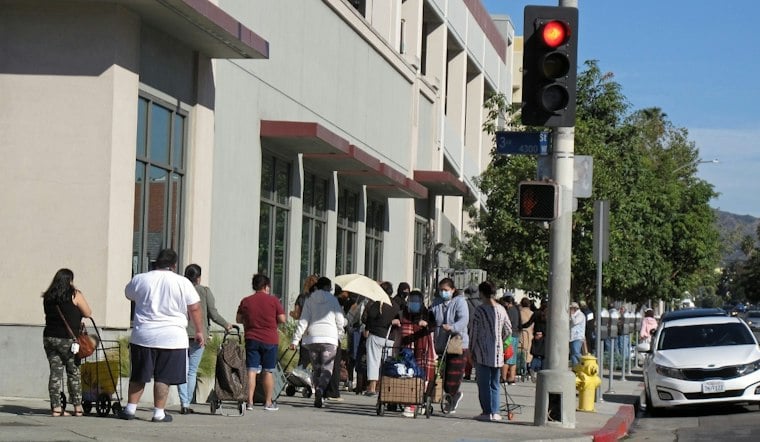
Close to 50 people were already lined up in Koreatown before a brand-new food distribution program even opened its doors for the first time. That kind of turnout has become the new normal for community groups across Los Angeles County since stricter eligibility rules and benefit-delivery changes to SNAP and CalFresh took effect on October 1, and local organizers say they are scrambling to keep pace.
The program, called Sijang, is a mutual-aid food distribution effort launched by the Korean Resource Center, which hands out rice, kimchi, fresh produce and other staple groceries out of its Koreatown facility. As reported by LAist, Sijang is organized in partnership with Polo's Pantry and the Hollywood Food Coalition, and it held its second distribution in September at the Korean Resource Center. The next marketplace is scheduled for October 23, also at the center's Koreatown site.
Danny Park, who spearheads Sijang, said community and social networks step in when social welfare programs and public institutions fail. The center has told organizers it will turn no one away, according to the same LAist report.
A County-Wide Benefit System Under Strain
Los Angeles County receives CalFresh benefits for about 1.5 million people, but roughly 320,000 eligible residents remain unenrolled, per the latest available data cited in the LAist report. The Korean Resource Center helped enroll 4,286 people in public assistance programs in 2025, handling an average of 18 enrollments a day — numbers that hint at how much ground community organizations already covered before this month's rule changes took hold.
Founded in 1983, the Korean Resource Center has spent more than four decades offering low-cost immigration legal services, healthcare enrollment, housing counseling and civic advocacy to low-income Asian American and immigrant communities across Southern California. Staff there also help elderly residents take cans and bottles to recycling centers to earn extra money, the LAist account notes.
Those efforts are unfolding against a backdrop of stark need. A USC Dornsife study found that 24% of Los Angeles County households experienced food insecurity in 2025, the same study cited in the LAist report. Separately, California's Legislative Analyst's Office estimated that roughly 840,000 Californians would become subject to expanded federal SNAP work rules in 2026, with about 660,000 of them at risk of losing food assistance under the changes, according to Hoodline's earlier coverage of the rule changes.
Pico-Union Grocer Says It Wasn't Ready for This
A few miles away in Pico-Union, With Love Market & Café has been absorbing its own version of the strain. Anna Cho-Son, the store's community programs director, said the market was deeply unprepared for the full impact of the SNAP changes, per the LAist report. Most customers at the market use EBT, but the store has seen a decline in EBT users since the changes took effect, and some partner organizations have lost funding and canceled contracts with the market, according to the same account.
The market, which is owned by 38 community investors and operates at a loss on its grocery sales, offers a produce incentive program called With More California. The program matches SNAP spending on California-grown produce and provides up to $40 worth of free produce per day, the LAist report states. The market has also increased outreach at schools and community colleges while it works to develop a more sustainable local food system.
With More California fits into a broader state framework: the California Department of Food and Agriculture's California Nutrition Incentive Program doubles CalFresh spending dollar-for-dollar when used on California-grown produce at participating farmers markets and small grocery retailers, supporting both household nutrition and local growers.
Why Even CalFresh Recipients Are Going Hungry
The strain is not limited to those losing eligibility. A December 2025 USC Dornsife study found that 25% of all food-insecure LA County residents earned more than 300% of the federal poverty level, making them ineligible for CalFresh despite struggling with housing and grocery costs, according to reporting from LAist. Nearly half of all CalFresh recipients in the county — 44% — experienced food insecurity in 2025, the same research found, suggesting standard benefit amounts often fail to stretch through the month in one of the nation's priciest regions.
That gap between enrollment and actual food security helps explain why mutual-aid efforts like Sijang are drawing crowds even before their doors open. It also underscores a paradox tracked by FoodCycle LA: despite the county's hunger numbers, as much as 40% of surplus edible food historically went to landfills, a dynamic that prompted California's Senate Bill 1383 to mandate that larger commercial food businesses divert edible surplus to food recovery organizations instead.
Sijang's partner organizations include the Hollywood Food Coalition and Polo's Pantry.
Where To Find Help Right Now
Sijang distributions take place at the Korean Resource Center, located at 900 Crenshaw Blvd Unit B, which can also be reached at 323-937-3718. With Love Market & Café is located at 1969 S. Vermont Ave. and is open 8:30 a.m. to 6 p.m. Monday through Friday and 8:30 a.m. to 3 p.m. Saturday. The next Sijang marketplace is set for October 23 at the Korean Resource Center's Koreatown facility.
CalFresh benefits help feed households. As stricter rules squeeze household budgets this month, organizers in Koreatown and Pico-Union say they cannot afford to stand still.





