

























































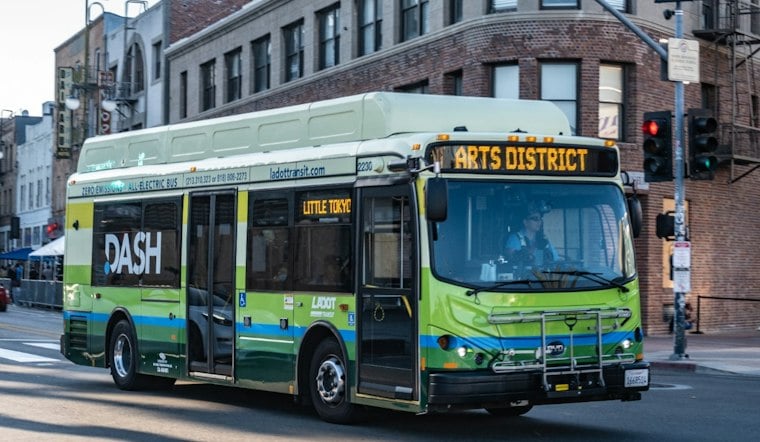
Los Angeles DASH buses are about to get a lot more watchful. The City Council voted 13-1 on Wednesday to authorize installing up to 50 cameras on city DASH buses to catch drivers blocking bus lanes, with the Los Angeles Department of Transportation set to flip the system on starting Nov. 1 with 30 buses covering downtown routes A, B, D, E, F and Pico-Union.
The council also approved a resolution designating specific street segments as bus lanes and signed off on LADOT's updated automated license plate reader use policy. According to NBC Los Angeles, a second phase would add 20 more cameras on buses serving Crenshaw, Panorama City/Van Nuys, Watts and Wilshire Center/Koreatown. Drivers won't be hit with fines right away — the city plans to issue warnings for the program's first 60 days.
Councilman John Lee cast the lone dissenting vote, and he didn't hold back about why. Lee said he had serious concerns about Hayden AI, the contractor LADOT wants to use, accessing city data under a proposed master data license and protection agreement, noting that the city's current ALPR policy authorizes users — including contractors assisting the city — to access that data. He also said Hayden AI's founders have faced recent accusations of fraud and espionage, including allegations involving the sharing and distribution of company secrets, adding that those accusations had not appeared to affect Los Angeles residents but merited consideration as the city hammers out its ALPR policy.
A Council Ally Pushes for Broader Data Rules
Councilwoman Monica Rodriguez ultimately voted in support of the item, but she didn't let Lee's concerns go unanswered. She thanked Lee for highlighting inconsistencies in which city agencies are authorized to use the technology and introduced a motion calling on the city to examine data usage and collection practices across every department. Rodriguez said data-sharing protections should apply uniformly across every city department and contract, not just the DASH camera program. Councilmember Eunisses Hernandez was absent for the meeting.
The data fight centers on a familiar name: LADOT is proposing to piggyback on an existing Metro contract with Hayden AI rather than negotiate a brand-new deal. That proposed three-year contract would cost the city $3.43 million if finalized, per the same NBC Los Angeles account, covering installation, operation, management and maintenance of up to 50 cameras on DASH buses.
Why LA Is Betting on Bus-Lane Cameras
Officials say the push is about more than ticket revenue. Bus-lane violations have caused slower boarding and alighting, created safety risks and added to traffic delays, officials said. A 60-day LADOT pilot found the scale of the problem: the agency collected data on more than 2,400 violations along DASH routes A and F and downtown stops, averaging four bus-lane violations per bus per hour, the station's report notes.
LA isn't inventing this approach from scratch. Metro launched its own Bus Lane Enforcement pilot with LADOT in November 2024 after a competitively bid request for proposals led the agency to select Hayden AI, according to Metro. That 2023 agreement covered hardware, software and data processing for 100 cameras placed on Metro buses running on five routes that cross into city jurisdiction. The Metro system uses bus-mounted cameras to capture suspected violations, which LADOT then reviews before issuing citations.
The contract's price tag has been reported differently by different outlets. The Los Angeles Times described it as an $11 million agreement to deploy 100 camera systems expected to last roughly five years, according to the Los Angeles Times, while LAist reported that Metro paid Hayden AI $10.5 million for camera equipment and to facilitate the program.
Early Results From Metro's Program
Metro's existing cameras, active on Lines 70, 212, 720, 910 and 950 and serving more than 61,000 riders daily per Metro, have already generated significant numbers. Through January 2026, the program had sent 281,000 potential violations to the citation management system and generated more than $21 million in gross revenue, NBC Los Angeles reported. LAist separately found that more than 5,500 citations were sent in a single month for vehicles parked in bus lanes or at bus stops on the 720 and 212 routes.
The data also suggests the cameras change driver behavior over time. After one year, citations issued fell by about 33%, about 77% of people committed only one violation, and chronic offending was reduced, according to the NBC Los Angeles report. Speed and reliability on routes 212 and 720 improved by 7% to 9.8% through January 2026, with officials crediting the program for improved rider satisfaction and safety as well.
Other transit agencies have taken similar steps. AC Transit equipped 100 buses with two forward-facing cameras, initially issuing warnings for 60 days before moving to $110 citations, according to AC Transit, which says its camera system has no facial-recognition or other biometric-detection capabilities. In West Hollywood, citation notices began in September 2025 along part of North La Brea Avenue, per Metro's program page.
Privacy Safeguards and a Looming State Deadline
On the privacy front, a LADOT report tied to the council item states that law-enforcement-agency requests for city-collected citation information require a subpoena and consultation with the City Attorney's Office. John Lee said the council should maintain the same level of scrutiny for all ALPR contracts across the city, a point he and Rodriguez both raised Wednesday in criticizing aspects of LADOT's policy even as most of the council ultimately backed the program.
Hanging over the whole effort is a state law set to expire soon. The legal authority allowing transit agencies to collect video images of bus-lane violations and issue citations comes from AB 917, which then-Gov. Gavin Newsom signed in 2021, authorizing public transit agencies statewide to use the cameras. According to California Legislative Information, that authority is effective only until Jan. 1, 2027.
LADOT expects the DASH program to run for three years, but that timeline depends on the state extending the 2021 law. If the authority lapses, Los Angeles can terminate the Hayden AI agreement early, and the city says it will cover costs only for the duration of whatever contract is in place. The council authorized the camera rollout, but the contract still must be finalized and the program depends on an extension of state-law authority; the Legislature had approved an extension bill awaiting the governor's signature.


