

























































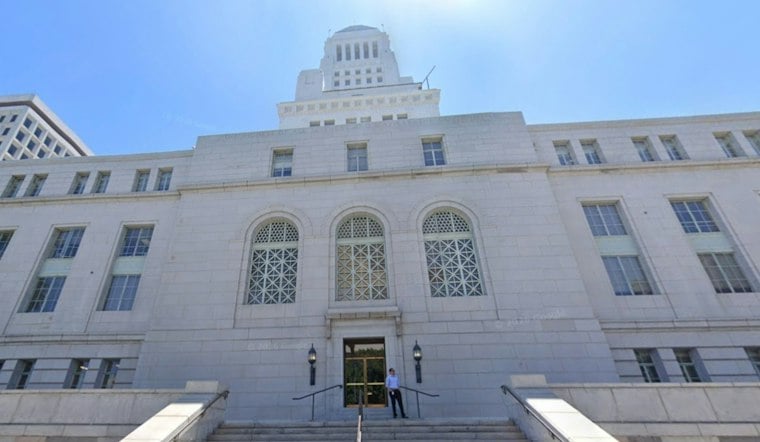
Los Angeles' Transportation Committee voted unanimously to ask LADOT to report what resources it would need, including heavy equipment, to start installing durable concrete bike lane barriers itself, instead of relying on flimsy plastic posts that keep failing across the city's protected bikeway network. The motion, introduced by committee chair Heather Hutt, now heads to the full City Council for consideration.
At issue is the plastic K71 bollard, a post that separates most of Los Angeles' 90.7 miles of protected bike lanes from vehicle traffic. As reported by MyNewsLA, Hutt described the bollards as only a temporary treatment, noting that, per the motion, they are designed as quick-build barriers that can bend or crumble when struck by a vehicle and, when damaged, no longer protect cyclists at all. The average K71 bollard requires replacement every seven months, according to the same motion.
Toronto-Style Barriers Already Being Tested
LADOT has been experimenting with an alternative: pre-cast modular concrete barriers, sometimes called Toronto barriers, that bolt directly to the pavement. Per the motion covered by MyNewsLA's report, these low concrete walls serve as a durable alternative to cast-in-place concrete curbing on busy streets, creating a sturdier buffer between bike lanes and moving traffic. City officials have already run successful pilots on 3rd Street in Downtown Los Angeles and on Imperial Highway near Dockweiler Beach, the motion states.
The 3rd Street pilot began modestly. LADOT first installed the low concrete walls, standing roughly 18 to 24 inches tall, across 140 feet, according to Streetsblog Los Angeles. The outlet later reported that LADOT extended the installation to approximately 300 feet along the corridor between Main and Spring streets while collecting cyclist and community feedback through an online survey.
More Corridors in the Pipeline
LADOT now plans additional concrete barrier installations on Ohio Avenue, Chandler Boulevard, and Spring and Alameda streets, according to the motion cited by MyNewsLA. The Spring/Alameda corridor is already under construction: Streetsblog reported that work began in July 2026 on a 1.2-mile Spring/Alameda Safety & Mobility Project connecting Union Station to L.A. State Historic Park, which is designed to install permanent concrete Toronto barriers along protected bike lanes near the Chinatown Metro A Line Station.
But there's a catch holding the program back. LADOT cannot install the concrete barriers on its own, per the motion, because it depends on the Bureau of Street Services for the heavy equipment needed to move and position them. Hutt's motion argues LADOT should have the in-house capacity to install barriers itself without waiting on another department.
Measure HLA's Legal Pressure
The push for sturdier barriers comes against the backdrop of Measure HLA, approved by 65.5% of Los Angeles voters in March 2024. The law, codified as LAMC Section 85.11, sets requirements for certain improvement projects on Mobility Plan streets, including Class IV bikeway standards that allow several forms of separation, such as concrete curbs or barriers, bollards, and flexible posts, according to Los Angeles City Planning.
Yet the city's overall bikeway mileage has barely budged. During Fiscal Year 2025–26, Los Angeles added only 7.5 lane-miles of new bikeways while removing 5.3 miles of existing ones, for a net increase of just 2.2 miles citywide despite the HLA mandate, Streetsblog's analysis found. The Transportation Committee also approved a separate motion seeking an LADOT report on the cost of converting Class 4 bikeways from plastic bollards to concrete or other rigid delineators, per MyNewsLA's coverage. That cost question has drawn neighborhood-level interest, too: the North Westwood Neighborhood Council submitted a formal statement in September 2026 supporting the directive while asking LADOT to calculate a 20-year cost per linear foot comparing concrete to plastic delineators, according to meeting records reviewed by CityHallPass.
A Long Search for the Right Material
This isn't LADOT's first attempt to find a barrier that actually holds up. Back in March 2015, cars, trucks, and an LAFD fire truck ran over plastic K71 bollards and rubberized “armadillos” in tests of durability and fire access to blocked lanes, according to the LADOT Livable Streets blog. More than a decade later, the city is still searching for the right balance between durability and flexibility for emergency access.
Los Angeles has used concrete separation elsewhere, too. In a project Hoodline covered in March 2026, construction began on March 3 to convert travel lanes on Crystal Springs Drive in Griffith Park into a curbside protected lane using Jersey barriers, rubberized curbs, and bollards. Class IV bikeways are exclusive bicycle rights-of-way separated from vehicular traffic by grade separation, flexible posts, or rigid physical barriers.
With Hutt's motion now headed to the full City Council, the question of whether giving LADOT its own heavy equipment will meaningfully speed up protected bike lane construction remains unresolved.



