

























































Devein Payne had just handed a homeless woman a jacket and pants on a downtown San Diego street corner when a fight broke out nearby and a loosely leashed pit bull turned on him, tearing into his lower leg so severely that doctors later warned he might lose part of it. The La Mesa handyman used his own T-shirt as a tourniquet and drove himself to the emergency room, beginning an ordeal that has left him with staples, nerve damage and an uncertain road ahead.
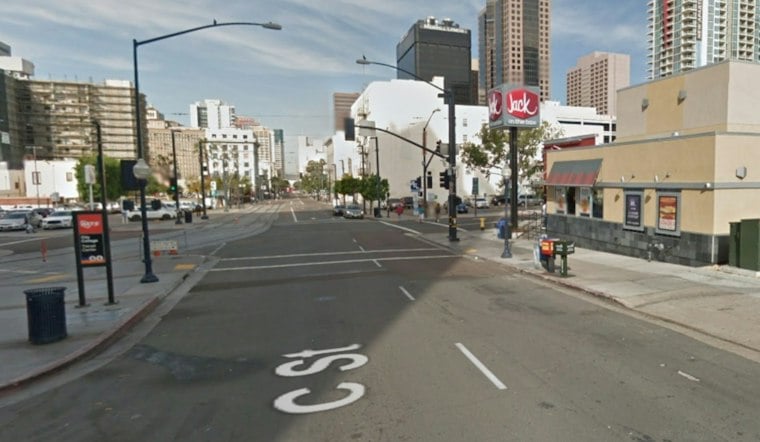
The attack happened in early September in the 1100 block of C Street, according to 10News. Payne had stopped to hand out clothes to homeless people and recognized a woman in her 20s, giving her a jacket and pants, when two homeless men nearby started a fight that agitated the woman's pit bull, which was loosely leashed at the time.
“The dog lunged around the opposite side of her and locked onto my leg, threw me into the street, and shook me twice,” Payne said, describing how the animal removed a large portion of his leg in the attack, per the same report. He applied the tourniquet himself before getting behind the wheel and driving to the hospital.
A Harrowing Scene in the Emergency Room
At the hospital, an emergency-room nurse removed Payne's makeshift bandage and recommended he call a plastic surgeon. Doctors who treated the injury warned him he could lose the lower extremity of his leg if it wasn't handled properly. “I could lose the lower extremity of my leg,” Payne said, recalling the warning.
Doctors ultimately saved his leg, and Payne was discharged four days after the attack, still carrying staples in the wound. He says he suffered nerve damage, now has limited range of motion at certain angles, and cannot push on the gas pedal for long stretches while driving. His long-term prognosis remains unclear, the station's report notes.
An Active Investigation and Unanswered Questions
Payne reported the attack to the San Diego Humane Society, which said it is treating the incident very seriously and is conducting an active investigation. Payne, who has experienced homelessness himself in the past, said he had heard the pit bull had a history of prior attacks, but he acknowledged, “I haven't been able to confirm that.”
Humane Society officials told the outlet that dangerous-dog declarations are handled through a county process that often involves a hearing, and that muzzling can be imposed as a condition once a dog is formally declared dangerous. Payne said he believes dogs declared dangerous should be muzzled, and added that the circumstances of the attack could easily have involved a child instead of him.
A Broader Pattern of Bites in San Diego County
Payne's case lands amid long-standing concerns about how San Diego County tracks and discloses dangerous-dog incidents. San Diego County Animal Services investigates more than 6,000 dog bites or attacks every year, according to San Diego County Animal Services, which also notes that nationwide, about 800,000 people require medical treatment for dog bites annually. Roughly 2,500 bites are reported each year to the state health department from the county, though the true number is believed to be higher, as reported by the Los Angeles Times.
Despite that volume, the San Diego Union-Tribune reported that the Humane Society logged only an average of nine to 18 dangerous-dog hearings annually over the prior three fiscal years, and the county has acknowledged there is no known single source letting the public identify where declared dangerous dogs live. Under county ordinance, an owner may not possess a dog declared dangerous unless it is restrained, confined or muzzled so it cannot bite, attack or injure someone, according to county code.
Other recent San Diego-area attacks illustrate the stakes. A woman was attacked by a long-haired black German shepherd at Mission Heights Neighborhood Park in an assault that lasted more than a minute, as detailed by Fox 5 San Diego. And in El Cajon's Granite Hills neighborhood, an unleashed pit bull attacked a woman walking her own dog in 2021; the Humane Society served the owners with a Dangerous Dog declaration roughly a week later, the Union-Tribune reported separately.
For Payne, the physical and emotional toll continues as he awaits word on what comes next for the dog involved in his case. He said some dogs owned by homeless residents simply aren't trained or secured well enough, a concern he raised even as he continues handing out clothes and helping people on the street.




