

























































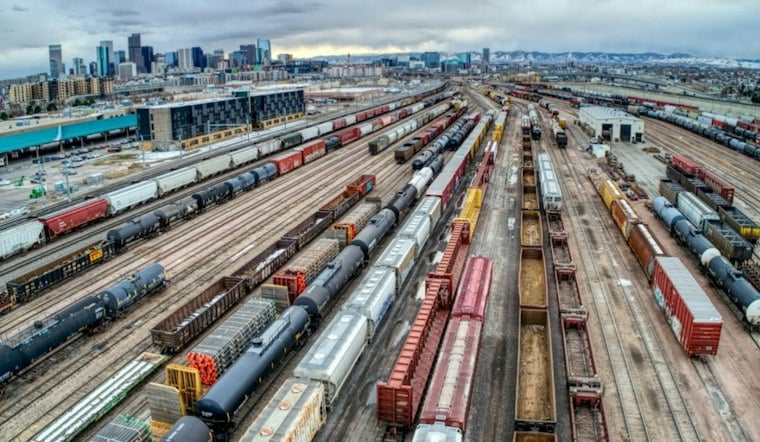
A downtown Los Angeles startup that builds driverless, battery-powered freight rail cars has closed a $100 million funding round to ramp up production and push into international markets. Parallel Systems announced the Series C raise in early October, bringing its total funding to more than $200 million since the company launched.
Advance Venture Partners led the round, according to a company announcement, with Hillspire, Agility Global and Cobalt Capital joining as new investors alongside returning backers Anthos Capital, Congruent Ventures, Riot Capital and Collaborative Fund. As the Los Angeles Business Journal reports, Anthos Capital, Cobalt Capital and Riot Ventures all contributed additional funding to the company as well. The fresh capital will go toward accelerating production of Parallel's next-generation Panther rail vehicle and fueling commercial expansion, including into international markets, per the announcement.
Parallel Systems makes autonomous, battery-electric rail vehicles — essentially self-propelled wagons that can travel in platoons without an onboard operator, according to RailFreight.com. The Panther vehicles are powered by batteries and can haul intermodal containers up to 500 miles on a single charge without a human operator, according to the Los Angeles Business Journal and a partnership announcement from Agility.
A SpaceX Pedigree Behind the Driverless Trains
The company traces back to Matt Soule, who spent 13 years at SpaceX starting in 2006 and worked on every program the company developed during his tenure, including Starlink, according to the Los Angeles Business Journal. Soule founded Parallel Systems in 2020, though accounts of the company's founding differ: the prnewswire.com announcement credits Soule alone as founder, while CNBC reported in 2022 that Soule launched the company in January 2020 alongside two other former SpaceX employees, John Howard and Ben Stabler.
Soule has said the company's mission is to equip the rail industry with tools to gain market share, according to the Business Journal. Parallel Systems is based in downtown Los Angeles and is targeting the U.S. railroad sector, which the company argues has left shorter freight routes underused — with some track untouched for decades, per the Business Journal's reporting.
Trucks Still Dominate — Parallel Wants Rail's Share Back
The numbers help explain the pitch. The U.S. Department of Transportation reported that trucks accounted for 63% of transborder freight utilization in 2025, compared with just 11% for rail, according to the Business Journal. Parallel's own figures, cited in the prnewswire.com release, say routes shorter than 500 miles make up 60% of the surface freight market and remain significantly underutilized — the exact gap the company is targeting with its driverless rail cars rather than trucks.
Parallel also points to efficiency as a selling point: its electric rail vehicles use about 25% as much energy as a long-haul truck, according to CNBC. KTLA reported that the company's broader goal is to make better use of existing rail infrastructure by enabling smaller shipments, shorter routes and lower costs. In Los Angeles specifically, the Business Journal notes Parallel Systems could help move more goods from the city's two ports onto rail and reduce truck traffic on the 710 Freeway.
Georgia Pilot and Early Customer Interest
Parallel's most advanced real-world test is underway in Georgia, where the company is working with short-line railroad operator Genesee & Wyoming under Federal Railroad Administration supervision, according to the prnewswire.com announcement. The company also says a number of major railroads are now under contract to deploy its system to move commercial freight, though it has not disclosed which railroads.
Arun Gupta, Parallel Systems' executive chair and an adviser at Anthos Capital, said in a statement reported by the Business Journal that the company has a proven, viable and scalable autonomous freight rail platform that has generated significant commercial interest among major rail companies in the U.S. and globally. Parallel previously raised $38 million in a Series B round in 2025, according to DC Velocity, making the new $100 million raise a significant step up.
Going Global, and Facing Competition
Parallel is also looking beyond U.S. borders. The company recently entered an agreement with logistics firm Agility to explore bringing its platform to the Gulf Cooperation Council region and wider EMEA markets, with the two companies initially focusing on identifying priority corridors and commercially viable opportunities, according to Agility's announcement.
Parallel isn't alone in chasing autonomous rail freight. Trains.com reported that Intramotev has struck a commercial agreement to deploy its TugVolt autonomous railcars for industrial switching operations on R.J. Corman Railroad Co.'s Memphis Line, adding to existing TugVolt deployments at a Carmeuse Americas mine in Michigan's Upper Peninsula and at a Watco transload facility in Wood River, Illinois. For investors, the timing lines up with a broader wave of capital flowing into logistics technology: the global transportation and logistics sector pulled in $266 billion in capital in 2025, according to the Business Journal, and Parallel is betting its driverless Panther vehicles can capture a meaningful slice of that shift from road to rail.





