

























































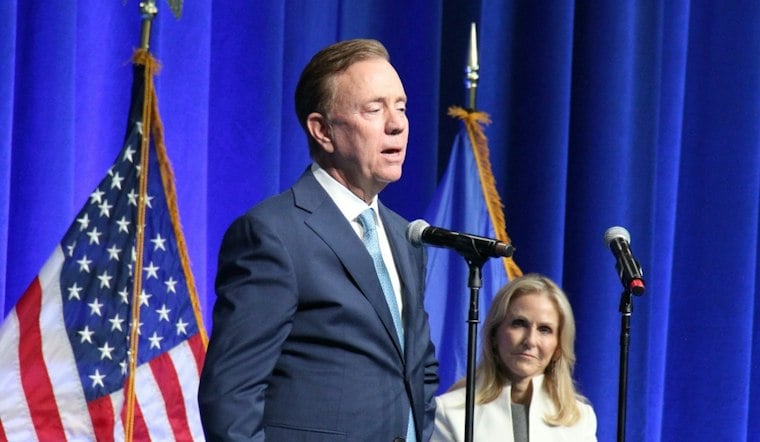
Connecticut Gov. Ned Lamont and state Sen. Ryan Fazio, both of Greenwich, released partial tax returns this week showing a staggering gap in their personal finances, with ten days remaining before Election Day. Lamont reported $64,836,781 in gross income since 2022, while Fazio reported just $328,904 since 2023 — a figure built entirely on salary with no investment income at all.
The numbers come from documents both campaigns allowed reporters to inspect on Friday, according to CT Insider. Lamont let reporters view the first two pages of his returns for each of the last four years in person at his campaign office, while Fazio provided the first two pages of his last three years of filings, saying his 2022 return could not be produced in time. Neither candidate released any pages of their Connecticut state tax returns, and neither provided the underlying schedules that would detail itemized deductions or the makeup of capital gains, as the Hartford Courant reported.
Lamont's income swung wildly year to year: $6 million in 2022, $6 million in 2023, a jump to $35 million in 2024, then $17 million in 2025. The 2024 spike was driven almost entirely by capital gains — about $34.5 million of that year's $35,208,487 total, per CT Insider's review of the documents. Over the four years for which tax totals were detailed, Lamont paid $19,965,534 in combined taxes, including $15,466,410 federal and $4,499,124 state, and reported $1.9 million in charitable giving across the four-year span.
Capital Gains Dominate Lamont's Fortune
The pattern isn't new for Lamont. Nearly 90 percent of his earnings over the past five years came from capital gains, averaging $14.1 million annually, according to an analysis by the Connecticut Mirror. The outlet found his adjusted gross income averaged more than $16.2 million a year between 2021 and 2025, ranging from slightly less than $6.1 million in 2022 to the $35.2 million peak in 2024. The filings reviewed this week did not include the returns of Lamont's wife, Ann Huntress Lamont, who files separately.
This isn't the first time Lamont has shown reporters a sliver of his finances rather than full returns. When he released three years of partial tax data in 2022, he reported earning $26 million over the 2018 through 2020 tax years, a period that included his first two years as governor, with his adjusted gross income having averaged $8.65 million annually in 2018 through 2020, according to CT Public. That same year he released the first two pages of his federal returns and four pages of his state returns — more than he's shown this cycle, since this year's disclosure skipped any state pages entirely. A separate summary distributed in 2022, reviewed by CT News Junkie, showed Lamont's adjusted gross income at nearly $26 million for 2018 through 2020, all of it from investment income, with reporters again denied access to the full returns or their schedules.
Fazio's Modest Salary Stands In Stark Contrast
Fazio's financial picture looks nothing like the governor's. He reported salary income of $134,601 in 2023 and $143,319 in 2024 while working as a business analyst for Services Capital, an investment firm co-founded by his father. In 2025, after stepping away from that private-sector job to run for governor full-time, Fazio reported only a state salary of $50,984 — with the lines for interest, dividends, IRA distributions, and capital gains all blank on his federal return. CT Insider noted that his combined income across the three years, $328,904, averaged out to $109,634 a year, a figure confirmed separately by the Connecticut Mirror.
Fazio's campaign has leaned on Connecticut's public financing system rather than personal wealth, qualifying for $18 million in public funds that have powered a wide-reaching campaign including multiple television commercials. That stands in contrast to Lamont, who has self-funded his past campaigns for governor and U.S. Senate, spending more than $60 million of his own money across those races, including $25.7 million in his 2022 re-election bid, and turning down public financing each time he has run for governor.
Why The Disclosures Stay So Limited
Governors and candidates for other high offices in Connecticut have generally released partial or full tax returns in election years, a pattern CT Public has tracked going back to Lamont's earlier filings. But the documents shared this week, like those before them, stop well short of full returns: both candidates provided only the first two pages of their federal filings, with no schedules spelling out itemized deductions or the sources behind reported capital gains. Lamont's campaign has maintained that the releases are about transparency, with spokesperson Lauren Gray saying disclosing the governor's tax information is about continuing to be transparent with Connecticut and something she believes all candidates should do.
Reporters seeking a look at Lamont's filings this year, as in 2022, had to view them in a controlled setting — this time at his campaign office, with aides present, rather than being handed copies to take away. With ten days left before Connecticut voters decide the race, the dueling disclosures leave the public with a partial picture of each candidate's finances: a multimillionaire investor whose wealth rests heavily on stock sales, and a state senator living on a government salary after giving up his private-sector paycheck to campaign full time.





