

























































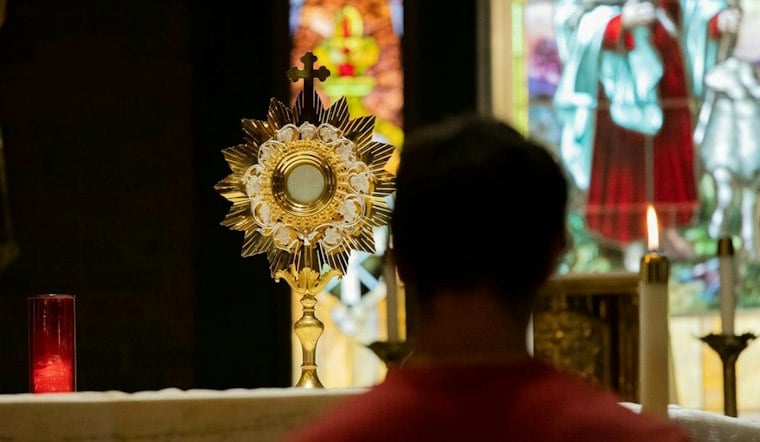
Archbishop George Leo Thomas directed that a letter opposing Nevada Ballot Question 6 be read at Masses across the Archdiocese of Las Vegas over the weekend of Oct. 3-4. The archdiocese spans Clark, Nye, Lincoln, White Pine and Esmeralda counties and says roughly 750,000 people are registered with its parishes. Pew Research Group estimates that 21 percent of Nevada adults identify as Catholic.
The letter was read at churches across the archdiocese’s 34 parishes, according to lvcatholic.org. Parishes were also asked to make a Nevada Catholic Conference advisory on Question 6 available in English and Spanish throughout October. The conference, which includes the Diocese of Reno and the Las Vegas archdiocese, opposes the measure, as does the Church of Jesus Christ of Latter-day Saints.
Question 6 would add a constitutional right to abortion in Nevada, protected until fetal viability or when needed to protect the pregnant patient’s life or health. The measure defines viability as a significant likelihood of sustained fetal survival outside the uterus without extraordinary medical measures. It would replace the state’s current 24-week limit with a viability standard that sets no specific week cutoff, according to the Nevada Independent. Nevada’s existing law, approved by voters in 1990, separately permits abortion after six months when necessary to preserve the pregnant woman’s life or health.
Why the Measure Is Back on the Ballot
Nevada voters approved Question 6 in 2024 with 64.4 percent support. Because a constitutional amendment must win majority approval in two consecutive general elections, the measure must pass again this November to take effect; changing the existing statutory law requires only one majority vote, according to the same Nevada Independent report. A no vote would leave the Constitution unchanged and would not alter abortion’s availability under current state law.
Thomas has said he opposes the amendment in part because he believes it would remove parental involvement from minors’ abortion decisions and broaden who could perform abortions. He has argued that the proposed health-care-practitioner standard could include nurses, dentists, opticians and medical laboratory technicians, rather than the licensed-physician standard in current law. The amendment itself does not set a week limit for abortion access before viability.
The dispute over parental notification is also before the courts. The Nevada Supreme Court temporarily blocked enforcement of a law requiring parents to be notified when minors seek abortions, finding its notification and judicial-bypass provisions unconstitutionally vague, according to court records. The justices reversed a lower court and ordered it to grant a preliminary injunction. Planned Parenthood Mar Monte and an unnamed Nevada physician are challenging the law, which took effect in July 2025 after a federal judge ruled that the original 1985 version could take effect following the 2022 overturning of Roe v. Wade.
Money and Messaging Favor Supporters
The financial resources reported by the campaigns differ sharply. Nevadans for Reproductive Freedom, the main political action committee backing Question 6, raised more than $815,000 and spent nearly $49,300 so far in 2026, the Nevada Independent reports. On Sept. 28, the group also launched a $1 million digital advertising campaign, according to Reproductive Freedom for All.
The opposition PACs have reported much smaller totals. Protect Our Girls raised $10,000 and spent more than $3,000 this year, while Students for Life Action Ballot PAC raised roughly $1,700 and reported no expenses, according to the same Nevada Independent accounting. “It's all uphill for us,” Thomas said, according to the Las Vegas Review-Journal.
Denise Lopez, president of Nevadans for Reproductive Freedom, said Question 6 would protect abortion rights and keep private medical decisions between patients and doctors, according to the Review-Journal. The archdiocese has also opposed other bioethics proposals, including physician-assisted-suicide legislation in 2021 that failed in the Legislature that year.
What Else Is on the Ballot
Question 6 shares the November ballot with Question 7, a voter-identification measure that also first passed in 2024; both require this second vote to become permanent. Nevada Secretary of State Francisco Aguilar issued a ballot question guide covering both measures, and no constitutional initiative petitions qualified for the 2026 General Election, leaving Questions 6 and 7 as the only statewide measures voters will decide.
How Other States Have Approached Abortion Ballot Measures
The Nevada vote is part of a wider post-Dobbs ballot debate: The Associated Press, republished by PBS NewsHour, reported that voters in California, Kansas, Kentucky, Michigan, Montana, Ohio and Vermont sided with abortion-rights supporters on ballot measures. Those results do not indicate how Nevada voters—or Catholic voters in the state—will decide Question 6. Nevada’s amendment process requires a second consecutive general-election majority, and Nevada Current reports that the protections established by the 1990 referendum also require a direct vote of the people to change.
Church leaders elsewhere have taken different positions on different measures. In a separate Missouri case, Catholic bishops issued a March 26 statement supporting a ballot measure that would limit abortion and certain medical or surgical procedures for minors who identify as transgender, UCA News reported. That measure differs from Nevada’s Question 6, which would establish a constitutional right to abortion.





