

























































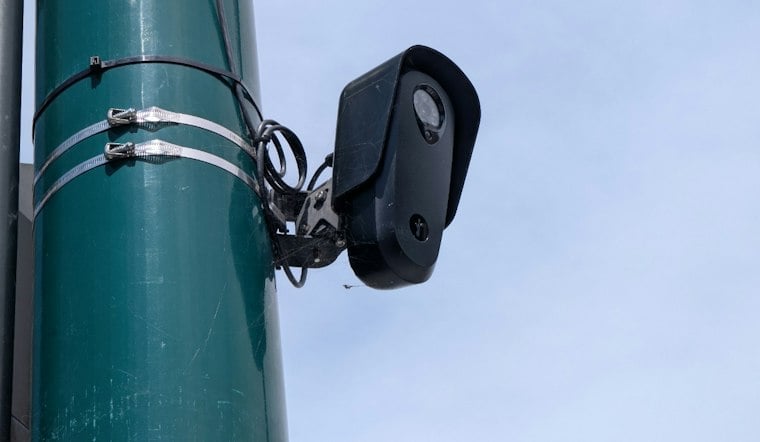
League City's police department has 55 Flock Safety license plate readers watching the city's roads, and come November 3, voters will decide whether any of them stay up. City council members have gone a step further than a simple advisory question: they've approved a resolution requiring the city to disable the cameras within 72 hours if a majority of voters reject them at the ballot box, according to Houston Public Media.
The move marks a notable shift from the measure's original framing. League City Council voted 7-0 back on August 11 to place Proposition A on the ballot as a nonbinding statement on whether police should keep operating fixed-location license plate readers on public roads, according to the City of League City. Council members had initially planned to review the election results before making any final decision on the cameras, per Houston Public Media's reporting, but that changed when the binding removal resolution passed.
From Straw Poll to Binding Promise
Council member Courtney Chadwell had called the original vote a city-wide straw poll, the station's report notes, while Mayor Nick Long said he placed the resolution on the agenda specifically to show voters their ballots could actually force change. Long said the cameras would be taken down within 72 hours whether they end up bagged or physically cut down, per the same account.
Council members have acknowledged that the cameras offer legitimate benefits while also raising real concerns about privacy and potential law enforcement abuse, the outlet reported. Residents across both Harris and Galveston counties have voiced similar privacy worries about the technology, according to the article.
The stakes are not abstract. League City's Flock system assisted in 305 criminal investigations between July 2025 and July 2026 — including homicides, robberies, and assaults — and helped recover roughly $1 million in stolen property, according to the City of League City. The city says the alerts have helped officers locate and stop wanted individuals before further crimes occur. The department has also pointed to a $400,000 retail theft case in which Flock cameras helped lead to an arrest, as Hoodline previously reported.
A Citizen Committee Waits in the Wings
If voters choose to keep the cameras instead, League City has a backup plan: a citizen-led oversight committee. The city will implement a five-member Citizen Data Privacy Committee, with three citizens appointed by council members alongside the mayor and city auditor serving in non-voting roles, per Houston Public Media. Committee members will review monthly or quarterly audit reports on the Flock system, consider public concerns, and recommend privacy protections and data security measures.
Final approval of the committee ordinance was still pending, according to the City of League City. Council members amended the ordinance to ensure voting power rests exclusively with the citizen appointees rather than city officials. Flock cameras are intended to help police locate and arrest people suspected of involvement in crimes, Houston Public Media noted, but the department's own guidelines say recorded license plate data is automatically deleted after 30 days, the system does not use facial recognition, and captured vehicle data is not shared with federal immigration authorities.
Part of a Statewide Reckoning
League City's vote didn't happen in a vacuum. The controversy follows a wave of police misuse scandals that have shaken public trust in automated license plate readers across the Houston area. A former Katy Police Department officer, Sergio Rodriguez, was indicted in Fort Bend County in April 2026 on two third-degree felony charges of stalking and misuse of public information after allegations that he searched his ex-partner's license plate through the department's Flock system 2,386 times, according to KHOU. A Lufkin officer also figured in broader investigations of Flock misuse this year.
State government has also pulled back. Texas Governor Greg Abbott ordered all state agencies to halt grant funding for Flock cameras in August after reports showed state grants had financed more than 3,200 cameras statewide, and Texas Comptroller Glenn Huffines formally banned grant expenditures for the technology in October, according to The Texas Tribune. Separately, the Texas Department of Transportation suspended issuing new permits for license plate readers along state-owned roadways in September, according to KERA. League City has 16 additional planned cameras in the TxDOT permitting process.
At least 14 Texas cities and counties had dropped Flock contracts or scaled back camera counts as of late September, with Midland's city council voting unanimously in October to terminate its 71-camera contract and save $225,500, per the Texas Tribune. More than 900 Flock cameras have gone dark statewide following the funding cuts and contract terminations. League City is joined by Laredo, where council members voted in September to place a nonbinding May 2027 referendum before voters on whether to spend $1 million annually to retain 165 Flock cameras, the Tribune reported.
League City's Proposition A gives residents a direct — and now consequential — say over whether the cameras watching their streets stay on past November 3.





