

























































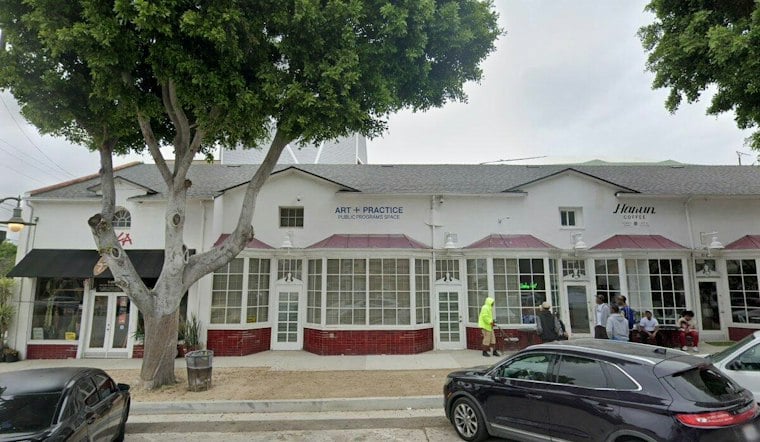
In 1967, two years after the Watts Rebellion reshaped Los Angeles, brothers Alonzo and Dale Brockman Davis opened a small storefront gallery on Degnan Boulevard in Leimert Park that would go on to launch and nurture the careers of some of the most significant Black artists in American history. Now, nearly four decades after it closed its doors, the Brockman Gallery is finally getting the museum treatment it has long been owed.
The Los Angeles County Museum of Art opened The Brockman Gallery: Los Angeles, 1967–1990 on Sunday, marking what the museum describes as the first large-scale exhibition dedicated to the gallery's impact, according to LACMA. The show, which runs through January 24, 2027, at the museum's Wilshire Boulevard campus, gathers more than 60 works of art and archival material documenting a gallery that, as LACMA puts it, was founded in South L.A. by brothers Alonzo and Dale Brockman Davis in the wake of the Watts Rebellion.
The Davis brothers named their gallery after their grandmother, Della Brockman, according to the Daily Breeze. A year before opening, in 1966, the pair set out in a green Volkswagen Beetle with the mission of connecting with Black artists across the country, the same outlet reports. The gallery that resulted, located at 4334 Degnan Boulevard, became what the New York Times has described as one of the defining Black-owned art spaces of its era in Leimert Park.
A Launchpad for Careers That Reshaped American Art
Brockman Gallery nurtured the early careers of David Hammons, Suzanne Jackson and Carrie Mae Weems, according to LACMA, and also featured artists including Betye Saar, Noah Purifoy and John Outterbridge, per the station's documentary account carried by PBS. For many of those artists, the Daily Breeze notes, Brockman offered their first opportunity to show work in a commercial gallery space at all. The Los Angeles Times, which reported on the LACMA exhibition's opening, adds that the gallery exhibited and cultivated more than 200 underrepresented artists of color over its run, with a roster that also included Judy Baca and Elizabeth Catlett.
The gallery's reach went beyond exhibitions. It also functioned as an artist-in-residence studio and hosted internships and public events, according to the Beverly Press. By the 1970s and 1980s, per UCLA's Hammer Museum, the space had become a gathering place where both artists and neighborhood residents came together to celebrate their arts and heritage. The Daily Breeze also notes the gallery's mission extended to other underrepresented communities, including Latin, Asian American, Chicano and women artists.
Inside the LACMA Exhibition
Curated by Lauren Hanson with contribution from Dale Brockman Davis, the exhibition traces the gallery's evolution from a local artist space into a cultural hub, drawing objects from LACMA, private collectors, the Los Angeles Public Library and the David C. Driskell Center at the University of Maryland, per the Los Angeles Times. Among the works on view: Noah Purifoy's assemblages incorporating debris and found objects from the Watts Rebellion itself, and David Hammons' body prints, made by greasing his own body and pressing it onto newspaper and paper. Hammons' Injustice Case, depicting a bound and gagged figure framed by the American flag, references Bobby Seale, who was imprisoned for conspiracy and inciting a riot at the 1968 Democratic National Convention.
Dale Brockman Davis is also represented as an artist in the show. His piece Home Is Where You Make It is an assemblage interpreting home and Black families' transient history, while his mixed-media work Viet Nam War Games includes clay, ceramic and metal sculptures resembling munitions and rockets, one marked with a red handprint symbolizing blood. Hanson has described that piece as a reference to young Black men killed in Vietnam. Elsewhere, Elizabeth Catlett's trio of wooden sculptures includes Black Unity, carved with two faces on one side and a raised fist on the other.
From Storefront to Freeway Murals
In 1973, the brothers launched Brockman Gallery Productions, a nonprofit that produced outdoor exhibitions, film festivals and community classes, and which created a jobs program for unemployed artists using Comprehensive Employment and Training Act funding. The organization's civic footprint grew considerably by 1984, when the city commissioned ten Brockman artists to paint ten freeway murals for the Summer Olympics. Those murals included Judy Baca's Hitting the Wall: Women in the Marathon, a 100-foot-long tribute to the first women's marathon in Olympic history, and Alonzo Brockman Davis's Eye of Consciousness, a mural study incorporating Olympic rings, an arrow, a trumpet and Egyptian iconography. The exhibition also displays archival books, posters, fliers, press releases, an opening invitation and photographs documenting those years, and in 1981 the gallery's profile was such that Sidney Poitier and his family attended one of its shows.
Brockman Gallery's influence ran alongside a small network of peer spaces working toward similar ends. Gallery 32, which opened in Los Angeles in March 1969, gave artists who had previously been relegated to community centers and backyards a space of their own, according to the New York Times. Brockman and Gallery 32 usually coordinated their openings to fall on the same weekends and shared collectors and artists, the paper reports; Suzanne Jackson closed Gallery 32 in 1970 after losing money on postage and printed invitations for a year and a half, and later went on to work for Brockman Gallery herself.
The Gallery's Close and Its Long Afterlife
The brothers closed Brockman Gallery in 1990, after which Alonzo relocated to Sacramento while Dale took a job as a full-time teacher at Dorsey High School and began pursuing an MFA at UCLA that he did not complete. Dale has said the brothers were simply tired, and that running the gallery had come to hinder their own personal progress as artists. Alonzo Brockman Davis died in 2025, a loss that the trade publication ARTnews marked by noting that together, the brothers championed Black art and artists at a time when they were often overlooked and underrepresented.
The Los Angeles Public Library acquired the gallery's archive. The collection, which the library completed processing in March 2022, spans 16.59 cubic feet across 17 boxes and includes 219.5 gigabytes of digital files, containing photographs, correspondence and print materials such as ephemera, press clippings, flyers, publications and brochures, according to the archive's own finding aid hosted by the Online Archive of California. Dale has said the gallery recognized a lack of opportunity for the entire minority community, and that it showed young and established artists alike who had not yet received recognition.
The Brockman Gallery has already been the subject of exhibitions at the Lancaster Museum of Art and History, the Vincent Price Art Museum, the University Art Gallery at Cal State Dominguez Hills and Lore bookstore, reflecting what the public broadcasting outlet PBS SoCal has described as a renewed interest in Black Los Angeles artists active from the mid-1960s to the late 1970s. Dale has said he hopes the LACMA exhibition conveys the gallery's importance beyond the Black community alone. Tickets to see it run from $15 to $30.





