

























































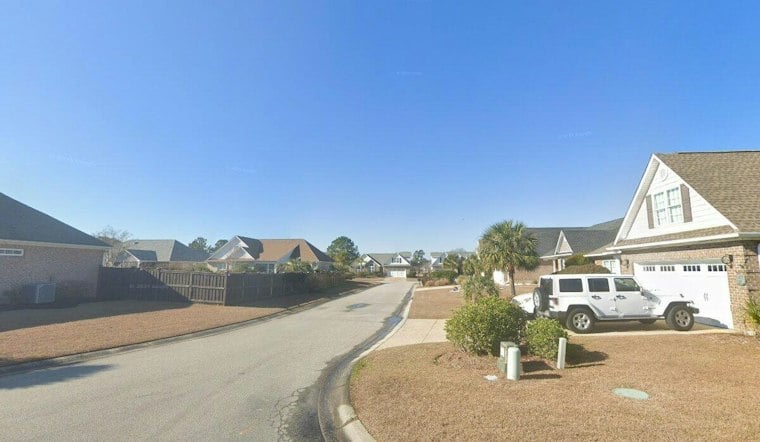
Rasa Love was up late catching up with a houseguest who had just arrived from out of town when a loud thump hit her front door around 1 a.m. last Friday. She opened it thinking the noise might have been her cat. Instead, she found herself staring down the head of an 8-foot alligator parked right at the threshold of her home on the 1100 block of Spring Glen Court in Leland.
Love first slammed the door. Her houseguest, who did not believe her, reopened it, said “oh my,” and slammed it shut again, according to a report from the Charlotte Observer. Love called 911, and Leland police arrived to find the 8-foot alligator still sitting on her porch, police said. Officers contacted state wildlife officials, who helped remove the animal and relocate it to a nearby open waterway. Love reported that the gator moved around her yard for a while afterward before she finally went to bed around 2 a.m., stunned by how close the encounter had come to her front door. “We surprised each other,” she said, adding that she felt lucky to have seen the animal even as she was shocked to find it practically on her doorstep.
Why Alligators End Up on North Carolina Porches
Southeastern North Carolina sits at the northernmost edge of the American alligator's range, and the federally protected species is a familiar, if unpredictable, presence around Leland. Alicia D. Wassmer, an alligator biologist with the N.C. Wildlife Resources Commission, said animals can be drawn toward homes by scents from pets, pet food, or the wild animals that pet food attracts. She also said an alligator may simply take a wrong path around a house, since human structures are difficult for the animals to navigate from ground level — consistent with state guidance advising coastal property owners to remove pet food and other outdoor attractants, according to the North Carolina Wildlife Resources Commission.
Brunswick County, where Leland sits, is home to the state's highest concentration of American alligators, anchored by the nearby Orton Pond, a roughly 500-to-688-acre waterway near the Cape Fear River that serves as the species' primary stronghold in North Carolina, according to WNCN. Wassmer has said that alligator movement and neighborhood encounters typically peak during the spring mating season in May and June, though warm coastal weather keeps the animals active into early autumn, as reported by Coastal Review.
A Growing Pattern Across Brunswick County
Love's late-night visitor is far from an isolated case in the area. In nearby Southport, Hoodline previously reported on a 12-foot gator that parked itself on a homeowner's front porch, requiring removal by local police and state wildlife officers. Southport's municipal Animal Protective Services unit has captured and relocated roughly 20 alligators in a single season. County sheriff's deputies also had to remove an alligator twice in one night from Highway 17S near the Cape Fear Memorial Bridge this past May, according to a report cited by Cardinal & Pine.
Rapid suburban growth and wetland development across Brunswick County are increasingly pushing alligators onto roadways, bridges and residential properties as their habitat shrinks. Male alligators are estimated to reach sexual maturity at 14 to 16 years. Slower growth can make alligator populations more vulnerable to local extinctions.
Strict Protections, Rare Removals
Only N.C. Wildlife Resources Commission employees or licensed agents are permitted to handle out-of-place alligators in North Carolina, and state law has made it illegal to intentionally feed wild alligators since 2007 under North Carolina General Statute § 113-291.11. Wassmer has noted that between 2019 and 2025, only a single alligator statewide was euthanized for human-fed aggressive behavior, since guidelines direct officers to relocate non-aggressive or misplaced animals whenever possible rather than destroy them.
Hunting remains tightly restricted as well. Even though the Wildlife Resources Commission approved a municipal alligator hunting framework in 2018, it applies only to public-safety population-reduction hunts formally requested by local governments, and just one such hunt — in Hyde County in 2018 — had taken place statewide as of 2025, according to Port City Daily.
For now, Love's encounter ended without injury, and the alligator is back in open water. Anyone who spots an out-of-place alligator in North Carolina is urged to contact the N.C. Wildlife Helpline at 866-318-2401, staffed Monday through Friday from 9 a.m. to 5 p.m. Leland sits roughly 140 miles southeast of downtown Raleigh, deep in the coastal corridor where the state's alligator population is most concentrated.





