

























































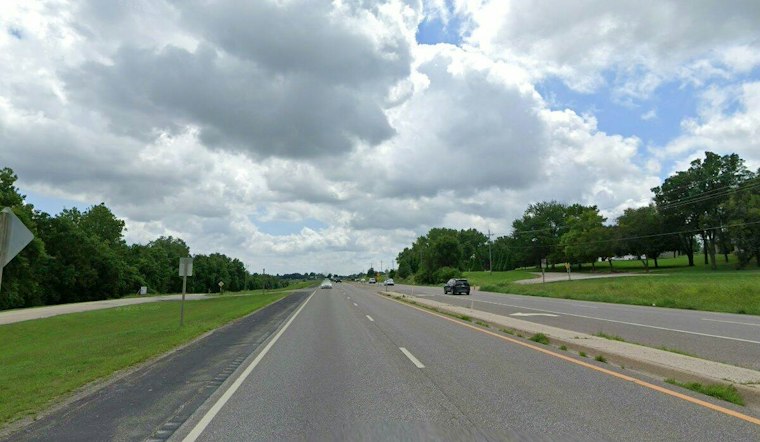
A 23-year-old Lenexa woman suffered serious injuries Sunday afternoon when her Jeep Wrangler collided with an emergency vehicle clearing an intersection on K-7 near Bonner Springs, sending her SUV rolling twice before it landed on its side. The crash happened just after 4 p.m. on October 18 at K-7 and 130th Street, the same stretch of highway that saw a fatal pedestrian collision just over a week earlier.
According to KCTV5, the Kansas Highway Patrol said crews responded to the scene after the woman's 2012 Jeep Wrangler, traveling north on K-7, collided with a 2015 Ford Taurus emergency vehicle. The emergency vehicle, driven by a 32-year-old Kansas City, Missouri man, was clearing the intersection from 130th Street to turn south onto K-7 with its lights and sirens activated, and had started across the intersection from a stop, crews indicated.
Troopers said the Jeep Wrangler failed to yield to the emergency vehicle before the two collided. The impact sent the Jeep rolling twice before it came to rest on its side. The Lenexa woman was taken to the University of Kansas Medical Center with suspected serious injuries, per troopers, while the emergency vehicle driver was not injured in the crash, the Kansas Highway Patrol said. Both drivers were wearing seat belts at the time of the collision, the same station's report noted.
What Kansas Law Requires at the Intersection
The collision sits at the intersection of two sections of Kansas traffic law that govern exactly this kind of encounter. Under K.S.A. 8-1506, drivers of authorized emergency vehicles responding to a call with lights and sirens activated are permitted to proceed past red lights or stop signs, but only after slowing down as necessary for safe operation, and they remain bound by a statutory duty of care for all persons, according to the Kansas Office of Revisor of Statutes.
At the same time, K.S.A. 8-1530 requires civilian drivers who encounter an emergency vehicle sounding an audible signal and displaying flashing lights to yield the right-of-way, pull over parallel to the right edge or curb clear of any intersection, and remain stopped until the emergency vehicle passes. The statute describes the duty to yield that the Kansas Highway Patrol said the Jeep failed to meet.
Kansas courts have weighed in on how these two duties interact. The Kansas Supreme Court affirmed in cases including Robbins v. City of Wichita and Montgomery v. Saleh that K.S.A. 8-1506 creates a specific statutory duty of care owed to all road users, permitting civil liability if an emergency vehicle operator acts with reckless disregard for safety, according to the Kansas Peace Officers Association.
A Dangerous Stretch of K-7 Gets Another Close Call
This is not the first serious incident at or near this intersection in recent weeks. Eight days before this crash, on October 10, a 24-year-old pedestrian was struck and killed just north of North 130th Street along K-7, an incident that shut down the state highway for roughly three hours, Hoodline previously reported. That earlier coverage also noted that Wyandotte County ranks third among all 105 Kansas counties in cumulative traffic fatalities since 1975, trailing only Sedgwick and Johnson counties; it separately stated that more than 1,190 fatal vehicle crashes had been recorded.
Regional transportation planning documents classify K-7 in Bonner Springs as a critical north-south arterial carrying heavy volumes of suburban commuter and regional freight traffic connecting Johnson and Wyandotte counties to Interstate 70, with the Kansas Department of Transportation maintaining a District 1 Area 3 facility directly along the corridor. The combination of high traffic volume and an intersection that has now seen two serious incidents in little more than a week is likely to draw continued scrutiny from safety officials.
Emergency Vehicle Crashes Are a Known National Risk
Collisions involving responding emergency vehicles are a documented, if less common, category of roadway danger. According to National Safety Council analysis of federal crash data, operating with lights and sirens increases the crash rate for emergency response vehicles from 4.6 per 100,000 responses without lights and sirens up to 5.5 per 100,000 responses when active.
The same organization's analysis of Fatality Analysis Reporting System data found that emergency vehicle crashes killed 225 people nationwide in 2024, with occupants of non-emergency vehicles accounting for half of those fatalities. Hoodline reported a similar case earlier this month involving an Independence, Missouri police SUV that crashed at U.S. 24 and Susquehanna while responding with lights and sirens, a collision that killed the driver of an Audi.
Statewide, Kansas had recorded 261 preliminary traffic fatalities for 2026 as of October 13, a 7.45 percent decrease compared to the same date in 2025, according to the Kansas Department of Transportation's Drive to Zero initiative. Kansas Department of Transportation safety records also show that 97.7 percent of all individuals involved in Kansas traffic crashes in 2024 were wearing seat belts, exceeding the 2025 national adult restraint usage average of 91.3 percent — a figure consistent with both drivers in Sunday's crash being belted at the time of impact.


