

























































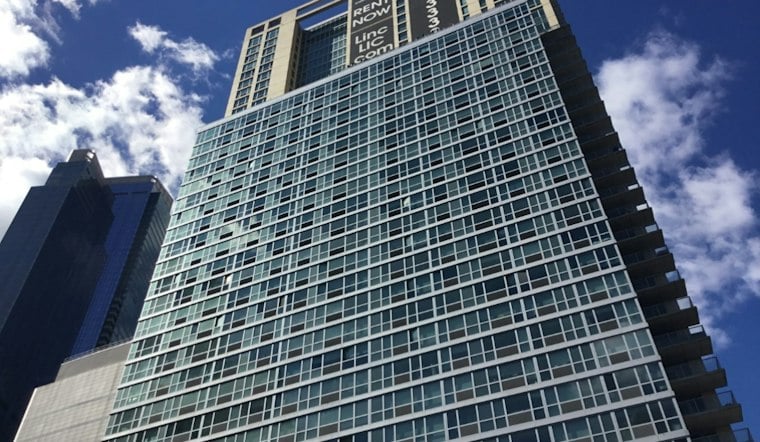
Tenants at three Long Island City apartment towers say their landlord lured them in with discounted rent, then quietly jacked up their renewals far beyond what the law allows — and they want more than $50 million back. The class-action lawsuit, filed Tuesday against Rockrose Development Corporation, covers renters at Eagle Lofts, the Linc and Hayden LIC, all buildings owned by the same Long Island City landlord.
According to QNS, the tenants, represented by Newman Ferrara LLP, are demanding that Rockrose refund the alleged overcharges and roll rents back to the net-effective base rate originally advertised. The lawsuit claims Rockrose dangled lower net-effective rents to attract renters, then revoked those concessions at renewal time while still layering on increases approved by the city's Rent Guidelines Board — increases calculated from the higher, pre-concession rate rather than the lower rent tenants actually paid.
The complaint points to one listing as an example: a Rockrose unit advertised at $4,987 carried a net-effective base rent of just $4,796 once the concession was applied. The lawsuit states that Rockrose then claimed it could calculate renewal increases off the higher $4,987 figure rather than the $4,796 tenants had actually been paying.
A Tenant's Years-Long Fight Becomes a Blueprint
The case traces back to Hyun Choi, a tenant in a Rockrose-owned, rent-stabilized apartment who became the named plaintiff in Choi v. Linc LIC L.L.C. Choi has said Rockrose advertised a lower net-effective base rent before disclosing the preferential lease rate, and that the company gave him a rent concession covering his first couple of months after he moved in back in 2021.
Choi grew concerned about his rent in 2023 when his two-year lease came up for renewal, and he eventually read about the Housing Stability and Tenant Protection Act of 2019, concluding Rockrose's practices might run afoul of it. He contacted a lawyer who told him he might have a case, and the two sent Rockrose a letter laying out his concerns — a letter Choi said went unanswered. He formally sued Rockrose in 2024.
A May 2026 decision found that Rockrose had violated the Housing Stability and Tenant Protection Act, and the court urged Choi and Rockrose to settle. Choi's attorney requested a settlement meeting with Rockrose's legal team, but Choi said the company has not responded. Choi has also claimed Rockrose charged him legal fees despite the ruling in his favor, even though Real Property Law 234-a bars landlords from charging a tenant legal fees tied to their unit unless a court authorizes it. A related case, Grey v. LIC Development Owner, L.P., is also pending.
Watchdog Group Ties Overcharges to Nearly $200 Million Tax Break
Housing Rights Initiative investigated Rockrose's rent practices alongside State Sen. Kristen Gonzalez's office, and the groups allege Rockrose was overcharging tenants at the same time it was claiming benefits under the state's 421-a tax program. HRI founder and executive director Aaron Carr said the company illegally claimed $194,273,281.13 in 421-a tax exemptions, and that HRI reviewed dozens of Rockrose tenant leases and found a similar pattern across them.
“This is one of the most willful players we’ve ever investigated on the issue in the history of the organization,” Carr said, adding that Rockrose was cheating both rent-stabilized tenants and New York taxpayers at once. The 421-a program offers tax breaks to developers building new market-rate multifamily housing, and while it formally expired in 2022, it still honors existing terms and extensions — meaning buildings like Rockrose's can keep collecting the benefit for years to come, so long as owners continue filing annual compliance paperwork with the city's Department of Housing Preservation and Development.
Gonzalez's office mailed tenants in July, informing them of HRI's findings and alleging illegal rent hikes. Gonzalez has said she learned about the concession schemes through housing advocates and residents in her district, and that rent concessions became especially common in Long Island City, northern Brooklyn and Manhattan during the pandemic — often without tenants realizing those initial discounts could entitle them to lower rents. Her office and HRI have since partnered on a know-your-rights campaign targeting 421-a buildings in her district.
Rockrose Says It Hasn't Been Served
Rockrose has said it has not yet been served with the new complaint and is waiting on final determinations in both Choi v. Linc LIC L.L.C. and Grey v. LIC Development Owner, L.P. before responding further, per the company's statement to QNS.
The Long Island City case lands amid a wave of similar lawsuits targeting New York landlords over so-called net-effective rent schemes. Plaintiffs in a separate suit against Black Spruce Management's Copper development in Murray Hill allege the landlord used net-effective rents to set artificially high base rates, producing renewal increases as steep as 20 percent, according to The Real Deal; that case seeks class-action status for more than 3,500 tenants. A separate class action accuses Spitzer Enterprises of overcharging tenants at 420 Kent Avenue in Williamsburg, with Carr estimating those renters could be owed $30 million. HRI has said its investigations have now led to three class-action lawsuits against New York City real estate companies over alleged tenant fraud tied to the 421-a program, as reported by amNewYork.
These cases follow a 2024 settlement in which Blackstone agreed to pay nearly $15 million to dozens of renters at Parker Towers in Queens, resolving a 2018 class action over rent-stabilized overcharges, according to The New York Times. That building has more than 1,300 units, and some tenants were expected to collect more than $100,000 each. Whether the Long Island City tenants will see a similar resolution remains to be seen, with Rockrose yet to formally respond to the latest complaint.



