

























































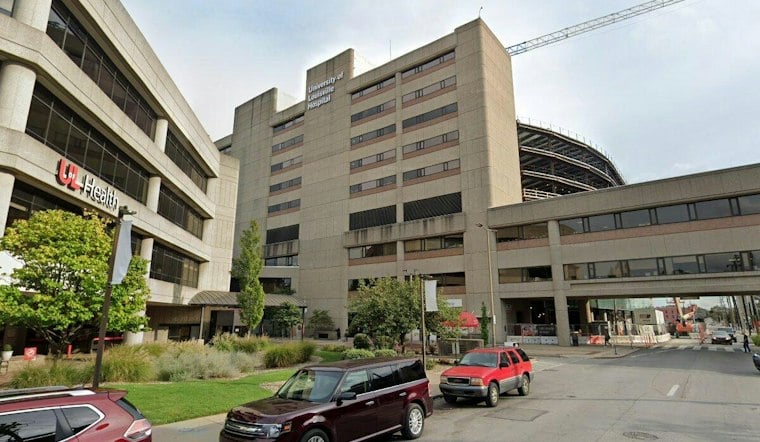
A man showed up at UofL Hospital with a gunshot wound Sunday, telling Louisville Metro Police only that he'd been shot at a house party — and then declined to say anything else. No location. No suspect description. Nothing that would help detectives figure out where the shooting actually happened.
Officers responded to the hospital after staff reported a gunshot patient had arrived, according to WDRB+WAVE. The outlet reports the victim told investigators he had been shot at a reported house party but gave no information about where that party took place or who might have fired the shot. As of the station's report, no arrests have been made.
The hospital where the man turned up is no stranger to these cases. UofL Hospital runs the region's only adult Level I Trauma Center, re-verified by the American College of Surgeons in October 2025 as one of just two such facilities in Kentucky, according to UofL Health
. Its J. David Richardson Trauma Center is where severe gunshot wounds across the metro routinely land, which is part of why the hospital also runs a Hospital-Based Violence Intervention Program alongside Louisville Metro's Office of Violence Prevention — a partnership that engaged 83% of interpersonal gun violence and stabbing victims treated at the trauma center in 2025, per
LouisvilleKY.gov
.
A Squad Built for Cases Just Like This One
When a shooting victim survives but won't talk, the case typically lands with LMPD's Non-Fatal Shooting Squad, a unit created in June 2023 with 16 detectives, two sergeants, a lieutenant and federal ATF agents specifically to chase down cases where the victim lived, as Hoodline has previously reported. Squad members go through homicide-level investigative training aimed at closing more of these cases, since survivors often provide far less information than homicide investigations typically yield.
Without a crime scene location or a named suspect, detectives are leaning on the same tool LMPD uses in most tight-lipped cases: anonymous tips. The department's 24/7 Service Center takes calls at 502-574-5673 (502-574-LMPD) and accepts reports through an online portal, a system the agency relies on heavily when walk-in hospital victims aren't forthcoming with details.
Why Victims Stay Quiet — and What the Law Allows
Victims aren't legally required to cooperate beyond what they choose to share. Kentucky's constitutional Marsy's Law amendment, adopted in 2020, guarantees crime victims rights to protection and case consultation while preserving their ability to decline certain discovery requests — it doesn't compel someone to testify or provide details during a preliminary police inquiry. Separately, state lawmakers introduced legislation in February — BR 2128 — that would create a Class A misdemeanor for witnesses who fail to report a serious crime resulting in serious injury or death when they could safely do so, though that measure targets bystanders rather than victims themselves.
This case isn't an outlier. Earlier this month, Hoodline reported a man was critically shot inside a downtown hotel near Fourth Street Live, another non-fatal shooting that sent a victim to UofL Hospital under an ongoing LMPD investigation. Days before that, a teen was killed and another critically wounded in a Whiskey Row shooting downtown, a case that also involved emergency care at UofL Hospital and a public appeal to the anonymous tip line.
The Broader Numbers Behind the Headlines
Citywide, the picture looks better than it has in years. Mayor Craig Greenberg announced in October that homicides fell 23% and non-fatal shooting victims dropped 25% year-to-date compared to the same period in 2025, according to LouisvilleKY.gov. That continues a steady decline from the pandemic-era peak in 2021, when the city recorded 168 firearm homicides and 643 non-fatal shootings, a figure that had already fallen to 363 non-fatal shootings by 2024.
The city's Office of Violence Prevention has also tracked who bears the brunt of this violence. Roughly 77% of all fatal and non-fatal gunshot victims in Louisville between 2020 and 2025 were Black, more than 80% were male, and 56% fell between the ages of 18 and 35 — demographic data the city uses to target community violence intervention sites and outreach programs.
None of that context resolves what happened to the man who walked into UofL Hospital on Sunday. For now, LMPD is working with what little the victim gave them, and detectives are asking anyone with information about the shooting to call the department's tip line or submit a report through its online portal.





