

























































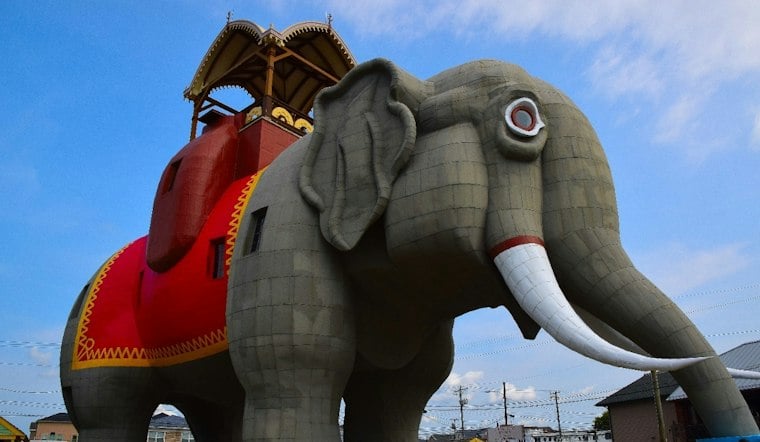
Lucy the Elephant, the six-story wooden pachyderm that has loomed over the Margate shoreline for more than a century, just won approval for $5.4 million in state tax credits to help pay for a long list of interior repairs. The money is meant to defray the cost of an improvement program that supporters say is critical to keeping the aging landmark standing for future generations.
The tax credits come through a state fund that provides financing to nonprofits, according to Courier-Post, whose reporting confirmed the award and its purpose. Lucy, a 64-foot-tall historical landmark according to phillyvoice.com — though The Philadelphia Inquirer has described her as 65 feet tall — sits in Margate as one of the Jersey Shore's most recognizable roadside attractions.
What the Renovation Will Actually Fix
Renovations are expected to start in the first quarter of next year, per phillyvoice.com's reporting, and will include replacing Lucy's HVAC system, refinishing her wooden floors, upgrading fire-suppression equipment and repairing walls damaged by water intrusion. Shore Local Newsmagazine's earlier reporting described a similar scope of interior work, including fixes to water-damaged plaster walls, flooring, HVAC and fire-suppression systems.
Cost estimates for that interior work have varied across outlets. The Inquirer reported the interior repair project was slated to cost between $800,000 and $1 million, while Shore Local Newsmagazine put the total cost of the interior restoration at an estimated $1.2 million. The dossier does not resolve which figure is accurate, and it's unclear how the newly approved $5.4 million in tax credits will be divided among the various pieces of the overall improvement program.
A Visitor Center Years in the Making
Beyond the structural repairs, plans call for a separate visitor or interpretive center intended to improve accessibility and amenities for the roughly tens of thousands of people who tour Lucy each year. Shore Local Newsmagazine reported the new interpretive space would bring improved ADA accessibility, public comfort facilities and a larger retail area with integrated exhibits. Estimates for that project also diverge — the Inquirer put the visitor-center cost at around $5 million, while DownBeach reported it as a $3.5 million project toward which Margate had pledged up to $1.5 million.
NJ.com reported that the nonprofit behind the attraction, the Save Lucy Committee, expects both the interior renovation and the new welcome center to be finished by summer 2027. That same outlet noted the Margate Board of Commissioners approved a 20-year lease for the attraction back in 2019, a deal that underpins the site's long-term future even as funding for its physical upkeep has come together in pieces.
A Patchwork of Grants Built This Moment
The newest state tax credits follow years of fundraising that has stitched together public and private dollars to keep Lucy intact. Phillyvoice.com reported the Save Lucy Committee had previously secured $800,000 for renovations through a $300,000 state grant and $500,000 from the National Park Service's Save America's Treasures program, and that a $2.4 million restoration project fitted Lucy with a new metal exterior in 2022.
More recently, Shore Local Newsmagazine reported the committee was awarded a $350,000 federal grant for interior restoration work. That funding had been in jeopardy at one point — phillyvoice.com noted that after a related grant was rescinded, Lucy's supporters raised nearly $200,000 through hundreds of private donations and ultimately received $350,000 in federal funding after Sen. Cory Booker encouraged the group to reapply.
How the State Tax-Credit Program Works
The newly approved credits appear tied to New Jersey's broader push to support historic preservation through tax incentives. The state's Historic Property Reinvestment Program funds rehabilitation projects for what it calls “transformative” historic resources, leveraging dollars from the Federal Historic Preservation Tax Credit Program, according to the New Jersey Historic Preservation Office. The credits support rehabilitation work on Lucy, a historic landmark.
Lucy isn't the only Garden State landmark benefiting from this kind of state support. Courier-Post has reported separately that the CAFE program, which offers tax breaks for arts and cultural facilities, has expanded into South Jersey, while ROI-NJ reported the NJEDA approved up to $75 million in tax credits toward Asbury Park Convention Hall's $130 million historic renovation. Those larger awards underscore how aggressively the state has been using tax-credit financing to prop up aging landmarks along the Jersey Shore, with Lucy now counted among the beneficiaries.




